
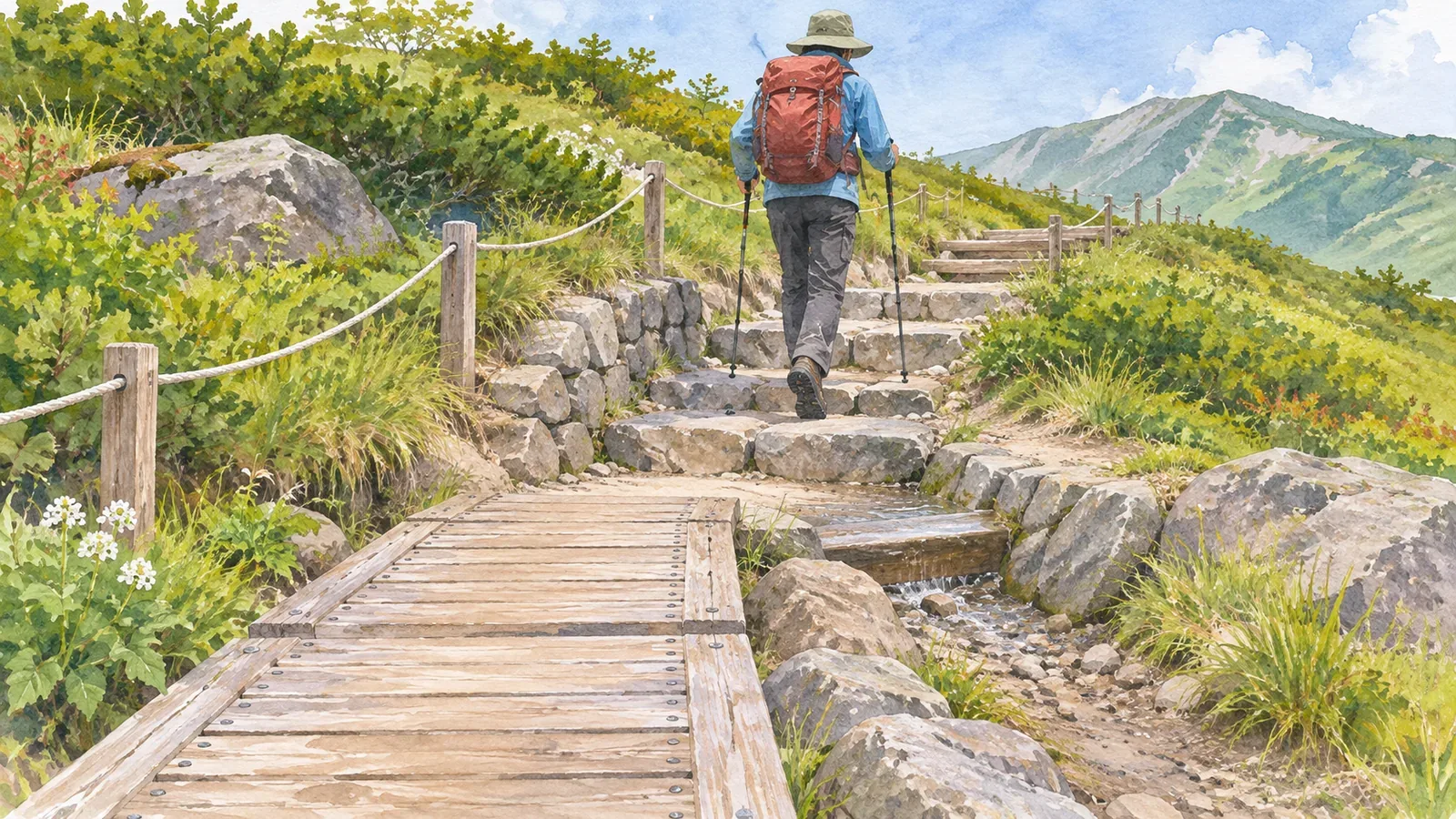
A maintained trail combines walking surfaces with features that drain water or protect soil and plants. Check where people are meant to walk and follow the site's instructions. A piece of wood or stone beside the path may serve another purpose. To help the work last, leave those features in place.
Check which stones are part of the walking surface
The March 2005 technical guidelines for Daisetsuzan National Park describe combining features that retain soil, disperse water and provide footing, depending on the damage. A rock or piece of wood may be there for more than walking. Even a rock beside the path may affect how water flows or how soil stays in place.
As a visitor, first look for the marked walking route and any areas protected from foot traffic. A flat stone outside the route may be there for another purpose, so keep to the existing path. If you cannot tell where to walk, check signs or the trail manager's information. Construction measurements are for the work itself. Use the current condition and guidance to judge whether you can pass.
New boards or stones do not establish that a trail is open. Follow any signs about closures or work in progress. Stay behind ropes even if work looks finished. Stonework that appears natural may have been placed by a crew, so leave the stones where they are.
Use the designated boardwalks and steps
Japan's Ministry of the Environment asks national park visitors to stay on boardwalks and trails. This protects plants from trampling, limits soil loss and helps people stay on route. If a track beside the boardwalk looks like a shortcut, use it only if it is marked for passage.
If a step is awkward to use, check whether you can safely continue before using vegetation beside the steps as footing. In a 2021 Ministry of the Environment account from the Kinpu-san mountain hut, rain washed away soil next to a timber step, making it taller. People then walked around the side, widening the trail. Conditions vary, but this example shows how walking around steps can change a trail after repairs.
Even open boardwalks and steps can be damaged or wet. Watch your footing and the people in front of and behind you. If you cannot pass safely, consider waiting in a safe place or turning back. A height specified for construction says little about whether you can pass today.
Leave drains and gaps in stonework open
The earlier Daisetsuzan guidelines explain how to disperse water rather than concentrating too much in one spot and how to keep the path and drainage channels separate. They also discuss how gaps in stonework hold soil where plants can take root. The grooves and gaps you see can help with drainage or vegetation recovery.
Leave drainage features as they are. Filling a channel with stones or branches, shifting a timber or removing what looks like a blockage can affect where water goes. Report anything that concerns you without touching it.
Leave plants growing between stones in place. Before sitting or setting a bag at the edge of stonework, check whether the spot is designated for resting. A sturdy-looking structure may still serve another purpose. If you cannot tell whether a spot is on the path or in a protected area, leave it alone.
Use ropes to see where you can walk
The Daisetsuzan National Park Liaison Council explains that walking around eroded trails on grass or dwarf bamboo can create parallel paths. Its conservation rules ask visitors to stay on the trail or follow the designated route when snow remains. Using the established path gives vegetation beside it a chance to recover.
If ropes or signs mark a protected area, stay on the path when taking photos or passing. In narrow places, communicate with the people around you and wait somewhere safe on the marked path. You can let someone pass without standing in the protected area.
A loose or broken rope or a fallen sign does not tell you that a restriction has ended. Check the trail manager's current information rather than changing the boundary yourself. Report the problem before attempting to retie a rope or make a new boundary with stones.
Report problems without moving trail structures
If you notice a problem with a repair, make a note of what you saw from a safe position clear of traffic. For example, a stair board appeared to tilt to one side, or soil had collected near a drain outlet. Give the location and date without assuming the cause or quality of the work. Leave unsafe sections alone and avoid testing a feature by stamping on it.
Help repairs last by using marked boardwalks and steps, leaving drainage and stonework in place and staying out of protected areas. Conditions can change after the work is finished, so follow current signs and watch your footing.
References and sources
- Japan Ministry of the Environment: Daisetsuzan National Park trail maintenance guidelines, chapter 3 (March 2005)
- Daisetsuzan National Park Liaison Council: conservation rules
- Japan Ministry of the Environment: national park visitor etiquette
- Daisetsuzan National Park Liaison Council: trail maintenance guidelines, with link to the 2016 revision
- Japan Ministry of the Environment: how a hiking trail is repaired (August 24, 2021)