
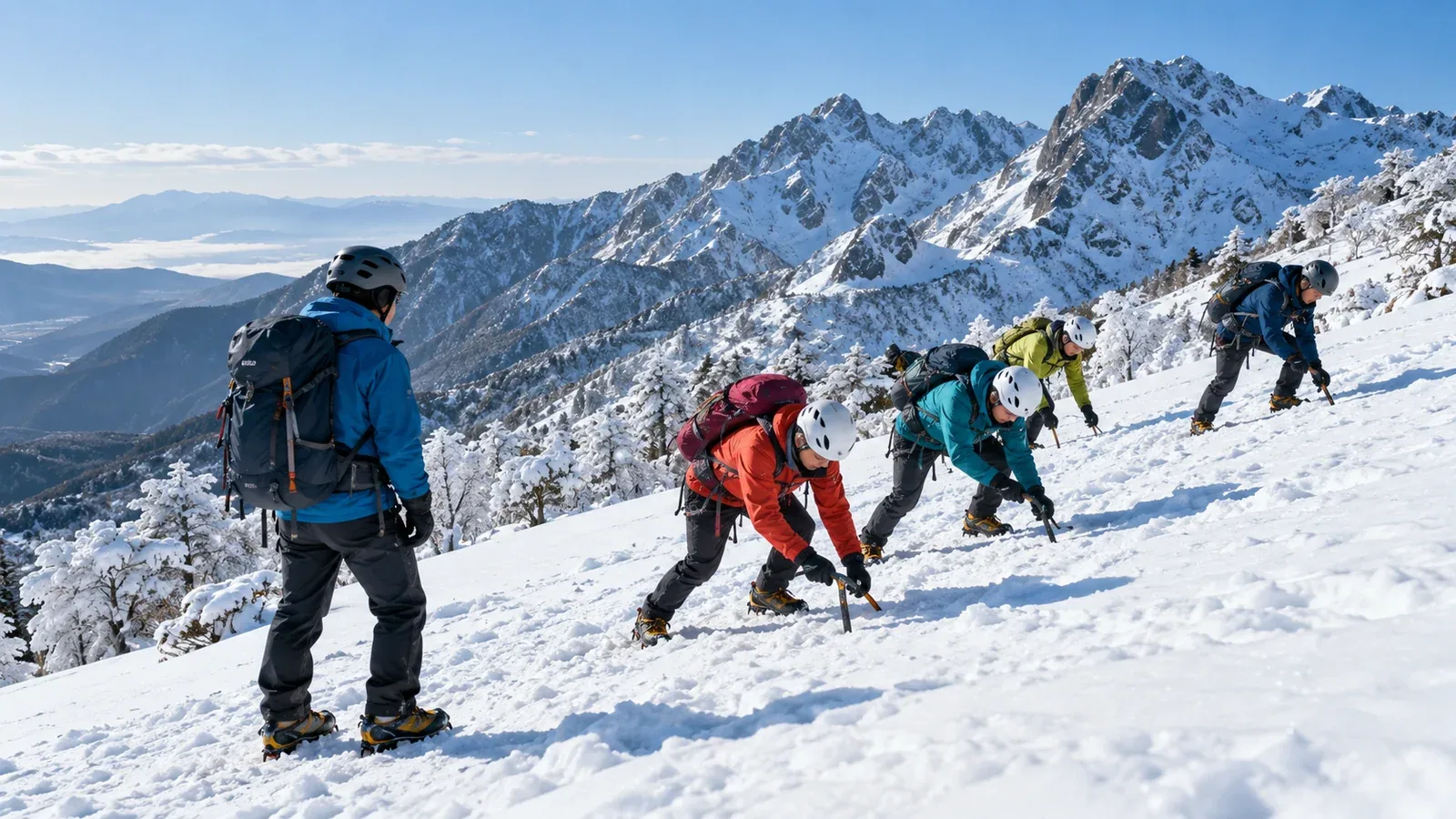
If you’re getting into winter mountaineering, the first question is often what course to take and where to find it. A book or video can show how crampons fit. Supervised practice lets you try the movements on suitable snow and get feedback where the instructor has chosen a safe practice area.
Use this guide to decide what to learn, which course fits your experience and where to start looking in Japan. Ask the provider about current dates, costs, equipment and the language used for instruction.
Start with the hazards you want to learn to manage
Three hazards help explain what winter courses teach and why.
- Sliding falls. On steep snow or ice, a slip can quickly turn into an accelerating slide. Learn footwork, route choice and when to turn back.
- Avalanches. A group can trigger a slide or be hit by one that starts above it. Learn to recognise and avoid avalanche terrain.
- Hypothermia and frostbite. Cold, wind and wet clothing can cool you quickly. Learn to protect yourself, spot warning signs and respond.
Crampon and ice-axe skills are part of fall prevention, terrain and snow assessment support avalanche avoidance, and clothing, food and shelter help manage cold. Companion rescue is a separate skill to practise. Apply these skills alongside route planning and conservative decisions.
What to learn at each stage
Course names vary. Compare the prerequisites and syllabus with what you can already do outdoors, and start with the level that lets you practise safely.
Stage one: basic winter movement
Look for an introductory course if crampons and an ice axe are new to you, or if you own them and want to learn when and how to use them.
- Fitting crampons and walking in them. Check boot compatibility and practise controlled footwork on suitable terrain under instruction. Ask when a technique such as front-pointing is appropriate.
- Ice-axe handling and self-arrest. Learn how to carry and use the axe to prevent a slip. Practise arrest under close supervision on a controlled slope with a clear runout. It may fail on steep or icy ground, so avoiding a fall comes first.
- Kicking steps. Practise making footholds in suitable snow under instruction and learn when the surface requires a different technique or equipment.
- An introduction to belaying. If your route goals include roped terrain, ask how and when belays are taught. Learn the limits of the systems and practise them with a qualified instructor.
Choose supervised on-snow practice for movement skills. Classroom teaching can help you prepare and review what you did in the field.
Stage two: broader winter mountaineering skills
Once you’re comfortable with basic movement, look for training suited to the longer or more technical outings you want to take. Learn avalanche avoidance before entering avalanche terrain, regardless of which stage a provider calls it.
- Assessing avalanche terrain and conditions. Learn to use forecasts, terrain and snow observations to select a route and avoid slopes, paths and runouts where you could be exposed.
- Transceiver, probe and shovel. Practise the full companion-rescue sequence as a group, from the search through probing and digging. Everyone needs hands-on practice with the equipment.
- Rope skills and protection. For steeper snow or mixed terrain, seek instruction in systems suited to the route, including their limits.
- Navigation and map reading. Practise position checks and bearings with a topographic map and compass, and use offline GPS as an additional tool.
- Emergency shelter and bivouac. Practise deploying a group shelter or bivy equipment and planning for an unexpected stop.
Formats range from short workshops to courses over several days. Check the prerequisites before booking. A separate avalanche course may be the right next step before a longer trip.
Where to find a course
Start with one of these four types of provider, then check the instructor and the course content.
Prefectural associations and mountaineering organisations
The Japan Mountaineering and Sport Climbing Association (JMSCA) lists its member associations and publishes events. Check your prefectural association’s programme and confirm who teaches, what experience is required and how much time is spent on snow.
Mountain guides and guide associations
Guides may offer small-group training tailored to your experience. Check the Japan Mountain Guides Association (JMGA) directory and verify that the guide’s qualification covers the winter terrain and activity. Ask about class size and the language of instruction.
Local mountaineering clubs
Some clubs run sessions for members or the public. Ask about who leads the session, what is practised, and whether you need to join the club. The course content and entry requirements vary.
Outdoor retailers
Outdoor retailers sometimes run introductory sessions with guides. Check official event listings and confirm the instructor, venue and amount of supervised practice before booking.
How to compare courses
Ask the provider these questions before signing up.
Instructor qualifications and experience. Verify that the qualification covers the activity, terrain and season. Ask who will teach and what relevant winter experience they have.
Time on snow and practice site. Ask how much supervised practice you get, how the instructor selects the site and what happens if conditions are unsuitable.
Group size and instructor numbers. Ask how many participants each instructor supervises and how each person gets feedback on their movements and rescue practice.
Prerequisites. Check expected fitness, prior crampon experience, equipment and language. Choose the level where you can practise the skills you actually need.
Weather and cancellation. Ask when the provider changes the venue or cancels, and read its rescheduling and refund terms.
What to do before and after the course
Check the equipment list and schedule in advance. Plan a follow-up practice session while the material is fresh.
- Bring equipment that fits. Ask the instructor what to bring and whether suitable equipment is available to rent. Check boot and crampon compatibility, and practise with the kit you’ll use outdoors.
- Review map basics. Look at how contours show ridges, valleys and slope changes so you can focus on navigation in the field.
- Practise again on suitable terrain. Repeat the skills in a controlled setting with supervision or an experienced companion. Choose terrain that fits your experience before trying more demanding routes.
Your next step
Write down what you need next: basic movement, avalanche training or another specific winter skill. Check your prefectural association, the JMGA directory and the Japan Avalanche Network. Nordwand’s Base Camp and guide request tools can help you find experienced partners or a qualified guide for supervised practice.
Further reading
- Japan Mountaineering and Sport Climbing Association (JMSCA)
- Japan Mountain Guides Association (JMGA)
- National Police Agency annual mountain incident reports
- Japan Meteorological Agency weather forecasts and advisories
References and sources
- JMSCA · Prefectural member associations
- JMSCA · Courses and events
- Japan Mountain Guides Association · Certified guide directory
- Japan Mountain Guides Association · Qualification scope
- Japan Avalanche Network · Avalanche seminars and field courses
- Japan Avalanche Network · Basic Safety Camp and prerequisites
- Mountaineering Scotland · Winter skills course examples
- National Police Agency · 2025 mountain incident report
- Japan Meteorological Agency · Forecasts
- Japan Meteorological Agency · Warnings and advisories