
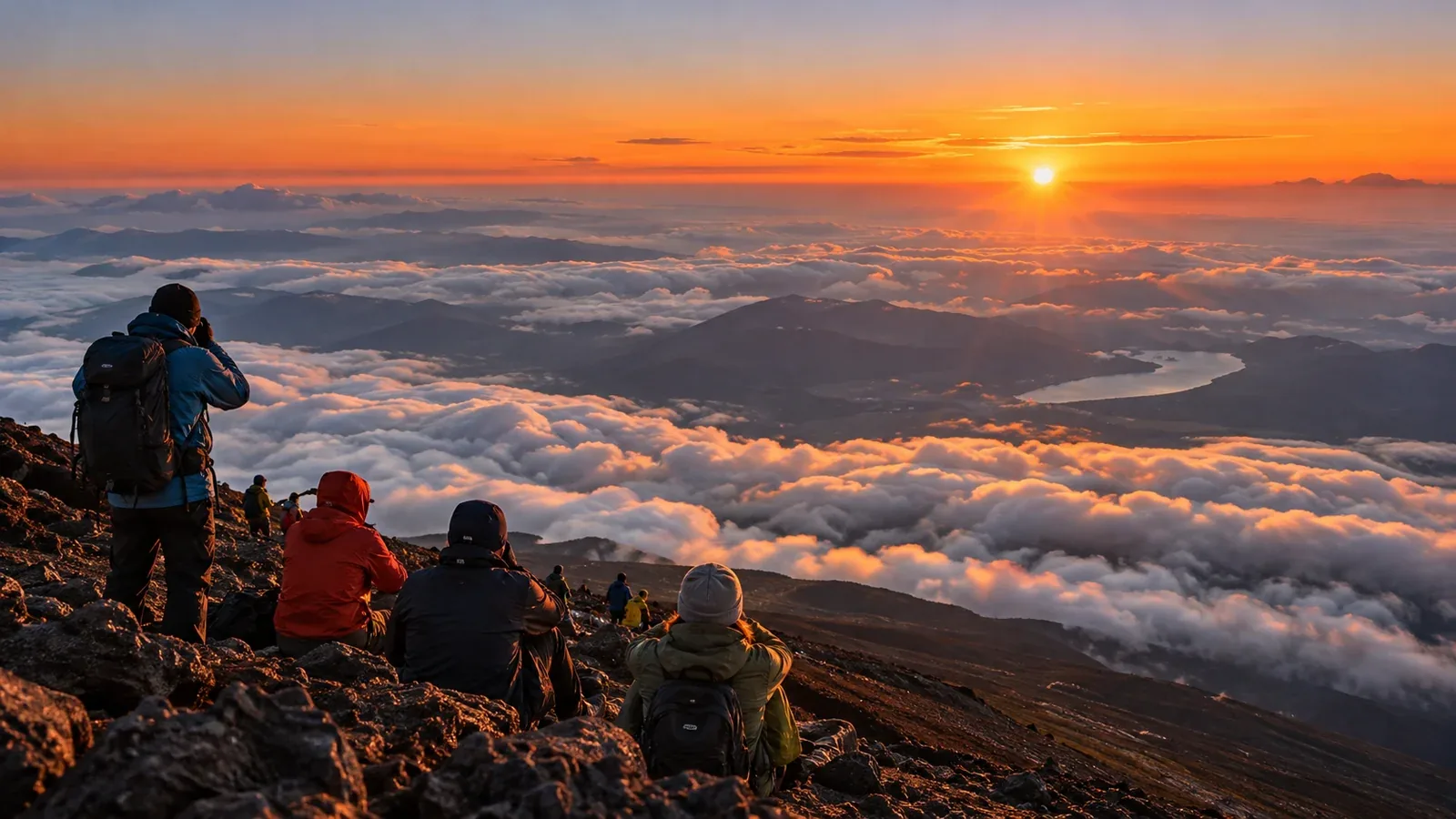
Many people climb Mount Fuji for goraikō, the sunrise seen from the mountain. Before choosing a station or aiming for the summit, check whether the route, weather and time of day allow you to reach a suitable viewpoint safely.
The view depends on cloud around your viewpoint and along the eastern horizon. You may see the sun rise over a layer of clouds below, or you may see the sky brighten while the sun stays behind cloud. Keep a plan for either outcome.
Conditions that shape the view
Check the weather on the upper mountain, the cloud on the eastern horizon and how cold or windy it will be while you wait.
A clear summit can still have clouds in the direction of sunrise. Thin cloud may light up while the sun itself remains hidden. Check observations when available, but leave room for changes that forecasts cannot resolve at a single viewpoint.
Use Japan Meteorological Agency forecasts, warnings and radar together with official trail notices and local information. A mountain-specific forecast can add detail. Check again near departure and reassess the conditions in front of you.
Wind and cold matter even if the sky is clear. The official guide warns of near-freezing temperatures before sunrise even in summer. Carry warm and windproof layers, and stop waiting or turn back if you cannot stay warm and steady.
Summit, hut or trailhead?
Choose somewhere you can reach and leave safely. Stay inside marked areas and keep the trail clear while waiting.
The crater rim offers an open view from suitable points when the trail is open and the weather allows. Upper paths can be steep and crowded before dawn. Plan a hut stay if your itinerary requires night walking and follow the current entry rules. The highest point, Kengamine, requires extra walking beyond some trail summits.
Near an open mountain hut can be a practical choice. Confirm the view and where guests may wait. Watching the sunrise near your hut lets you decide in daylight whether to climb higher or descend.
The 5th Station or a lower viewpoint involves less climbing. Visibility and the direction of the view vary by location. Check whether access is open at that hour and arrange return transport, especially for children or anyone who wants a shorter outing.
What the four trails offer
The official route guide lists sunrise views along much of Yoshida and Gotemba, on Subashiri after leaving the forest, and on Fujinomiya above the New 7th Station depending on the season. Check the hut or viewpoint you plan to use. Terrain and the sun’s rising direction both affect what you can see.
Choose the route for your group’s experience, pace, access and descent plan. Yoshida and Subashiri share their upper sections and may be busy before sunrise. A lower viewing point can leave the rest of the climb for daylight.
How to make the weather decision
Look ahead while planning, then make the final decision based on current conditions.
- Check the outlook ahead of the trip: Review the regional forecast and trail notices. Keep another date or itinerary in mind.
- Check again the evening before: Use the National Astronomical Observatory of Japan to look up the date and location. A nearby town’s sunrise time is a reference. The view from a hut depends on elevation and the local horizon.
- Reassess before and during the hike: Ask hut staff about the viewpoint, then look for wind, cloud and a stable place to stand. Avoid leaving the signed trail for a view.
- Use the alternate plan if needed: Watch from the hut, wait for daylight, choose a lower stop or descend if weather, cold or fatigue makes continuing unsafe.
Season and access
Mount Fuji’s summit trails are open during the summer climbing season. The 2026 season has ended. The official site expects the 2027 season to run from early July to early September, with exact dates to be announced. Check your route and the crater rim separately.
Sunrise time changes through the season and the view varies from one spot to another. Check the exact date and plan for wind and cold even in August. A sunrise goal can change at any time if conditions deteriorate.
Before you go
Choose a viewpoint you can reach at your group’s pace and an alternate if the weather turns. Confirm the hut booking, entry rules, return transport and turnaround time. On Nordwand you can ask local hikers about their experience or look for a guide familiar with the route.
Sources
- Japan Meteorological Agency: forecasts and warnings
- National Astronomical Observatory of Japan: sunrise calculator
- Official Mount Fuji climbing website: sunrise viewpoints and crowding
- Official Mount Fuji climbing website: season and facilities
References and sources
- Japan Meteorological Agency — Weather forecasts
- National Astronomical Observatory of Japan — Sunrise calculator
- Official Mount Fuji climbing website — Sunrise viewpoints
- Official Mount Fuji climbing website — Avoiding crowds
- Official Mount Fuji climbing website — Trail and facility openings
- Official Mount Fuji climbing website — Current season outlook