
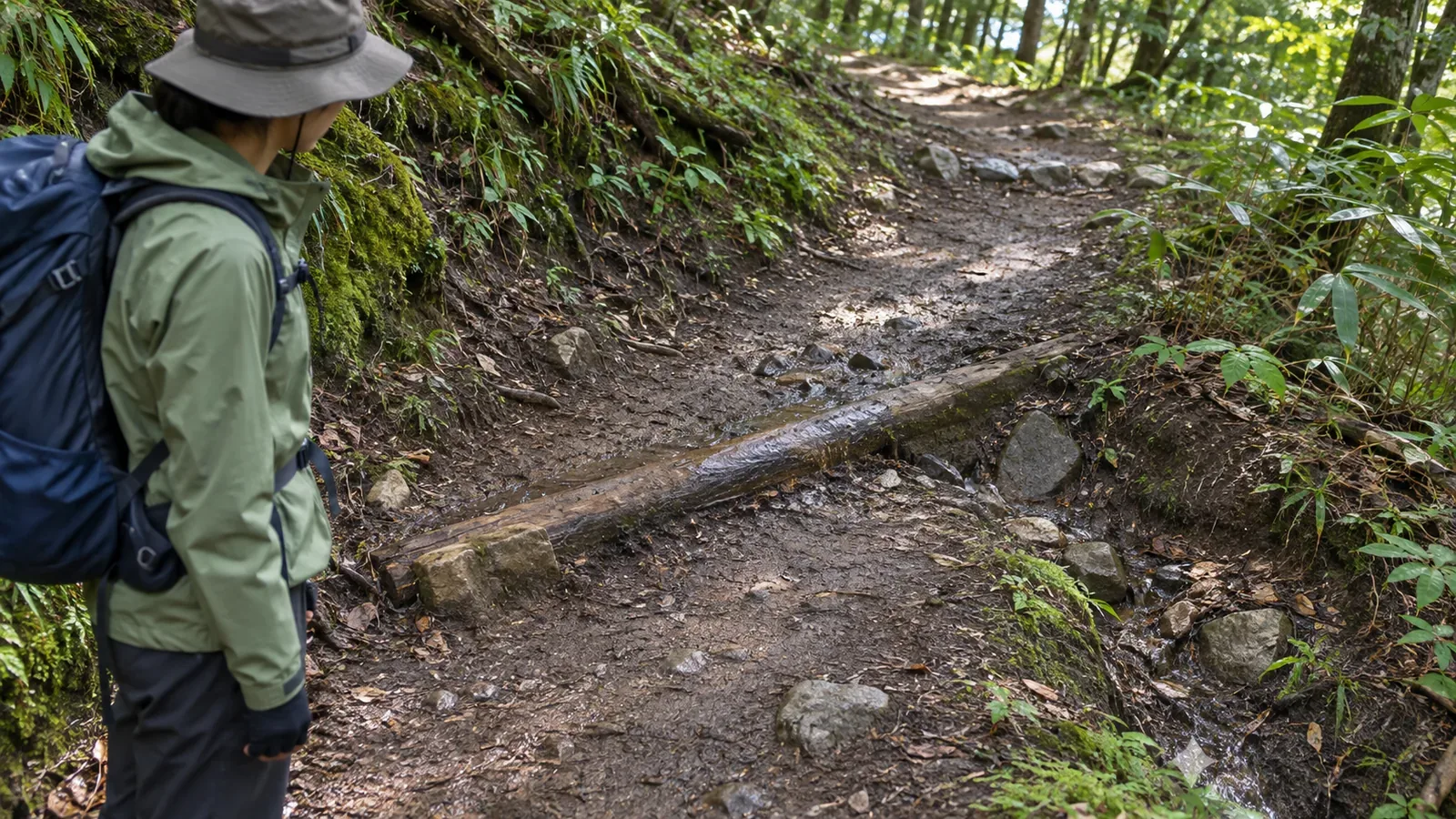
To understand a water bar, look at where the water comes from and where it goes. This guide draws on material checked by October 28, 2026. It helps hikers stop safely, observe what is there and use what they notice to report a problem or plan a future hike. It does not cover designing or installing drainage.
Water bars carry water off the trail
A water bar uses a log or stones set into the path to divert water off it. The US Pacific Crest Trail Association (PCTA) training material shows a crossbar made from buried stones or a log. The March 2005 Daisetsuzan National Park guidance describes cross-drainage, including channels with logs and attention to where the water discharges. The council's page also links to a separate 2016 revision.
Water can do considerable damage to trails. Daisetsuzan's guidance page identifies heavy rain and trampling as major causes of deterioration. When people avoid mud or ruts by walking through grass or dwarf bamboo, several parallel paths can form. Vegetation can take a long time to recover after a wide area has become bare. Our reading is that a water bar may interrupt a chain of pooling water, erosion and people stepping aside. That helps explain why one might be placed there.
Read the placement by following the water
Use the guidance to inform what you look for. Daisetsuzan's repair guidance says to disperse runoff at as many places as possible before it concentrates. Several water bars on a long descent may be intended to divert smaller amounts before the water gathers speed. We found no spacing standard in the material reviewed, so it does not tell us how many metres to leave between them.
Next, consider how the path lies across the slope. The PCTA glossary explains that trails running directly down the steepest line of a slope erode easily and are hard to drain. Look for whether water can run straight down the path or escape to the side. Small variations in the surface can change the flow, so the slope of the trail alone tells you little. Leave construction grades and dimensions to the people doing the work.
Consider the grade, where water may collect and whether the ground at the outlet can take the flow. Soil, past damage and the manager's decisions also play a part. What you see alone may not tell you why a water bar was placed there.
Four things to check from a safe spot
Stop on stable ground where you will not block others. Then take notes, photos or use your phone. If you cannot find a safe place to stop, skip the observation.
First, check the direction: does the bar cross the trail and direct water out of the channel? Second, look at the inlet for soil, leaves, roots or litter. Two US National Park Service volunteer pages list clearing water bars or fixing drainage as examples of maintenance. The PCTA material also describes clearing plants, roots and debris from drainage dips and ditches. The examples show why a water bar needs ongoing care.
Third, look at the outlet: is the ground scoured, or has runoff cut a new channel? The Daisetsuzan guidance asks crews using natural stone to consider the landscape, stability and flow. Stones that look out of place may have been laid deliberately. Fourth, check nearby for fresh footprints or parallel tracks where people may have avoided mud. The Daisetsuzan guidance calls for preventative measures such as rope barriers where these tracks are spreading.
When you are safely stopped, record the location using a sign, junction or another landmark and describe what you saw in a few words, such as “leaves at the inlet, new runoff channel at the outlet.” Record what you see without touching it. Leave the stones and channel in place.
Compare your observations with rain and a contour map
PCTA training suggests that rain can make it easier to understand water movement. If rain catches you on a planned hike, or it has just stopped, you may be able to observe the flow from a safe place. If water is rising, there is a risk of lightning or footing is getting worse, put turning back ahead of observing.
As a paper exercise, mark sections before your hike where contour lines are close together and the trail descends across them. Your hypothesis is that water may follow the trail there. Afterward, compare the map with the water bar locations you recorded while stopped. A match does not establish how water gathers there or what the builders intended. If locations match or differ, think about small landforms, soil and decisions by the manager that the map cannot show. Use those questions to guide a future visit.
Daisetsuzan's repair guidance describes identifying damage, finding the cause, considering options and carrying out repairs. Misreading the flow can worsen erosion, and the guidance asks crews to avoid excessive intervention. The July 2018 draft for the same area describes planning, consultation, coordination, legal procedures, work and reporting when someone other than the responsible organisation does the work. Checking procedures is part of planning. It is a Daisetsuzan draft, and current practice elsewhere may differ. Report problems to the trail manager. The material reviewed does not identify whom to contact for a trail with an unknown manager.
Follow the water and report what you see
A water bar has an inlet and an outlet. From a safe place, check its direction, any obstruction at the inlet, the ground at the outlet and nearby tracks. The idea that bars are placed where a steep path collects water is our hypothesis. Use a contour map to compare observations. Leave any problem as you find it and tell the manager where it is and what you saw.
References and sources
- Daisetsuzan National Park Liaison Council: Technical Guidelines for Mountain Trail Maintenance in Daisetsuzan National Park
- Japan Ministry of the Environment: Daisetsuzan National Park trail maintenance guidelines, chapter 3 (March 2005)
- Daisetsuzan National Park: draft trail maintenance procedures manual (July 2018)
- Pacific Crest Trail Association: Trail Skills College Field Reference, Course 100, Intro to Trail Maintenance
- U.S. National Park Service: Trail Maintenance, Blue Ridge Parkway
- U.S. National Park Service, New River Gorge: Basic Trail Maintainer