
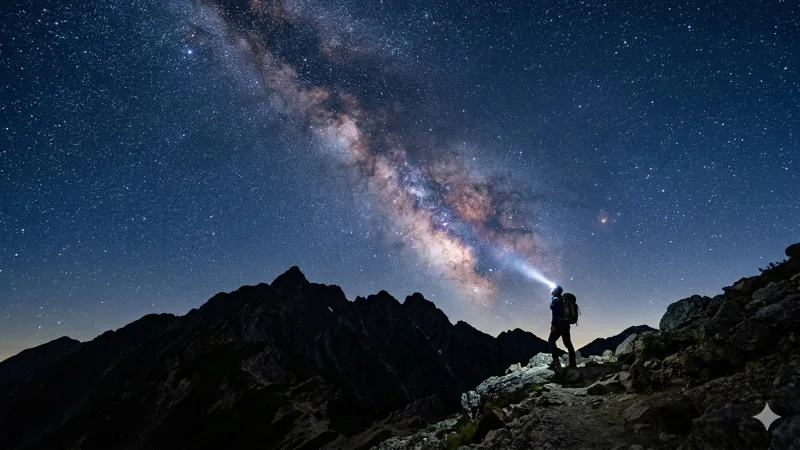
Under a dark sky, stars you couldn’t see in town start to appear. In the mountains, check city lights, the moon, the clouds and what’s underfoot. Before planning a long walk in the dark, find an open place near your accommodation where you can look up safely.
Why stars look different in town and in the mountains
You can see the Moon, bright planets and first-magnitude stars in town. Artificial light pollution makes the biggest difference to the fainter stars.
Light spilling from streetlamps and signs scatters in the atmosphere and brightens the sky. Against a brighter background, faint stars and the Milky Way are harder to see.
Even in the mountains, the sky towards town can be bright, and cloud or moisture can dim the stars. Look at the direction of city lights, how much sky you can see and the weather as well as the elevation.
How to choose a night to watch the stars
Check moonlight, cloud and wind for the object you want to see.
1. Choose a time when the Moon is down
For the Milky Way or faint meteors, the days around the new moon are a good starting point. Check when the Moon rises and sets at the site so you can choose a time when it’s below the horizon. To watch the Moon itself, plan for the shape and time you want.
2. Check the cloud forecast for your viewing hours
Even after a clear day, cloud or fog can form at night. Look at the hourly forecast and decide based on cloud, wind and visibility on the day.
3. Let your eyes adjust in a safe place
At a stable spot out of the wind, give your eyes time away from bright screens and lamps. Fainter stars will become easier to see. Use dim light only when you need it while watching, and enough light to see your footing when walking.
What to look for in each season
Where you’ll see constellations or the Milky Way changes with the season and the hour. Look at a sky chart and the astronomical calendar for the year before you go.
Summer: the Milky Way and the Perseids
On summer nights, look towards Sagittarius for the central part of the Milky Way. For the Perseid meteor shower in mid-August, check that year’s peak and when the Moon is up, then watch a wide part of the sky.
Autumn: the Andromeda Galaxy and meteor showers
Under a sky with little city light or moonlight, you may just make out the Andromeda Galaxy with the naked eye. Autumn also brings the Orionids in October and the Leonids in November.
Winter: Orion and the Geminids
Use bright stars in Orion and Taurus as landmarks. The Geminid meteor shower peaks in mid-December. A lodge or observation site open in winter offers a place to watch with an easy return, away from snow and ice at high elevation.
How to choose a stargazing spot
Plan to reach your lodge or designated campsite in daylight. Ask the operator which areas you can use at night.
- Northern Alps. If you’re staying in a hut near Tsubakuro or Jōnen, ask where guests can go outside at night.
- Yatsugatake. Some huts, such as Takamiishi in Northern Yatsugatake, offer talks about the night sky. Check the programme and who can take part.
- Kirigamine and Utsukushigahara. These plateaus have wide skies. Check where you can go after dark and whether the roads are open.
- Southern Alps. Check hut opening dates and walking times first, and plan an overnight stay only if you can reach the hut in daylight without rushing.
- Oze. Keep to designated paths near the wetlands and follow hut or facility rules for lights-out and night access.
Check the way to your viewing spot in daylight and look for steps or uneven ground. Follow your accommodation’s lights-out and access rules. After dark, watch from a nearby place where access is allowed.
Staying safe under the night sky
Slopes and changes in level are harder to see in the dark. Choose your spot in daylight and return early if the weather changes or you feel unwell.
What to do when watching at night
- Bring a headlamp and spare batteries. Light your footing properly when walking. When you’re standing still to watch, use a dim red light only if needed.
- Stay near your hut or campsite. Choose a stable place where access is allowed and keep away from exposed ridges.
- Keep clear of slope edges and cliffs. Stay behind fences. Stop watching if you can’t see where you’re standing.
- Keep light and noise down around others. Point your lamp at the ground and speak quietly near huts and tents.
Staying warm while you wait
Wind and cold can catch up with you when you’re standing still, even in summer. Bring warm layers, a windproof jacket, a hat and gloves suited to the weather. Go back to the hut or tent if you get cold.
For stargazing, choose a lodge or viewing site you can reach in daylight, with no long walk after sunset. If fog thickens, the wind picks up or you feel unwell, finish early.
For your next night under the stars
Little city light or moonlight, gaps in the clouds and a wide view of the sky make it easier to see faint stars. Check the route and access hours first, and choose the spot while it’s still light.
On your next hut stay, pick one constellation or meteor shower and look up when and where to see it. Set aside time to stop and look up close to where you’re staying.
References and sources
- Ministry of the Environment: Looking at the night sky and light pollution
- National Astronomical Observatory of Japan: Choosing a site for observing the sky
- National Astronomical Observatory of Japan: How to observe a meteor shower
- National Astronomical Observatory of Japan: Major meteor showers
- National Astronomical Observatory of Japan: Observing summer star clusters
- Takamiishi Hut: Takamiishi Hut in Northern Yatsugatake
- Oze Preservation Foundation: Rules and etiquette
- Ibaraki Prefectural Police: Preventing mountain accidents