
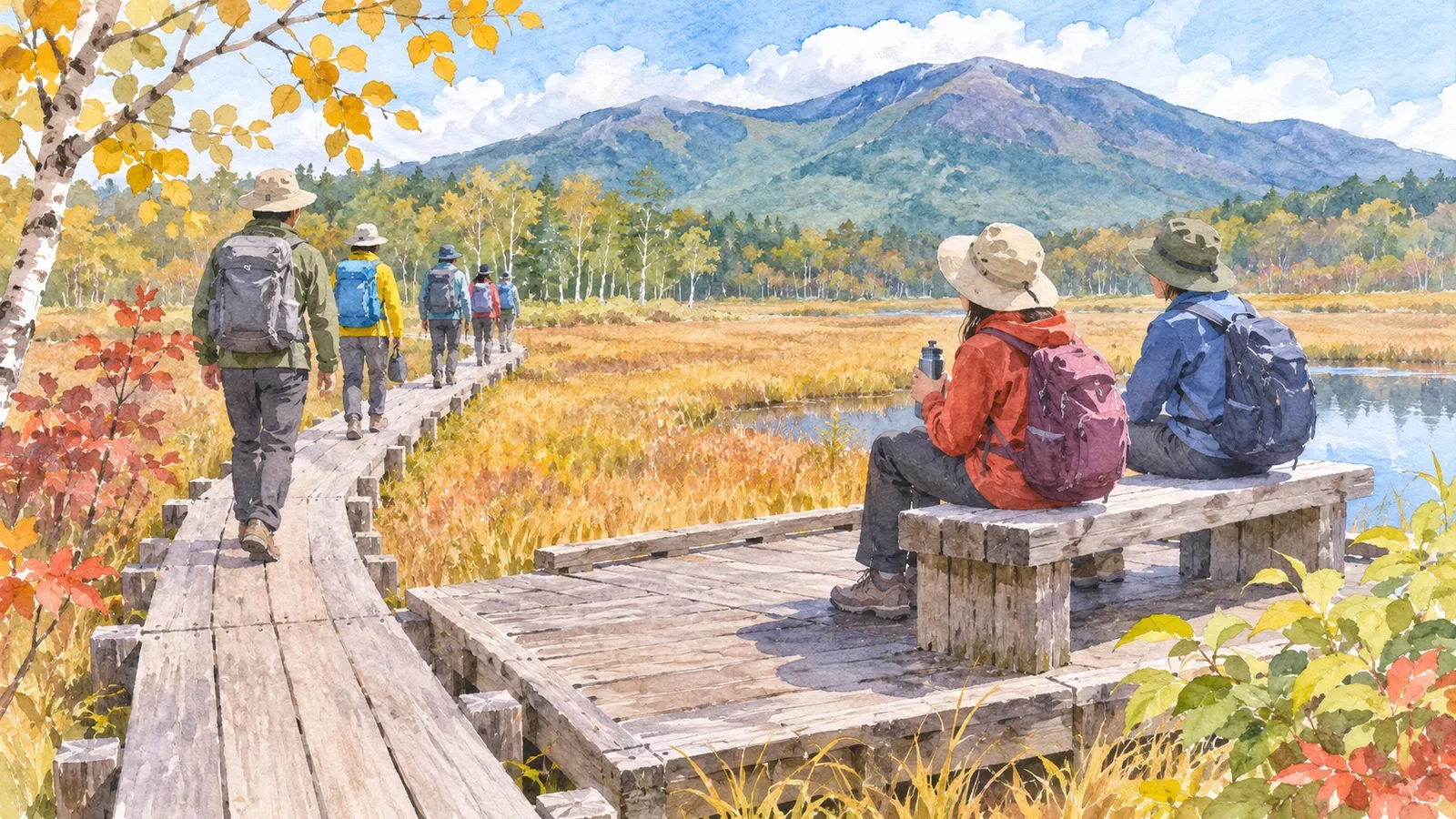
On a busy boardwalk, choose stable footing where your gear and poles can stay clear of the wetland when you stop. If you feel unwell, you can stop and ask for help even when people need to get past. A photo can wait, but a problem with your health or equipment may need immediate attention. Here is how to plan for those situations using Oze’s guidance. Follow local rules in other mountain areas.
Rules for Oze’s boardwalks
The Oze Preservation Foundation asks walkers to keep right, give way to uphill hikers and avoid smoking while walking. Keep your feet out of the wetland when sitting on a boardwalk or in a rest area, and keep tripod legs out of it too. The Ministry of the Environment also asks visitors to stay on the boards to protect the fragile wetland.
Before boardwalks were widespread, visitors walking through the wetland stripped vegetation from places such as Ayamedaira, where peat washed away. Fukushima Prefecture says peat accumulates at only about 1 mm a year. Gunma Prefecture explains that repeated trampling kills plants and can compact and dry the ground. Stay out of the wetland even while looking for somewhere to stop.
An Oze Preservation Foundation staff member told Fukushima Prefecture that private car restrictions introduced in 1974 helped relieve congestion on boardwalks and reduced rushed hikes. Crowds today vary with season and weather. The foundation’s FAQ says weekends can be busy when flowers or autumn colors are at their best.
Check the footing and how you feel
Consider your footing, the people passing and how you feel. The Oze trekking guide notes that a steep climb or heavy pack can mean you need to rest more often. If you need a break even partway up a slope, think about how to let others pass.
• Steps and damaged planks: The Ozenuma Visitor Center’s repair report warns about cracked and tilted planks. Decide what to do from stable footing before stepping onto a dangerous board. Keep your distance from damage when taking photos.
• Wet or slippery boards: Wet planks can be slick. If the footing is uncertain, stop where it is safe to do so without trying to reach the next rest area first.
• Boardwalk edges: Feet, gear and pole tips can stray over the edge into the wetland. Fit tip caps and keep them on the planks. Move your gear around only where there is enough room.
• Health and slope: Rest if you are tired or unwell, even on an uphill stretch. Tell people passing what is happening and avoid pushing on.
• Visibility: For optional stops such as taking a photo, choose a place where people ahead and behind can see you, so you can easily speak to one another. Stop before any unsafe section.
The author of the Oze trekking guide suggests that fatigue can make it harder to balance and contribute to falls alongside wet boards. In the guide’s figures for the 1997–2002 seasons, mainly on the Gunma side, 61 of 96 incidents were injuries while walking. Falls resulting in sprains, fractures and other injuries accounted for 63% of all cases. With those examples in mind, plan where to rest before you get tired.
How to stop for different reasons
What you need to check depends on why you are stopping. Here are four common situations.
• Resting: Keep your feet out of the wetland when you sit. For a longer break, find a rest area or another place that leaves the route clear. Check official maps or route information for rest areas along your hike.
• Adjusting gear: You might fit a pole cap, take out rain gear or remove crampons where there is no snow. The trekking guide recommends carrying rain gear even if the forecast for lower elevations is clear. Pack it where you can reach it, and put on or remove gear from stable footing.
• Waiting for your group: A sudden stop at the front can cause others to bunch up. Before setting out, agree that the leader will choose where to stop and give a short verbal warning.
• Looking at the view, a map or a phone: Wait until you are stopped on stable footing and out of the way to use your phone or write notes. If there is nowhere suitable, leave it for later.
Plan your rest stops before leaving
To make fewer decisions on the spot, work through these steps at home.
1. For each planned section, write down why you might want to stop: a break, gear, the view or waiting for someone.
2. Check official information for rest areas. If you cannot confirm one for a section, mark it as unconfirmed and plan accordingly.
3. Work out where you are likely to tire and plan to stop somewhere before that stretch.
4. Agree on short words to tell the group when you are stopping or going on ahead.
On the trail, tell your group before stopping. Get your footing before handling gear. If the boardwalk is too crowded for a photo, save it for later. If you feel unwell or there is another urgent issue, find stable footing and ask people nearby for help. Stop short of damaged or unstable boards even if your planned rest spot is further on. Stay out of the wetland and follow the manager’s signs for works and closures.
Check the footing and leave room to pass
Stay on the boardwalk and keep your feet and poles out of the wetland. Choose a place to rest based on how you feel and where you can stand securely. If you need to stop partway up a slope or while the boards are wet, look for firm footing nearby. Tell your group in advance that a photo can wait and that anyone who feels unwell can ask to stop or call for help.
References and sources
- Japan Ministry of the Environment: Visiting Oze National Park Responsibly
- Oze Preservation Foundation: Trail Etiquette in Oze
- Oze Preservation Foundation: Ozenuma Visitor Center, Boardwalk Repairs (August 6, 2024)
- Oze Preservation Foundation: Frequently Asked Questions
- Fukushima Prefecture: The History of Conservation in Oze, Part 2, Managing Overuse
- Gunma Prefecture: Boardwalks and Vegetation Restoration in Oze (booklet extract)
- Oze Preservation Foundation: Oze Trekking Guide (booklet)