
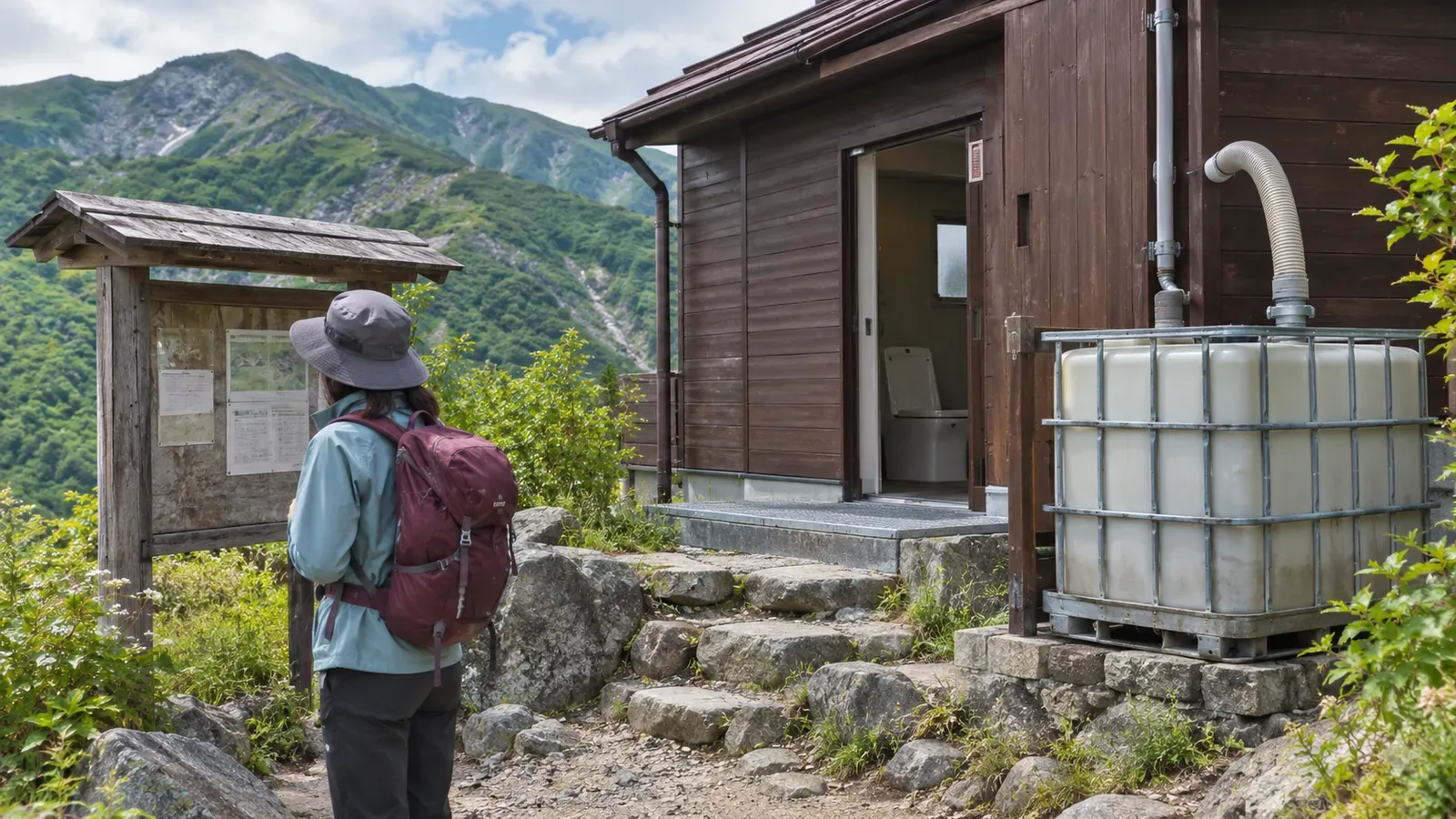
Mountain toilets may require the removal of raw waste from holding tanks or residue from on-site treatment. Knowing who takes what out helps explain the operating instructions and the role of toilet contributions. Environment Ministry guidance and examples from Mount Fuji and Yakushima show how it works and what walkers can prepare.
Who carries what
The ministry’s guide describes on-site treatment, facilities that store waste for removal and portable kits. Look at what has to be removed and who handles it to understand how each one works.
First, a pump-out holding tank stores the waste without treating it on site. A vacuum truck or another means takes it to a treatment facility. In some places, helicopters carry replaceable tanks to the foot of the mountain. The operator arranges this removal.
Second, there is on-site treatment. A 2022 ranger’s report describes the biological toilet at the seventh station on the Yoshida descent. It separated urine from solids, then treated the solids in a heated chamber where a screw stirred the material. Decomposition and evaporation reduced the amount of waste to 10% or less. The operator brought the residue down for disposal, for example when replacing the treatment medium.
Third, with a portable kit, the user carries out the bag. Yakushima’s guidance shows how to tie it closed, put it in an odor-proof bag and take it to a designated collection box. It says a bag carried back to a settlement can go in combustible waste under its local guidance. In other areas, check the product instructions, the collection point and local waste rules where you take it.
The operator handles removal for holding tanks and on-site treatment. With a portable kit, you carry it out yourself. How much on-site treatment reduces the waste and what has to be removed depends on the equipment.
Waste removal is part of maintenance
A ministry report documents cases where untreated waste seeped into the ground or was discharged at the end of the season, causing odors, water pollution and damage to the landscape. Treatment equipment needs cleaning and sludge disposal. The report also gives examples where user revenue at the time fell short of upkeep costs.
The Yakushima World Heritage Conservation Center says waste from mountain toilets is carried out by hand. In 2023, a ranger in Hokkaido described workers at Kurodake Ishimuro in Daisetsuzan emptying the tanks by hand and flying waste out every few years. Where there is no road, handling the waste beyond the bowl also means getting it off the mountain.
The 2022 report on the Yoshida descent’s seventh-station toilet lists staffing, generator fuel and buckwheat hulls as expenses, as well as the difficulty of sourcing and carrying in parts after a breakdown. Check whether the facility is open and follow the signs on site.
Foreign objects can interfere with the equipment. The guide explains the importance of separating paper where required and keeping rubbish out. At the seventh-station toilet described in 2022, standing to urinate could put too much liquid into the solids chamber and slow decomposition. That instruction reflected the design of that facility.
Put only what is allowed into the toilet, and follow the instructions for paper and waste. Foreign objects make treatment and repairs more difficult.
How contributions and portable kits help
The ministry report recommends publishing how user fees are spent. The official Mount Fuji site asks users to pay a separate contribution of about ¥100 to ¥300, according to the amount posted at the facility. Check the amount and payment method before leaving.
With a portable kit, the user carries the bag out. The ministry report says kits need to be easy to obtain, use and dispose of. It gives temporary booths in busy places as an example. Plan where you can use the kit and where you can dispose of it.
Yakushima’s booths have no toilet paper or rubbish bins. Bring what you need and carry it out. Fit the portable toilet bag over the seat, then seal it and take it with you after use. Check collection box locations and what they accept.
Four things to check before you leave
Check four things with the operator: how the toilet treats waste and who takes it out; opening dates and hours; where to get and return portable kits, when collection is available and what to do without it; and how to pay any fee or contribution and what it covers.
Go through your itinerary and note for each facility whether the operator pumps it out, treats waste on site and removes what remains, or leaves it to the user to carry out. If you cannot confirm how it works or when it opens, mark it as unconfirmed and check where to use and dispose of a portable kit in case you need one.
You might ask, “Does this toilet use a pump-out tank or on-site treatment?” or “Where and when do you collect used portable toilet bags?” Specific questions make the answers easier to use in your plan. Note the answer beside your itinerary. If it differs from signs on the day, follow the signs and staff instructions.
If you photograph a sign or take notes, stop somewhere stable where others can pass. If there is nowhere suitable, leave it for later.
Check opening periods and collection points too
Operators take away waste from holding tanks or the residue from on-site treatment. With a portable kit, the user carries it out. Before leaving, check the latest guidance on treatment systems, opening periods, collection points and how to pay on your route.
References and sources
- Mount Fuji Ranger Diary No. 110: The Toilet on the Yoshida Descent Trail
- Yakushima World Heritage Conservation Center: Using Toilets, Portable Toilet Guidance
- Japan Ministry of the Environment: Future Provision and Maintenance of Mountain Hut Toilets, Chapter 2
- Japan Ministry of the Environment: Guide to Toilet Waste Treatment in Natural Areas
- Official Mount Fuji Climbing Site: Frequently Asked Questions
- Japan Ministry of the Environment, Hokkaido Regional Office: People Who Maintain Mountain Toilets