
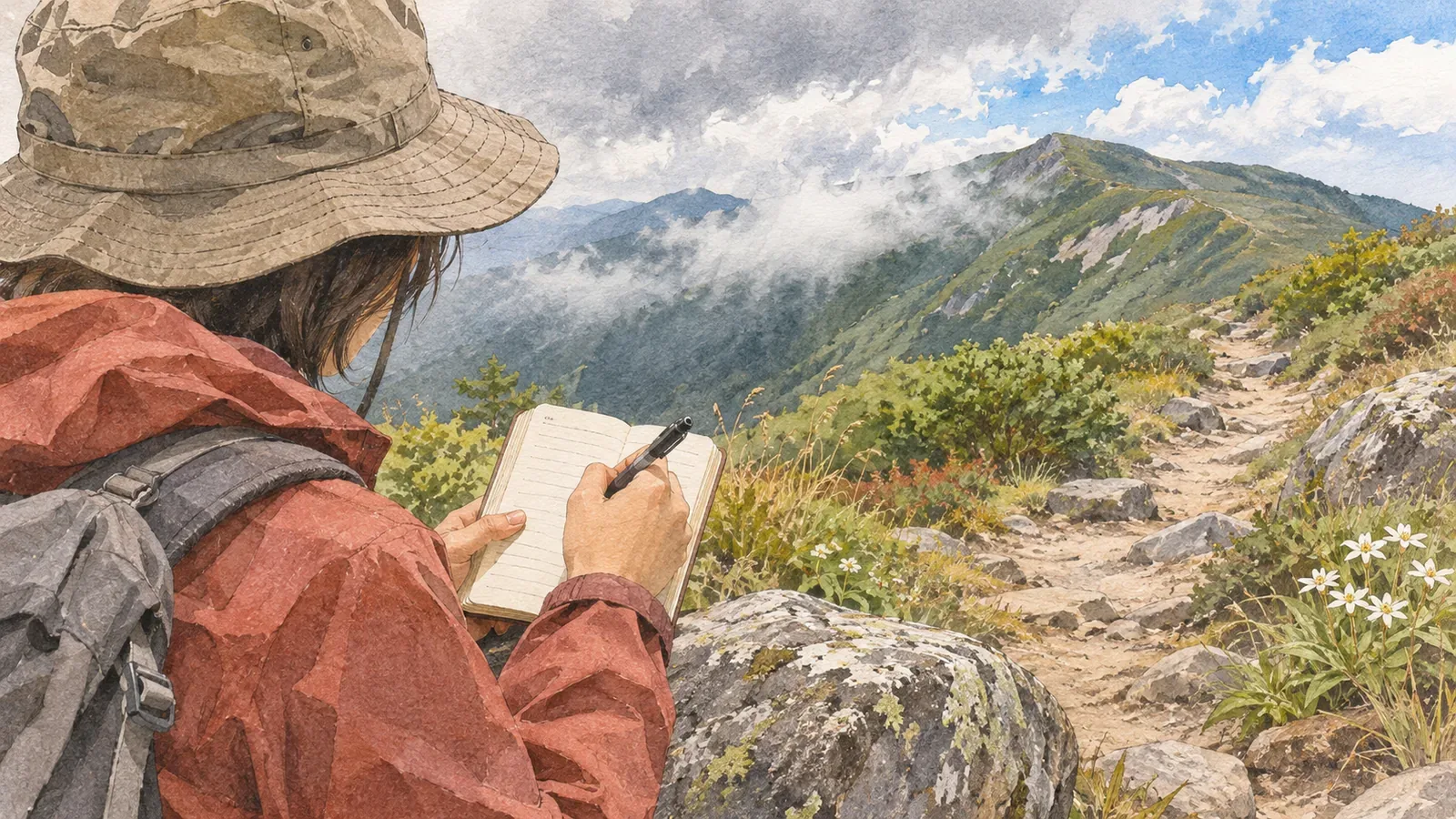
Stop on stable ground where other hikers can pass, then note the weather and location in words you can compare later. One line is enough to start. Seasonal monitoring and natural park guidance offer ideas for what to include. Keep what you saw clear and flag what you still don’t know.
Take an idea from repeated surveys: Keep notes comparable
Since fiscal year 2021, Japan’s National Institute for Environmental Studies has worked with the Japan Meteorological Agency and Ministry of the Environment to monitor seasonal events with volunteers. It suggests a survey site people can visit three or four times a week. Daily visits are ideal, with at least one visit per week. Volunteers can report the categories they recognize or choose one favorite species.
A single hike gives you the state you saw that day. Finding the first day of flowering or autumn color takes repeated observation. Name the field “conditions on the day” so you can tell what the entry refers to when you read it later.
Use common fields from one visit to the next. The meteorological agency monitors selected trees using consistent criteria across stations. The Phenology Observation Manual (version 3, November 13, 2023) keeps the subject tree fixed to account for different individuals and growing conditions. If a tree is replaced, observers record the change and selection year. In a hiking journal, use the same format for weather and place each time and note any change in format.
Describe the weather in a few words
You can describe the sky and how it felt with no instruments. Try four fields: date and time, visible weather, how it felt and any supplemental information. Keep any measurements separate from impressions and note the device and conditions so you can interpret them later.
First, record the date and time. Morning, around noon or afternoon is enough if you don’t know the exact time. Second, describe the sky or visibility: overcast, poor visibility in fog, raining. If the ground is wet and you didn’t see rain, write that the ground was wet. Third, label “felt chilly” as an impression. Fourth, if you look up earlier weather, record the source, date, time and station. Keep station readings and on-site conditions distinguishable.
Check current weather before deciding how to proceed. Japan’s National Police Agency’s 2025 overview recommends checking the latest weather, allowing time for breaks and identifying hazards and early descent routes in advance. Take notes when you have time and attention to spare. In fog, if you’re unsure of your position, stop observing and check where you are and which way to go. Turn back when conditions warrant it.
Write down where you stopped on the trail
In the location field, put your stopping point first. Nagano Prefecture asks hikers to stay on trails and keep out of vegetated and roped-off areas. Leaving the path for a photo can damage it or lead to a fall. On narrow trails, wait at a safe spot on the uphill side away from the exposed edge, and watch for loose stones and rockfall. For other mountains, check the local guidance before leaving.
For your journal, record what you can see from the trail. Skip subjects you would have to approach. Use three details for location: the route and segment relative to a mapped landmark such as a trailhead or junction, what made the stopping point suitable, and where the subject was relative to it. “On the uphill side” or “some distance away” works. If there’s nowhere safe to stop, record that fact later and skip the subject.
Check the collection rules too. Nagano asks visitors to leave plants and animals where they find them. Collecting or capturing some species in certain locations can carry penalties under national or local law. The Ministry of the Environment asks people to leave flowers and other plants in place in Fuji-Hakone-Izu National Park and to follow any site-specific rules. The Natural Parks Act regulates collection of and damage to designated plants in special zones of national and quasi-national parks. Check the list for the park you’ll visit. Your journal lets you keep a record while leaving the subject in place.
Write one line on the trail and organize it after the hike
Here is an example: “May 12, morning | Overcast, felt chilly | On the route just before the second junction, wide enough to step to the uphill side | One tree beside the trail, species field blank.” One line covering weather, place and subject is enough.
Before leaving, write the date, route and time window and mark them “planned.” Record the actual time separately. Try a practice line from an old hike to see how much fits. On the trail, write the weather and location after you stop. Stop before taking notes or photos. Skip the entry if the ground is poor, there’s no safe place to stop, you would block the trail or the weather needs your attention. Mark anything you add from memory later. At home, tidy the entry and describe the conditions that day.
A single visit can show which flowers were open, while a flowering date depends on the subject and its criteria. For a monitored Somei-yoshino cherry tree, the manual uses the day five or six flowers have opened, excluding flowers from the trunk or roots. For uncertain maple color, it suggests observations over several days and comparison with photos from other regions. Record what you saw on the visit.
Use a phone only at a safe stop. The National Police Agency notes that GPS phones can help relay your position to rescuers. Coverage is limited in many mountains, and battery charge matters. Keep phone use brief and bring backup power as appropriate. If you use paper, find a safe place to stop before getting it out too.
In brief: Leave one line when you can stop safely
Describe the weather in plain words and note your stopping point on the trail. Treat a single visit as a record of that day. Decide in advance to leave plants in place, stay on the trail and skip the entry if you can’t stop safely. This leaves you free to turn back or cancel when needed. Before your next hike, try making a space for the date and route.
References and sources
- National Institute for Environmental Studies: Citizen monitoring of seasonal changes in plants and animals
- Japan Meteorological Agency: Phenological observations
- Climate Change Adaptation Platform: Phenology Observation Manual, version 3
- Nagano Prefecture: Guidance for park visitors and hikers
- National Police Agency of Japan: Overview of mountain incidents in 2025
- Japan Ministry of the Environment: Visitor etiquette in Fuji-Hakone-Izu National Park
- Japan Ministry of the Environment: Designated plants in national and quasi-national parks