
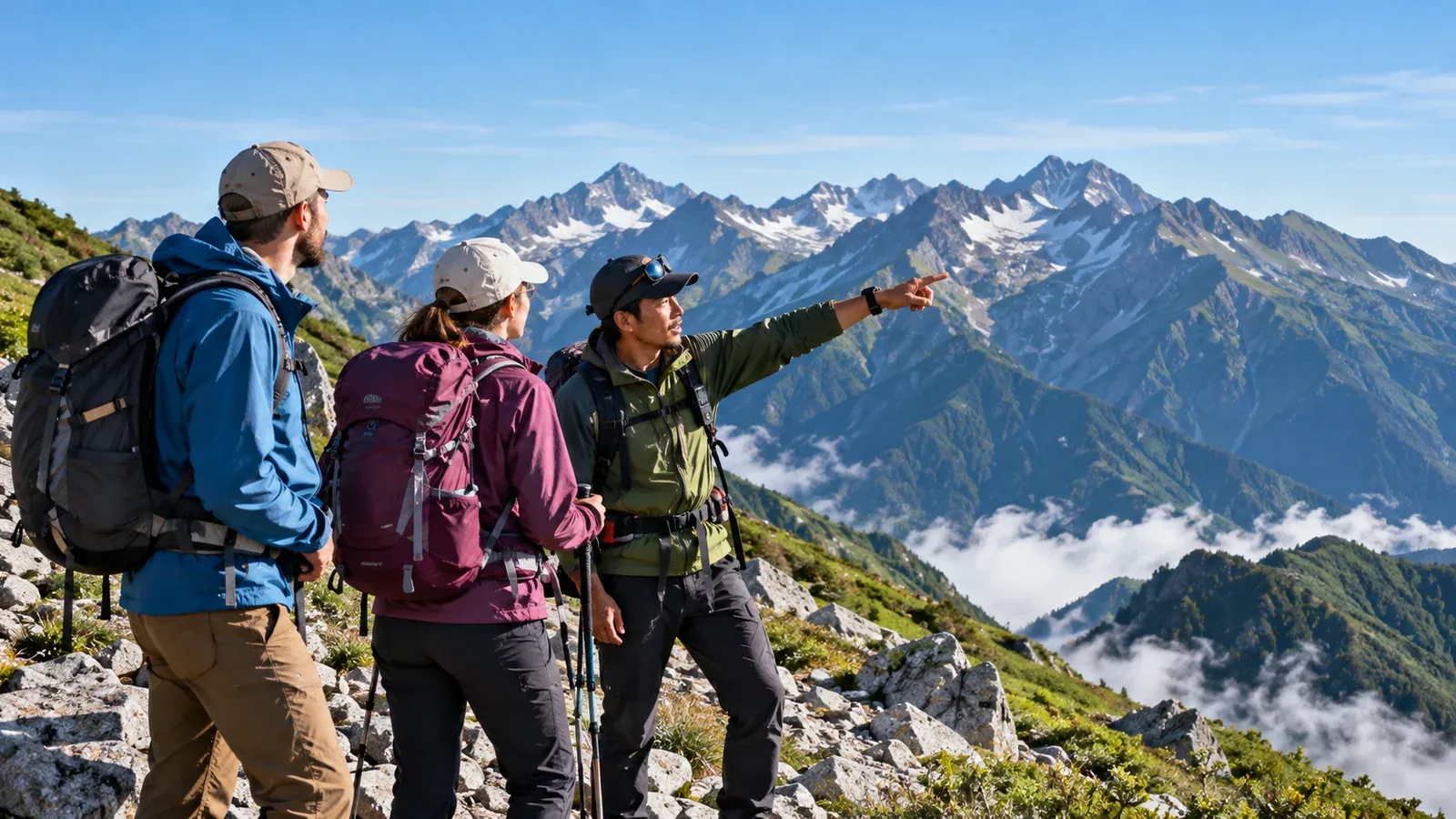
Visitors travel to Japan to hike places such as Mount Fuji, the Northern Japanese Alps and Yakushima. Guiding them calls for knowledge and skills in the mountains and the ability to explain things in a language they understand.
This article looks at the roles involved, relevant credentials, practical skills and how to begin. It is for both prospective interpreter-guides and hiking guides who want to work with more visitors.
Where interpretation and mountain guiding meet
When you guide international hikers for pay, two kinds of work overlap.
One is mountain guiding. It draws on the knowledge and experience needed to travel safely, including route decisions, reading the weather, managing risk and first aid.
The other is visitor interpretation in a foreign language. You explain Japan’s destinations, culture and natural environment in a way visitors understand and help them enjoy their time in the mountains.
The two roles draw on different skills and rules. Mountain guide credentials and interpreter-guide registration cover different parts of the work.
How Japan’s interpreter-guide system works
A National Government Licensed Guide Interpreter passes a national examination and registers with a prefecture. There are written and oral exams. The written subjects include a foreign language, Japanese geography and history, general knowledge and practical guiding. Check the Japan National Tourism Organization (JNTO) for current subjects and exemptions.
A Regional Licensed Guide Interpreter completes training in a participating municipality or prefecture and works in the region covered by the registration. Timing, training and geographic coverage vary by program. Check with the local authority or Japan Tourism Agency.
Since the 2018 legal change, people without the interpreter-guide qualification can give paid tours in a foreign language. The national and regional licensed titles and similar names are reserved for people with the corresponding registration. Check the rules on guide titles, technical requirements for the route and travel arrangements separately.
Combining that work with mountain guide credentials
Leading hikers safely requires mountain skills. The Japan Mountain Guide Association issues mountain and hiking guide qualifications with stages that define the terrain and kinds of outings each qualification covers.
The same applies when you guide in another language: match your skills and the scope of your qualification to the terrain, season and activity. Rocky ridges, winter mountains and stream routes require different experience and techniques. Check the requirements of any company or facility commissioning your work.
Consult the association’s official information for qualification categories, entry requirements and examinations.
What the work requires
Alongside pursuing qualifications, consider the skills you’ll use with clients.
Communicating in another language
You may suddenly need to explain a hazard, tell the group you’re turning back or ask how someone feels. Practice the words for safety instructions, health checks and weather. Keep instructions short and clear, and check that people understand. The languages you need depend on the area and the operator. Ask tour companies or huts what they encounter.
Explaining Japan’s mountain culture and nature
You can give visitors more context by explaining traditions of mountain worship, alpine plants, hut culture and customs such as greeting people on trails and carrying out litter. Studying Japanese geography and history, both on the national interpreter-guide exam, can help you explain these topics.
Managing safety and making decisions
Before leaving, check participants’ experience, familiarity with their gear, health and insurance coverage. Handle health information only as far as necessary. If headache, nausea or other signs of possible altitude illness appear at elevation, stop ascending. If symptoms worsen, descend safely. If symptoms are severe or the person cannot descend on their own, call for rescue. Be ready to explain the decision and how to get help in a language participants understand.
Finding your first guiding work
There are several ways to get started.
Signing up with a travel or outdoor company can be a first opportunity to guide. Companies that run mountain tours for international guests sometimes look for guides who can work in other languages.
Joining a mountain guide association or a local guide group can bring referrals, as well as training and a place to exchange information. Membership can help clients understand your professional background.
Working with huts and tourism associations that receive international visitors is another option. Some local authorities and tourism associations are building services for international hikers and may be looking for multilingual guides.
Clarify trip notification and access rules, insurance for participants and guides, and whether you’ll be hired as an employee or contractor. If you sell or arrange transport or lodging for payment, you may need registration under the Travel Agency Act. Check your business model with the Japan Tourism Agency or the authority responsible for it.
What to do next
Choose an area and a route to start with, then look up the relevant qualifications and scopes with the Japan Mountain Guide Association. If you want interpreter-guide registration, check the Japan Tourism Agency or the local authority for the area and requirements. Nordwand’s community is also a way to hear from guides already working there.
References
- Interpreter-guide system and protected titles (Japan Tourism Agency)
- Qualification categories (Japan Mountain Guide Association)
- Regional interpreter-guide registration (Japan Tourism Agency)
- National interpreter-guide examination (Japan National Tourism Organization)
- Overview of the Travel Agency Act (Japan Tourism Agency)
- What to do in an emergency (Mount Fuji official climbing website)
- High-altitude travel and altitude illness (CDC Yellow Book)