
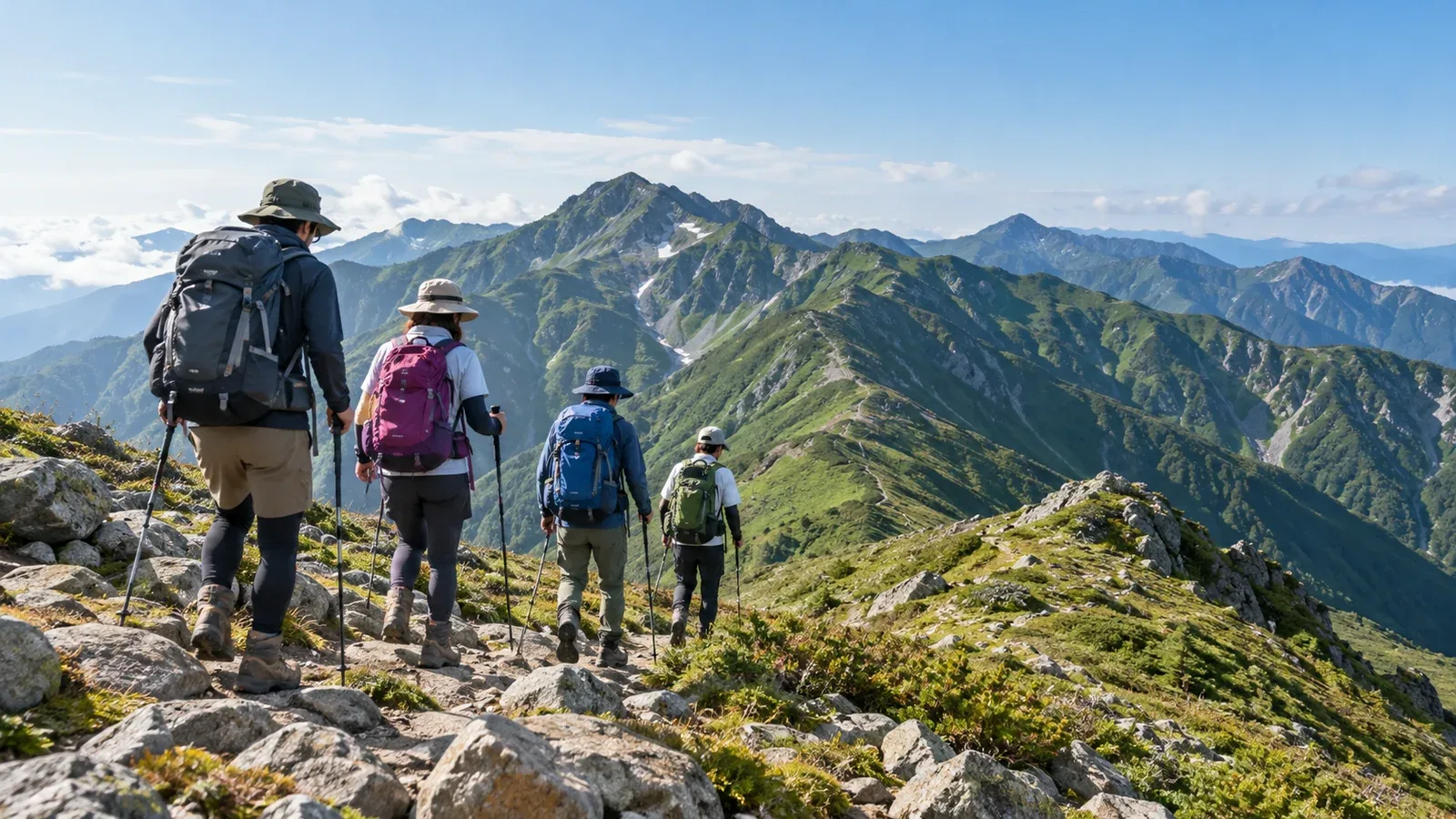
When beginners and experienced hikers go together, it’s easy to plan around what feels manageable to the experienced hikers. A mountain that feels easy to one person may demand much more fitness, skill and concentration from a newcomer. If the plan doesn’t account for that difference, beginners can run out of energy, the whole group can lose its pace and you may have to turn back.
Here’s how to choose a mountain, divide roles and adapt on the day. You can use the steps from choosing the route to deciding what to do on the trail.
Why mixed-experience groups take more planning
Compared with hiking alone or with people at a similar level, a mixed group needs to pay attention to both a safe pace for everyone and each person’s limits.
Experienced hikers may be used to walking through fatigue, and their sense of what’s manageable may differ from a beginner’s. Beginners may miss signs that they’re nearing their limit, or keep saying they’re fine to avoid inconveniencing others. Together, these habits can delay the moment a problem becomes apparent. Allow for them when making the plan.
Choose a suitable mountain and route
Choose a route that beginners can walk with energy to spare. A route that feels a little easy to more experienced hikers can be a good fit for the whole group.
Look at three things.
Cumulative elevation gain. For someone with very little hiking experience, up to 500 m of total ascent is one rough starting point. After several outings, you might consider around 700–800 m. These figures are only planning examples. Start by asking about the person’s actual fitness and usual exercise.
Trail conditions. Long sections of rock, chains or fixed ropes can be mentally demanding for beginners without technical experience. Choose a maintained route with few hazardous sections. Check route information from the land manager or local authority and look for hazard symbols on the map.
Options to turn back or descend. It’s especially important for a mixed group to have a way to cut the outing short. Find the junctions that offer a way down and check them on the map during planning.
Once you’ve chosen a mountain, check official information from the local authority or land manager about current trail conditions, restrictions and hut operations. Online trip reports can be out of date, so compare them with current information.
Estimate walking times and build the itinerary
The time on a hiking map is an estimate for a typical hiker. For an initial plan with beginners, you could budget 1.3–1.5 times that figure. Adjust it to the group’s walking pace and breaks and to current conditions.
You need extra time for both walking and rest. Beginners may need to stop more often than experienced hikers. If those stops are missing from the plan, you may feel rushed later in the day.
Build the itinerary in this order.
- Decide when you’ll be back at the trailhead. Set a finish time while it’s still light. Two hours before sunset is one example of a planning margin. Work backward from the finish to decide when to start.
- Set a turnaround time. Agree on a time to turn back even if you haven’t reached the summit. The call can be harder in the moment, so make it while planning.
- Find rest stops on the map. Look in advance for places to stop safely, such as water points, benches or flat areas with a view.
Share responsibilities and agree what to expect
Deciding who will do what before you leave reduces confusion on the day.
Front and back of the group. Ask an experienced person to set the pace at the front and another to walk at the back, with beginners between them. The person at the back can pay attention to how people are walking, breathing and looking.
Navigation. An experienced person can read the map and check junctions. Show beginners where the group is as you go so there’s less confusion if someone becomes separated.
Checking how people feel. “Are you okay?” is easy to answer with “I’m fine” and gives you little to work with. More specific questions such as “Do any of your toes hurt?” or “Does your knee feel different?” can be easier to answer.
Agree as a group that reaching the summit is optional. If a beginner starts to struggle, the feeling that everyone expects to reach the top can become pressure. Decide before leaving that you’ll turn back if someone’s condition calls for it.
Adjust on the day and decide when to turn back
Make decisions before the plan forces your hand.
If a section is taking at least 1.5 times what you allowed, consider turning back before the agreed time. Shorter steps, less conversation or a shift toward looking down at every step may be signs of fatigue.
Pay attention to changing weather. A mixed group may need more time to respond. Check regional forecasts from the Japan Meteorological Agency and forecasts for the mountain from the day before, and watch how the sky changes during the hike.
A beginner may say they can still walk. Someone with experience may still need to suggest turning back after considering how long the group has walked, the elevation gain and the route ahead. An agreed turnaround time makes it easier to speak up.
Before your next hike
Talk to the beginners in the group about their fitness, exercise habits and past hikes. Choose a route with that in mind, leave room in the schedule and share the turnaround time. Nordwand’s Base Camp and its option to request a certified guide can help you discuss the plan with people who know the area. Before leaving, check local authorities and mountain huts for restrictions, seasonal opening information and road access.
Further reading
- Japan’s National Police Agency · Overview of mountain incidents
- Japan Meteorological Agency · Regional forecasts and weather information for hikers
- Prefectural police mountain rescue guidance on filing a trip plan
References and sources
- Japan’s National Police Agency · Mountain and water incident statistics
- Japan Meteorological Agency · Weather forecasts
- Nagano Prefectural Police · Mountain information and trip plan filing
- Nagano Prefecture · Shinshu hiking route grades
- U.S. National Park Service · Hike Smart: group pace and turnaround time