
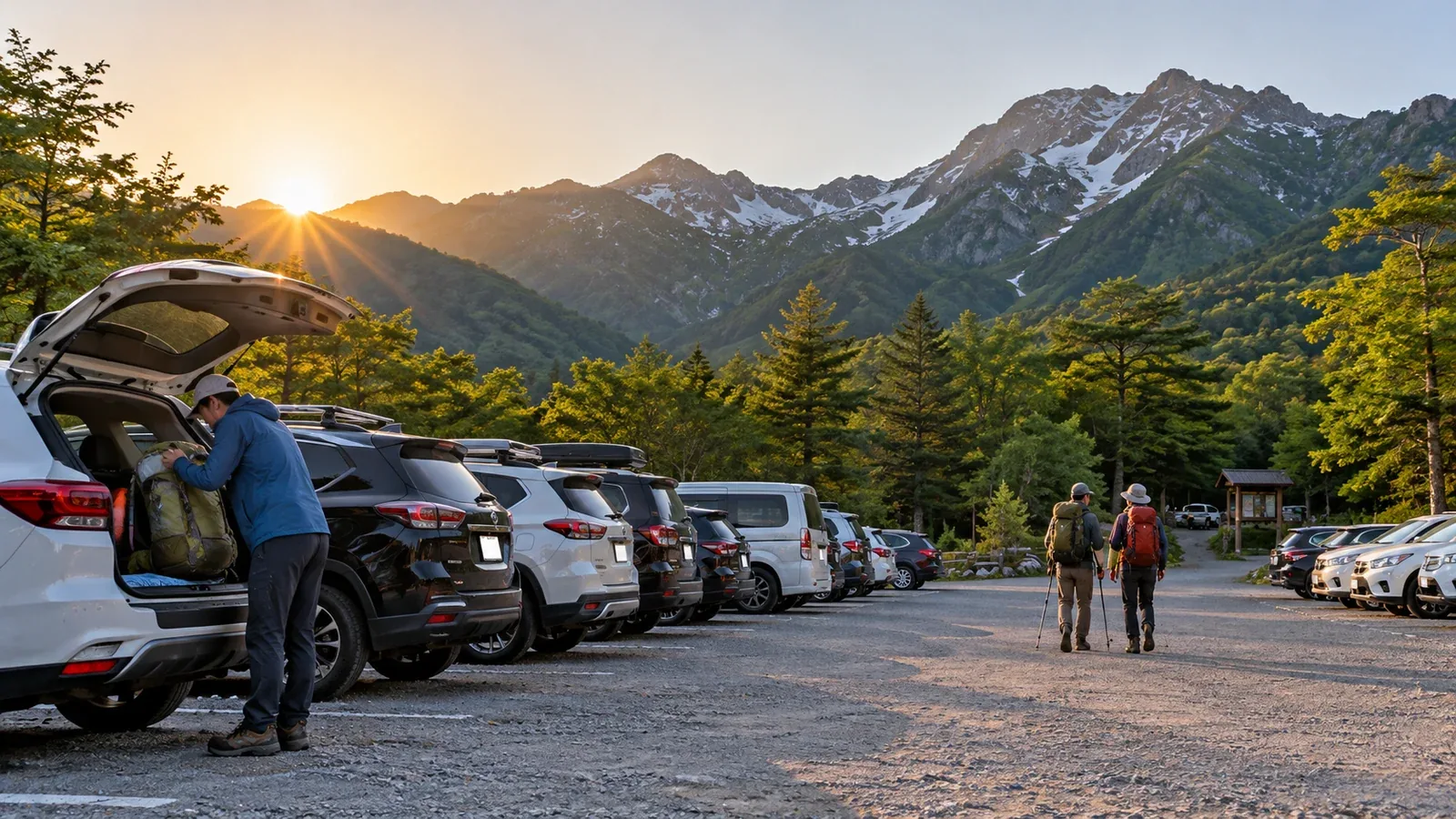
Popular trailhead car parks can fill early on weekends and in peak season. Check the rules and alternate ways to reach the trail, and decide in advance what you will do if you cannot park. Finding a space affects your route and the time you can finish.
This guide explains when and why car parks get busy and what to do before arriving, on arrival and if all spaces are taken. Rules and charges vary by location, so check the latest information from the local authority, hut or trailhead operator.
Why car parks fill early
Many hikers want to start at the same time. For a day hike, counting backward from the time you need to be down often means setting off around dawn. Many hikers therefore drive to the same car park in the same short window.
In mountainous areas, steep terrain and conservation needs can make it difficult to add spaces. On weekends, public holidays and in peak season, many visitors converge on the same car parks.
Take particular care during the summer holidays and autumn foliage season. Sightseers may be arriving alongside hikers.
Places and times to expect crowds
When a car park fills depends on where you go, the season and the day. Official information points to three examples where it pays to plan ahead.
- Sawando (Kamikochi) — The park-and-ride lots may fill early during the summer holidays and autumn foliage season.
- Okura (Omote Tanzawa) — The City of Hadano warns that spaces may be unavailable during holiday weekends, the summer break, foliage season and weekends.
- Hirayu Akandana (Kamikochi) — This car park serves the shuttle bus. Check opening hours and shuttle times together.
Even at the same trailhead, availability depends on capacity, the hours access roads are open and how vehicles come and go. Check official congestion notices or live cameras if available. Plan for the possibility that there will be no spaces when you arrive.
Spaces sometimes open up as hikers return from midday onward. You cannot count on when that will happen. Have a backup even if you plan to arrive in the afternoon.
Three checks before leaving
Start planning for a full car park before setting off.
1. Confirm capacity and rules with the operator. Look up the number of spaces, fees, opening times, reservation rules and whether sleeping in a vehicle is allowed. If reservations are required, make yours before leaving.
2. Check traffic restrictions. On some roads closed to private vehicles, you will need to change to a shuttle or permitted taxi at a designated car park. Check dates, restricted sections and transfer points with the local authority, and fares, reservations and times with the operator.
3. Find alternate parking and transport. Some areas have overflow lots farther from the trailhead. Find out in advance how to get from there on foot or by shuttle. Check where the lot is, when it operates and when the shuttle runs.
What to do if the car park is full
There are four main options when you arrive and all the spaces are taken.
Wait in the designated area. Follow attendants' directions and use the designated waiting area if there is one. Keep the road shoulder and entrances clear. Spaces may open up when hikers return, but you cannot predict the wait. Switch plans if waiting would leave too little time to finish safely.
Use your backup lot. Go to the alternative car park if there is room. Add driving, walking and shuttle time to your schedule. Reassess when you will finish and which route you can do with the later start.
Switch to public transport. If the trailhead can be reached by train or bus, consider parking in a paid lot near a station or bus stop and continuing from there. Check the route and timetable in advance to make this option practical.
Cancel or change the hike. A late start can erase the time cushion on a day hike. Pressing on after losing time to parking can contribute to an incident. If there is no workable backup and you would start much later, consider moving the hike to another day.
Build parking into the departure plan
Decide in advance how you will respond if you cannot park. Under pressure at the trailhead, it is easier to make a rushed decision.
Work through the following in order so the decision is easier when you arrive.
- Check how many spaces there are, whether you need to reserve and whether private vehicles are restricted.
- Use opening times, road access hours, connections and your intended hiking start to set a departure time.
- Check routes and times for backup lots, shuttles and public transport.
- Plan a shorter route that leaves enough time to finish if you start walking late.
- Decide the latest time you are willing to keep trying to park.
The final point matters in particular. The feeling that you have come all this way can cloud your judgment. Decide the cutoff before the trip so it is easier to follow on the day.
Next steps
Check official car park information for the mountain you are planning to visit and book any required space. If private vehicles are restricted, check how to transfer and how to get back. Add backup parking and your cutoff to the hike plan and share it with the group.