
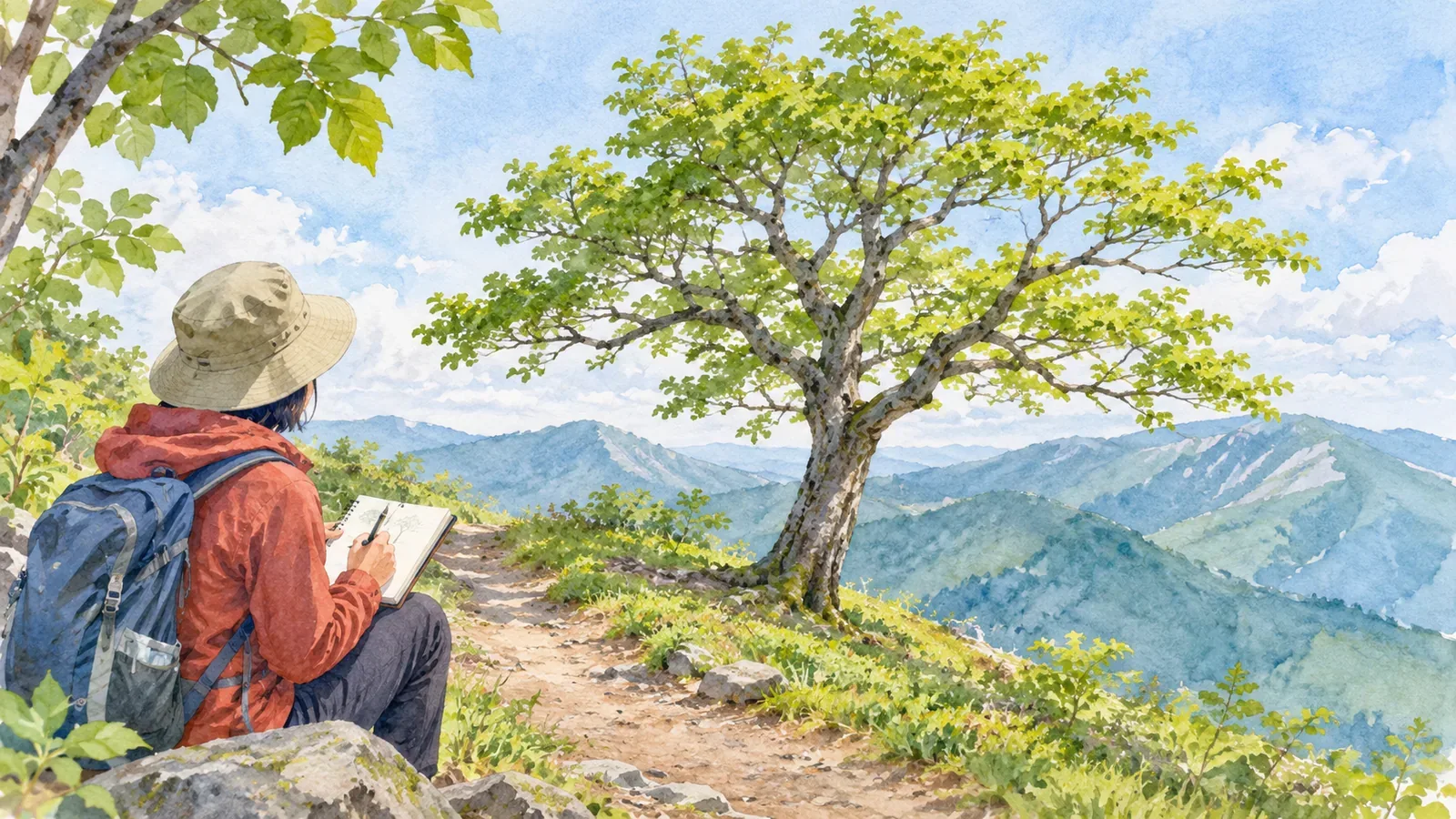
Start with one tree you can see easily from a safe spot on the trail. Each time you go, write down what it looks like using the same fields. The Japan Meteorological Agency’s approach to monitoring selected trees and a volunteer monitoring project offer ideas for a hiking journal. Include the weather and time of day, and compare entries before drawing conclusions about the season or climate.
Why follow the same tree?
The Japan Meteorological Agency uses common criteria at its stations to track when Japanese apricots and cherries bloom and when maples and ginkgos change color. Observations follow selected trees. The records help track shifts in seasonal timing and differences or changes in climate.
The Phenology Observation Manual on the Climate Change Adaptation Platform (version 3, November 13, 2023) also calls for repeated observations of selected trees to account for differences between individual plants and their growing conditions. If you look at a different tree each time, it’s harder to see whether changes reflect the season, the tree itself or its surroundings. Pick one tree for your journal.
Take the idea of a fixed subject into your hiking journal. Set the interval and the details you record to suit the hikes you can make.
How to choose a tree visible from the trail
Start with where you can stand. Look for a tree you can see from a safe spot on the trail where others have room to pass. You should be able to see it from much the same direction each time without leaving the trail or entering vegetation. Choose a spot near a landmark such as a rock, a sign or a bend, so you can find it again.
Nagano Prefecture’s visitor guidance, marked updated May 25, 2026, asks hikers to stay on trails and keep out of vegetated and roped-off areas. It notes that leaving a path to take a photo can damage the trail and expose you to a fall. On narrow paths, wait in a safe spot on the uphill side, away from the exposed edge. For hikes elsewhere, check the instructions from the local manager.
The Ministry of the Environment asks visitors to Fuji-Hakone-Izu National Park to leave flowers and plants where they are. In special zones of national and quasi-national parks, collection or damage to alpine and other plants designated by the environment minister is regulated. Check the list for the park you’ll visit. Observe and take notes without touching the tree or pulling branches closer. If you can only make out the tree by approaching it, pick another one. Skip the entry if there’s nowhere safe to stop.
A page for each season: What stays fixed and what changes
Set up fields you fill in once and fields you use on each visit. Put the landmark and viewing direction at the start, so you can compare from the same spot next time.
In the first fields, give the tree a label and note the landmark, viewing direction and year you picked it. Leave the species blank if you don’t know it. The manual describes asking a local museum through the project office to identify hard-to-recognize varieties. For your own observation, check whether the institution accepts inquiries. The manual also records a replacement and the year a new tree was selected. If you change trees, add the reason and date to your journal so later entries are clear.
On each visit, note the date, time, weather, what you saw, what’s changed since last time and the photo number if you took one. Use plain descriptions: buds, flowers, how many leaves you could see, their color, fruit or bare branches. Different trees change in different ways. Leave fields blank when they don’t apply.
If the leaf color is hard to categorize, record what you saw and mark the judgment as uncertain. When maple color is hard to classify, the manual suggests submitting observations for several days and comparing with photos from other regions. If you can’t return on consecutive days, keep the uncertainty and the color you actually saw in your notes.
The manual uses a specific count for a monitored Somei-yoshino cherry: five or six blossoms open, excluding those growing directly from the trunk or roots. Other trees have their own criteria. If you count flowers, note the portion of the tree you could see. If blossoms are open on your visit, describe that state and leave the first date of flowering open.
Take notes after stopping on stable ground and leaving room for other hikers. Stop before writing, taking photos or using a screen. If there’s nowhere suitable, make the entry later and mark anything you recall as “recalled after the hike.”
How often to return and what a single visit tells you
Japan’s National Institute for Environmental Studies started a long-term citizen phenology program in fiscal year 2021 in cooperation with the Japan Meteorological Agency and Ministry of the Environment. It recommends a site you can visit three or four times a week. Daily visits are ideal and once a week is the minimum. Volunteers can stick to categories they know or follow just one favorite species.
Seasonal hikes may be months apart. One visit can tell you flowers were open that day. Finding the first day they opened takes repeated observation. Write what the tree looked like on the day, from your chosen spot. Keep the dates of your visits in mind when comparing.
Four visits in a year give you four entries. Compare them with the same seasons the following year and note any difference in visit dates alongside what you saw. The dates help you describe the change without assuming it came earlier or later.
Keep to an itinerary you can manage. The Ministry of the Environment’s guidance for Mt. Fuji advises against rushed climbs without a hut stay and asks hikers to leave time and energy to spare. If you miss a season, leave the observation blank and record whether weather or how you felt led you to skip it.
In brief: Follow the same tree at a pace that suits your hikes
The meteorological agency and the manual use a fixed subject and comparable conditions. Start by choosing a tree you can see from a safe stop. Record its label, landmark, viewing direction and selection year once. On each visit, add the date, what you saw and changes since last time. Leave the tree undisturbed and stay on the trail. Skip the entry if it’s unsafe to stop. Use single visits to describe the day’s conditions.
Start by finding a safe place to stop on your next hike. Even if you don’t know the species, the landmark and date will help you return to the same spot next year.
References and sources
- National Institute for Environmental Studies: Citizen monitoring of seasonal changes in plants and animals
- Japan Meteorological Agency: Phenological observations
- Climate Change Adaptation Platform: Phenology Observation Manual, version 3
- Nagano Prefecture: Guidance for park visitors and hikers
- Japan Ministry of the Environment: Visitor etiquette in Fuji-Hakone-Izu National Park
- Japan Ministry of the Environment: Designated plants in national and quasi-national parks