
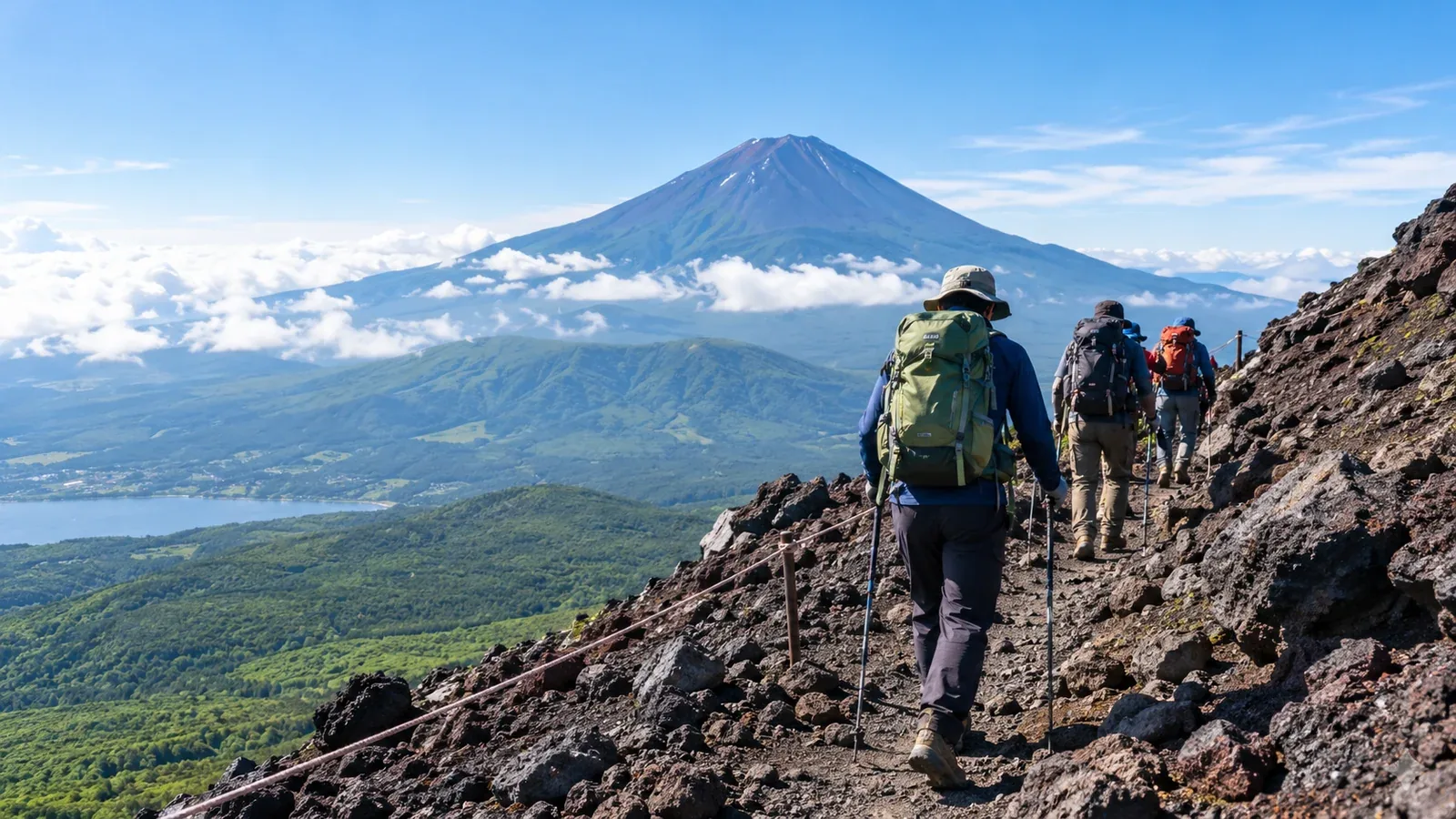
Mount Fuji’s summer trails have entry rules that affect when you can start and what you need to do at the trailhead. Check your route before buying transport tickets or booking a hut.
This guide covers fees, entry hours and reservations. It uses the completed 2026 season as a worked example. The official site lists early July to early September 2027 as provisional and will announce exact dates before the season.
Why Mount Fuji has entry rules
Mount Fuji was inscribed on the UNESCO World Heritage List in 2013. A short summer season concentrates many hikers on exposed trails. Queues, trail wear and overnight ascents without rest are among the issues that local authorities manage.
Yamanashi and Shizuoka administer their own access rules, while the official Mount Fuji climbing site brings their notices together. Check both prefectures if your ascent and descent use trails on opposite sides.
The hiking fee and conservation donations
In 2026 the compulsory hiking fee was ¥4,000 per person on each of the four main trails. On Yoshida, hikers who stayed at a hut also paid the fee. Confirm the current amount, scope and accepted payment methods for your route before departure.
The fee supports trail management and safety measures. Shizuoka also accepts separate voluntary conservation donations. Include the hiking fee, hut stay and transport as separate items in your budget.
Where to check
- Yamanashi Prefecture’s official Yoshida Trail notice
- Shizuoka Prefecture’s notice for Fujinomiya, Gotemba and Subashiri
- Ministry of the Environment and the official Mount Fuji climbing site for conservation and trail status
Entry hours
In 2026 entry toward the summit was restricted from 2 p.m. to 3 a.m. the next day on all four main trails, with an exception for hikers staying at a mountain hut. This measure addresses overnight ascents without a hut stay, which combine fatigue and rapid ascent to high altitude.
On Yoshida the restriction applied at the fifth-station gate. The notice allowed descent during the closure hours and asked descending hikers to tell the attendant. On the Shizuoka side the rules applied at designated entry points. Check the current notice before departure and follow staff directions on the day.
How to plan around entry hours
- If your trip includes a hut stay, book it directly and time your ascent to meet the hut’s check-in requirements.
- If you are planning a day hike, count back from the last transport and allow time for the entire ascent and descent.
- Allow time to get used to the altitude and set a turnaround time. The official climbing site suggests resting at the fifth station before starting, and a rest does not eliminate altitude illness.
Keep the current gate hours, your transport times and any booking confirmations available offline. A hut reservation and a trail entry confirmation cover different steps.
Passage reservations and entry registration
For Yoshida in 2026, an advance passage reservation was optional and required prepayment of the fee. A daily limit of 4,000 applied to hikers other than hut guests. Walk-up access depended on available capacity and the time of arrival. The three Shizuoka trails had no daily quota that season.
Check these three points before booking.
- Which procedure applies. In 2026 Shizuoka required safety instruction, entry registration and payment. The FUJI NAVI app let hikers complete these in advance. The prefecture also documented on-site procedures at the fifth station for hikers without a smartphone.
- When to book. Check the official opening date for your route and the reservation release date. Allow extra time for any on-site steps and keep proof of lodging if using the nighttime exception.
- Changes and cancellations. Read the rules for the specific passage booking, entry ticket and hut. Deadlines and refunds differ, so check each before paying.
Official prefectural notices explain the steps for the current season. Follow the links from those notices and check whether any downloaded form or screenshot is dated.
How the four routes differ
Yamanashi administers the Yoshida Trail. Shizuoka administers Fujinomiya, Gotemba and Subashiri. Choose a route based on its terrain, elevation gain, services and your experience, and then check the applicable rules.
The Yoshida system combined a gate, optional reservations and a daily limit in 2026. The Shizuoka system used its own entry instructions and verification. If you plan to use different trails up and down, check closures, signs and transport for both.
For a hut stay, confirm the hut’s operating dates, availability, price and check-in time directly. Save the booking details before you reach the trailhead.
Before your climb
Open the notice for your route and note the fee, entry hours, registration steps, hut details and last transport. Recheck trail status and the summit forecast just before leaving. A qualified guide can help you choose an appropriate itinerary on a first visit.
Sources
- Yamanashi Prefecture: Yoshida Trail access notice and FAQ
- Shizuoka Prefecture: regulations and on-site procedure
- Official Mount Fuji climbing site: season, rules and equipment
- UNESCO World Heritage Centre: Mount Fuji listing
References and sources
- Yamanashi Prefecture: 2026 Yoshida Trail entry rules
- Yamanashi Prefecture: passage reservations and equipment check
- Shizuoka Prefecture: entry procedures, including on-site processing
- Official climbing site: next season, preparation and access rules
- Official climbing site: trail and facility schedules
- UNESCO World Heritage Centre: Mount Fuji listing