
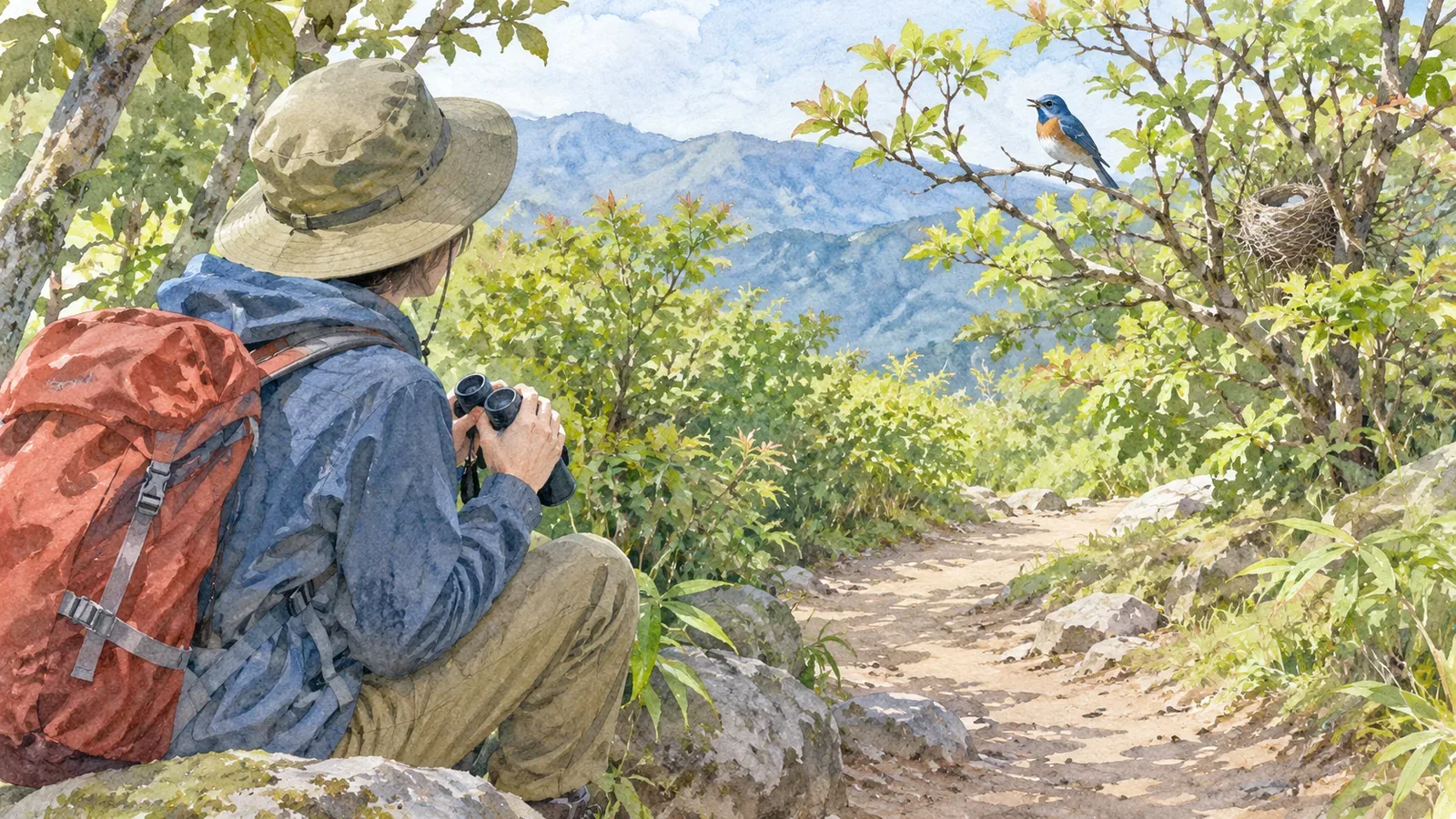
Before taking out your binoculars, ask three questions: can you stop here, where can you point them, and where will you move if the bird reacts? The Wild Bird Society of Japan and Japan’s environment ministry ask you to consider the people using the path and leave birds undisturbed. The order here is our way of putting those principles into practice.
Choose a place that keeps the path clear
The Wild Bird Society of Japan asks visitors to avoid crossing in front of other observers, blocking the path, leaving footpaths and observation trails, and entering private or restricted land. Its photography guide also asks visitors to keep tripods out of pedestrian areas and avoid occupying a spot for long periods. Japan’s environment ministry asks hikers to stay on boardwalks and paths.
Choose somewhere you can stand safely on the trail with room for others to pass. Nagano Prefecture advises hikers on narrow paths to wait somewhere safe on the uphill side and keep away from the drop. If you notice a bird, check your footing and surroundings before raising the binoculars. A suitable spot may be some way ahead. Keep walking if you cannot safely stop, and leave the bird where it is.
If the view is poor, stay on the trail and take what view you can get. Deciding this beforehand saves you from having to weigh up whether to step into the undergrowth.
Move away from nests and signs of alarm
Many birds breed from spring to summer. The Wild Bird Society of Japan explains that adults may abandon the nest or stop rearing their young if they sense danger or changes around it. An adult craning its neck to watch you, raising its feathers or calling may be alarmed. Keep away from nests.
The guidelines also list taking flight, fleeing, changing posture and giving alarm calls as signs of stress from being approached. Withdraw quietly when behaviour changes. If you encounter a nest or young just out of the nest, move on promptly. When adults leave a nest, eggs or chicks can be exposed to predators or cold. Some birds freeze when disturbed, so give them space even if they stay still.
When it is time to move, lower the binoculars and look at your feet and where you are going. Avoid walking while looking through them or backing away with your eyes still on the bird. If you turn back, check that the path is safe. Give the bird space without trying to test its reaction, and keep moving if you see a nest or fledgling. Use quiet words or an agreed signal to tell companions that you are moving on. Speak up if you need to warn them of danger.
Check the background before pointing binoculars
The society asks people to keep binoculars and scopes pointed away from homes, passers-by and people working in fields. Its photography guide also asks people to avoid pointing cameras towards residential areas. Stay out of private property and leave farm work and daily life undisturbed.
Before raising your binoculars, check for houses and people beyond the bird. If they are in view, lower the binoculars and leave that direction alone. If you move a few steps to change the background, stay on the path, keep your distance from the bird and check your footing. Never look at the Sun through birdwatching binoculars. The National Astronomical Observatory of Japan warns that binoculars and telescopes concentrate sunlight and can injure your eyes. If the bird moves towards the Sun, stop following it.
Use your map before leaving to see where the route comes close to settlements and fields. That makes it easier to decide where to keep binoculars down. This is our suggestion for applying the ministry’s broader advice to check the weather, access, trail conditions and volcanic information before hiking.
Leave birds where they are and give thought to the location
It is tempting to try to draw a bird closer. The Wild Bird Society of Japan asks visitors to avoid recordings and bird callers because birds may mistake the sounds for a territorial intrusion, spend extra energy responding or leave the nest. Avoid deliberately flushing a bird for a photograph.
Keep food to yourself too. Japan’s environment ministry asks national park visitors to avoid feeding wildlife and take rubbish home. Keep hold of snacks and wrappers while watching, and check for crumbs or items you may have dropped after a break. Follow local notices on access and observation.
Consider location details when you get home. The society advises keeping photos of active nests or recently fledged birds off social media, giving locations no more precise than the prefecture, and removing GPS data from images. Structures and scenery can also reveal where a photo was taken. News of a rare bird can travel quickly. The society describes an increase in cases where hundreds of people arrived the next day and disrupted the area, and advises against passing exact locations even to acquaintances.
Decide before you start watching whether you will tell anyone where you are. If you take photos, check for recognizable buildings and signs before sharing them. Leave any adjustments to the framing for later if changing position on the trail would be unsafe.
Choose the spot before getting out the binoculars
First, check whether others can still pass on the trail. Next, look for nests or signs of alarm and check that you can leave quietly and safely if the bird reacts. Check whether homes, fields or passers-by are in the line of sight. Finally, leave the bird undisturbed by calls or food and decide what you will do with information about the location.
The sources ask you to keep the trail clear, give nests room, keep optics pointed away from homes and people, let birds come and go on their own, and keep exact locations private. The sequence is our suggestion. Conditions can change while you watch. Give the bird’s behaviour and the people around you priority over the checklist.
References and sources
- Wild Bird Society of Japan: bird photography etiquette
- Wild Bird Society of Japan: etiquette guidelines for new birdwatchers and bird photographers
- Japan Ministry of the Environment: national park etiquette
- Nagano Prefecture: guidance for hikers and nature park visitors
- National Astronomical Observatory of Japan: how to observe a solar eclipse safely