
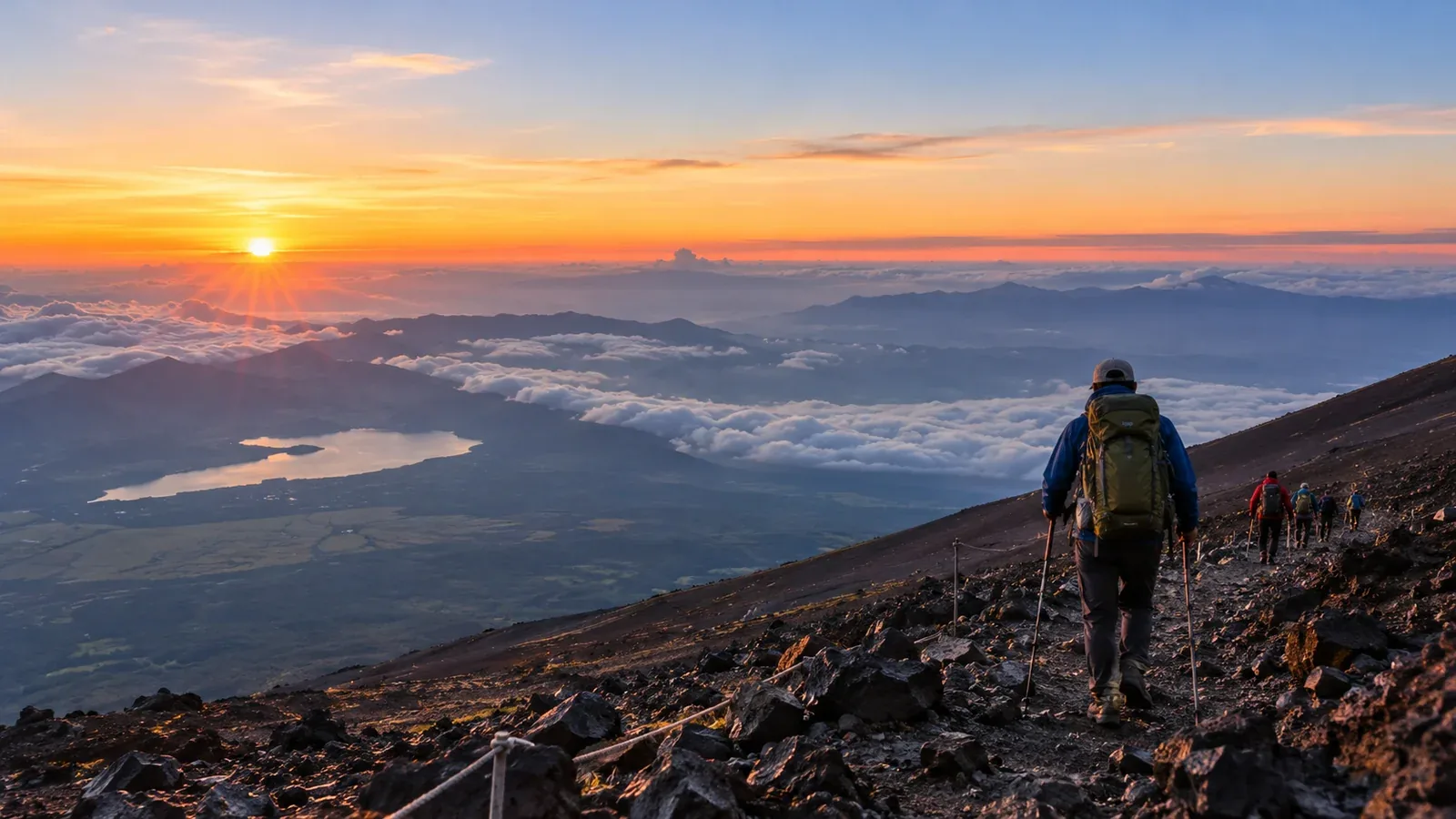
Mount Fuji’s summer climbing season is only about two months long. On busy days, lines can form on the trails below the summit, outside mountain huts and at popular viewpoints.
Two choices have a big effect on how crowded the climb feels: when you go and which route you take. Check the opening dates and access rules for your chosen trail every year.
How crowds build up
The week you choose affects the likely number of people on the mountain. The time you reach each section affects whether you will be walking alongside them.
The official climbing site flags weekends, public holidays and Obon, the mid-August holiday period, as especially busy. Use its crowd calendar for the season you are planning. Early and late dates can be quieter, but check snow, weather, trail closures and hut hours.
Huts can fill up on weekends and holidays. Once you find a weekday with favorable conditions and suitable transport, check availability directly with the hut.
Pick a quieter weekday
A weekday outside a holiday period is a practical first choice. Consider several dates so that you can move the climb if the summit forecast deteriorates.
A weekday can still be busy.
- Long weekends and holiday periods can bring crowds on adjacent weekdays.
- During the summer break, check the crowd calendar for the dates around Obon.
- A weekday late in the season may be quieter if your trail and services are still open. Check temperatures and the official closing date before committing.
A quieter date can give you more room on the trail and more flexibility when booking a hut. Leave time for delays regardless of the date.
Plan your hours around the sunrise rush
Queues near the summit follow a pattern because many hikers aim to arrive around the same time.
The upper trails are often busiest from about 3 to 5 a.m. above the eighth stations, according to the official climbing site. Hut guests and other hikers can reach the same narrow sections together. An overnight ascent without a hut stay, known as bullet climbing, adds fatigue and can be restricted by local entry rules.
If sunrise is important to you, consider watching it from your hut or another suitable open viewpoint and climbing in daylight. Viewpoints vary by trail, season and visibility. Book a hut whose location and check-in hours suit your group’s pace.
Allow time for the descent as well. On Fujinomiya, uphill and downhill hikers share a narrow path. Follow the signs and give uphill hikers priority when you can step aside safely. Check the afternoon weather and last transport from your descent trailhead.
Compare the four trails
The Ministry of the Environment recorded 240,436 passages near the eighth stations in 2026. These are trail counter readings, with gaps on Subashiri and Gotemba. Use the figures to understand relative traffic, alongside the terrain and services on each route.
- Yoshida (Yamanashi): 2,305 m at the trailhead. 134,777 recorded passages. Many huts and the heaviest traffic in the report.
- Fujinomiya (Shizuoka): 2,400 m. 60,866 passages. The shortest route by distance, with a steep path shared by ascending and descending hikers.
- Subashiri (Shizuoka): 2,000 m. 27,129 passages. A forested lower section and a busier shared trail higher up.
- Gotemba (Shizuoka): 1,440 m. 17,664 passages. The longest itinerary, with fewer huts and the fewest recorded passages.
Subashiri and Gotemba had lower counts in 2026. Gotemba starts much lower, and its long stretches between services call for more time, stamina and supplies.
Subashiri joins Yoshida at the Original Eighth Station, also called Hon-Hachigōme. Expect more people above that junction. On descent the routes separate at Shita-Edoya. Follow red signs for Subashiri and yellow for Yoshida.
Choose for the group’s ability and the trail conditions first. Subashiri on a weekday can suit a group comfortable with its distance, elevation and loose descent. Compare the huts, access and options for turning back before deciding.
Check prefectural entry rules for the year of your climb. In 2026 Yoshida had a daily limit of 4,000 with exceptions for hut guests, plus overnight entry restrictions. Shizuoka’s three trails had their own access procedure and overnight rules. Confirm your route’s current requirements before booking.
A checklist for planning a less crowded climb
Work through these choices in order.
- Pick an open window. Use the official season dates and crowd calendar, leaving alternative dates.
- Compare weekdays. Favor a weekday outside Obon and other holidays if the forecast is suitable.
- Plan sunrise and the descent. Choose a hut or open viewpoint if it fits, and leave time for daylight, weather and transport.
- Choose a suitable trail. Compare elevation gain, walking time, footing and services as well as traffic.
- Check again just before leaving. Look at summit forecasts, alerts, opening notices and entry rules for your ascent and descent.
These choices can spread out your time on the busiest sections. On the trail, leave room between hikers and let faster parties pass where there is a safe, wide spot.
Before you go
Check the current crowd calendar, pick a suitable route and look at hut availability before booking transport. Share your expected ascent, descent and return time with someone you trust, and plan for altitude, cold and rain.
Sources
- Official Mount Fuji climbing site: crowd calendar and sunrise advice
- Ministry of the Environment: 2026 trail counter report
- Official Mount Fuji climbing site: four-route comparison and opening schedule
- Yamanashi and Shizuoka: prefectural entry requirements