
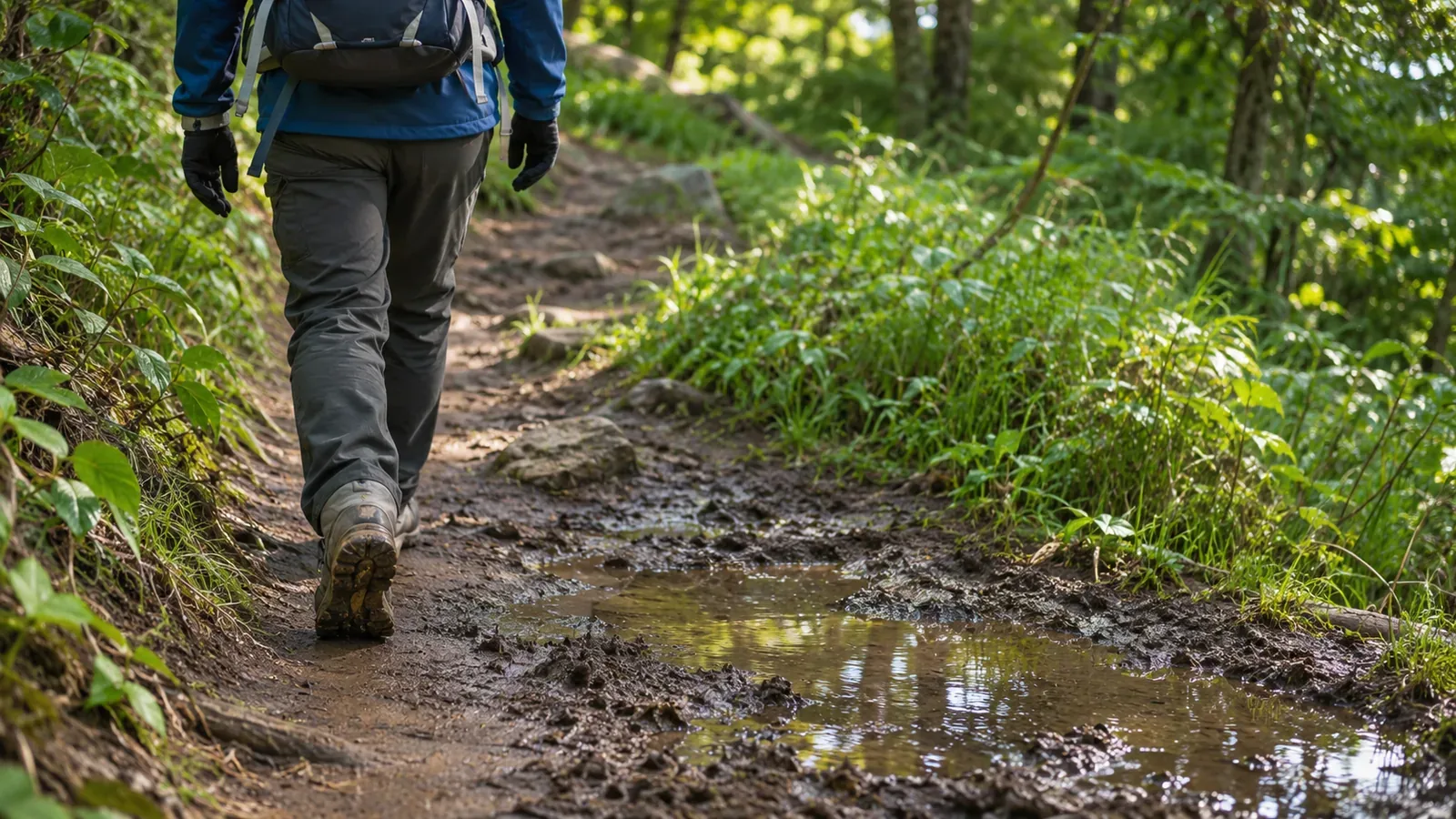
Walk through mud within the trail when you can do so safely. If you can’t get through safely, turn back without stepping onto the grass, or plan the hike for another day. Guidance from Japan’s Ministry of the Environment and the U.S. National Park Service explains why detours widen trails and what you can do before you leave. Check local guidance before heading out.
How Detours Around Mud Widen a Trail
Chapter 3 of the March 2005 Daisetsuzan National Park guidelines is a technical reference for trail managers and crews. It describes repeated freezing and thawing and how foot traffic churns rain- or snowmelt-soaked ground, spreading the mud. If a path becomes a slippery channel or erodes into a deep rut, hikers start walking along the raised edge, wearing down plants and spreading bare ground and erosion. Passing and overtaking can also widen the trail or create parallel tracks.
Japan’s Ministry of the Environment describes how passing other hikers can widen or split trails in Chichibu-Tama-Kai National Park. Managers work to protect the vegetation by making the intended path clearer.
When enough people skirt muddy patches, the edges get trampled and the mud and erosion can spread. Examples from Daisetsuzan and Chichibu-Tama-Kai show how repeated steps onto dry ground can change the width of the trail and the vegetation around it.
What Happens When You Step Onto the Grass?
The U.S. National Park Service explains that even when muddy, the trail itself is the surface most resistant to foot traffic. When people repeatedly step on grass, flowers, moss or ferns at the edge, a new track forms. Staying on the trail helps protect surrounding plants and limits soil compaction. The agency uses a subalpine meadow in Washington State as an example.
Japan’s national park etiquette asks visitors to stay on trails and boardwalks to avoid trampling plants and washing away soil. The Daisetsuzan National Park Liaison Council asks hikers to stay on the trail or on the designated route when snow remains.
Decide Before Leaving When to Go Through, Wait or Turn Back
The U.S. National Park Service recommends walking through puddles. It suggests suitable footwear if you want to keep your feet dry, or waiting a few days for the trail to dry. When a muddy trail is getting churned up badly, waiting can have the least impact. Here are two decisions to make before leaving.
First, choose footwear and a date. Japan’s Ministry of the Environment recommends checking weather, access, trail conditions and volcano information before setting out. Trails can get muddy after rain or during snowmelt. Check the manager’s trail updates, then decide whether to go with suitable footwear or postpone.
Second, agree with your group on when to turn around. The depth of the mud and how slippery it is can be hard to judge by sight. If continuing feels unsafe, turn back. Look at the route map before leaving and talk about where you could turn around and who will speak up. Stop on firm footing without blocking the path before checking a map, taking notes or photographing. If there’s nowhere to stop safely, do it later.
Leave Repairs to the Trail Crew
A muddy patch may tempt you to build a foothold with stones or branches. The Daisetsuzan guidelines recommend installing stepping stones or boards early to prevent a muddy trail from widening, as part of the trail crew’s work. They also warn against directing water in a way that worsens erosion or doing more work than necessary. Extensive stonework can harden the path, so they recommend limiting it to steps and severely eroded spots. If you find a muddy patch, leave the stones and branches where they are and let those responsible for the trail handle it.
A Ministry of the Environment ranger’s account describes how the Kinpusan Hut keeper has maintained the approach trail for many years. When building a step, for instance, the keeper adjusts how the timber fits and how high it sits so soil won’t wash out around it and hikers won’t need to step around it. Trail maintenance takes account of the terrain and how water flows.
If you see severe mud or a widening trail, find a safe place to stop and note what identifies the spot. After the hike, report it according to the local hut or trail manager’s guidance. The Daisetsuzan guidelines show how crews record the location, photos and problems before and after repairs. Reporting channels vary, so check the latest instructions for the area.
Plan to Stay on the Trail and Know When to Turn Back
Walking around mud may seem like a way to keep your footing, but it can gradually widen the trail. Choose suitable footwear and timing, and agree with your group on when to wait or turn back so you have a plan when the trail is too muddy to cross. Report spots that need attention through the trail manager or hut. Check current local information before leaving.
References and sources
- Japan’s Ministry of the Environment: Etiquette in National Parks
- U.S. National Park Service: Leave No Trace Principle 2 — Travel and Camp on Durable Surfaces
- Japan’s Ministry of the Environment: Conservation Work in Chichibu-Tama-Kai National Park
- Japan’s Ministry of the Environment: Daisetsuzan National Park Trail Maintenance Guidelines, Chapter 3 (March 2005)
- Japan’s Ministry of the Environment: How Trail Repairs Are Done, a Kinpusan Hut Case Study
- Daisetsuzan National Park Liaison Council: Conservation Rules