
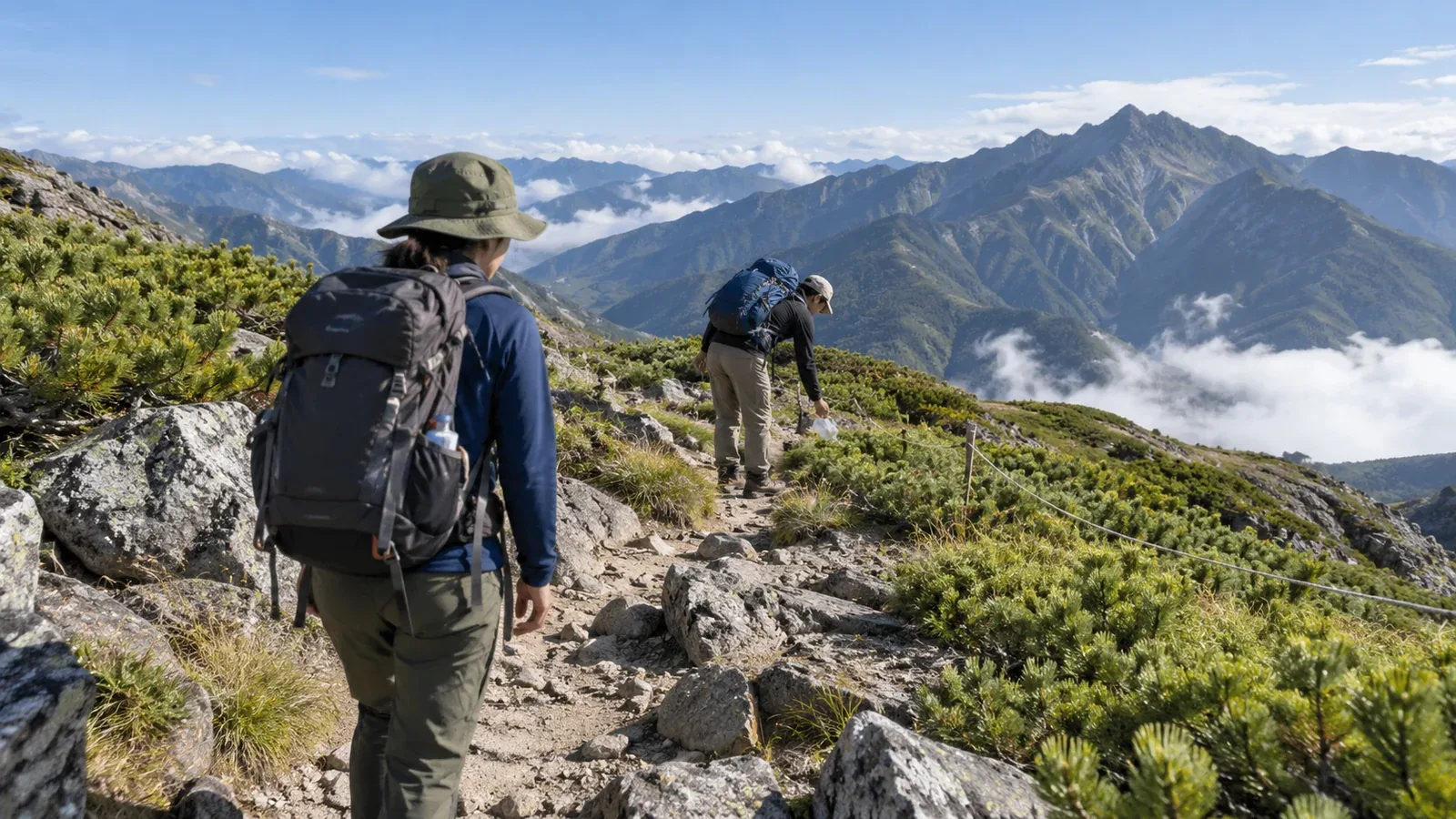
There’s litter on the trail. Someone steps beyond a rope barrier. Voices stay loud at a mountain hut. When something concerns you, check whether it’s safe to stop and what the situation calls for.
You can point out the posted guidance, ask staff for help or report what you saw after moving somewhere safe. If someone is injured or in immediate danger, prioritise rescue and emergency contact.
Check that you and others are safe
Look at whether you have stable footing, whether others can pass and whether you can keep a safe distance. Near a drop or on a narrow rocky section, prioritise moving safely.
If someone is intimidating or there is no safe place to speak, keep your distance. If you have companions, move away together and contact staff or the manager from somewhere safe.
If emergency help is needed, such as when someone cannot move after an injury or violence is taking place, call the police emergency number 110 in Japan. Give the location, what is happening and whether anyone is injured, as far as you know. Follow the dispatcher’s instructions.
Choose what fits the situation
Think about whether you can speak safely, whether there is a sign you can check and whether you can reach staff.
Point out the posted guidance. In a place where you can speak safely, point to a specific sign and keep it brief. “There’s a sign about protecting plants here. It asks us to stay within the trail.”
Tell the manager. Note the place, time and what happened. Share it with hut staff, the park office or a visitor centre. To ask for help, use the contact provided by the facility. Keep any photos for staff if they ask for them.
Let someone know they dropped something. If they appear unaware of a dropped wrapper, say “This fell near your feet.” If you pick it up, stay away from drops and out of protected vegetation.
Put some distance between you and leave. If the other person has gone, daylight is running out or you’re short on energy, prioritise getting down safely. Report it later if needed.
Keep it brief and specific if you speak up
Say what you can see and what you are asking for in a few words.
Describe what you can see. Give the location or situation. “The sign says this section is closed.” “Someone is resting nearby. Could you lower your voice a little?”
Step away after saying it once. If the person does not listen, leave before it turns into an argument. Pass the matter on to staff if needed.
Speak to one person in a group. Tell someone nearby who you can approach safely while keeping the path clear. If the situation is escalating, end the conversation and leave.
Check local guidance and report what you saw
Parks and huts have their own visitor guidance. If you are unsure which stretch is closed, when the closure applies or where people can go, read the posted or official information.
When reporting later, describe what you saw and the place and time. You can add relevant details, such as a damaged closure sign.
A point on the map or the name of a nearby junction can identify the location. Stay away from dangerous ground and avoid following anyone to document what happened.
What to check before you go
Check your destination’s trail restrictions, facility rules and contact details. If you’re unsure what to do on the trail, move somewhere safe and decide whether the situation needs urgent help or can be reported later.