
Name and Official Record
The name Yoho comes from the Cree language as an exclamation of surprise, according to British Columbia Geographical Names records. The place name appeared under Yoho Peak in early gazetteers from 1910 and received official adoption on March 31, 1924.
Early Glacier Monitoring
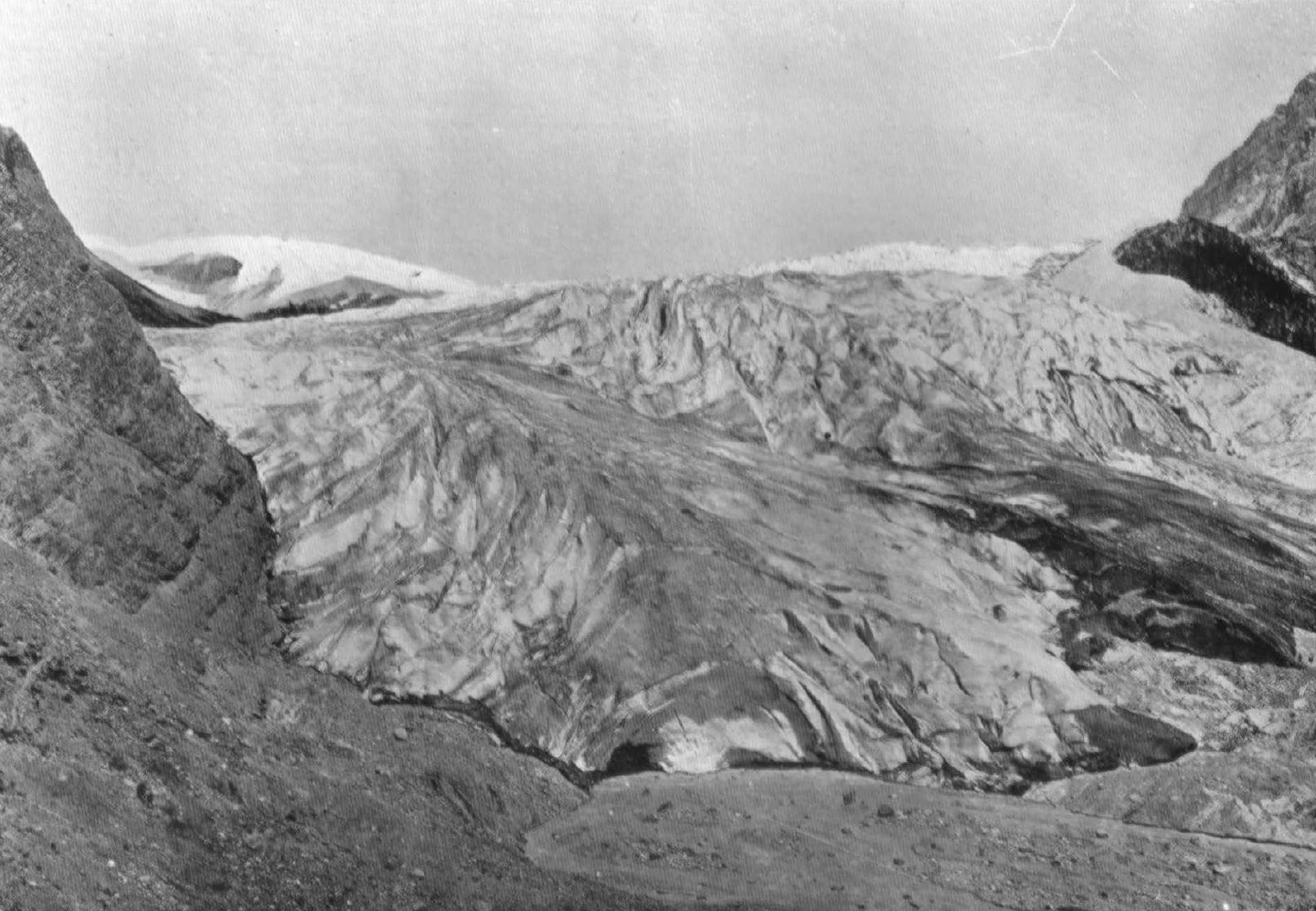
In July 1906, the Alpine Club of Canada selected the Yoho Glacier as the site for its first annual glaciological study, with surveyor Arthur Oliver Wheeler leading observations. Wheeler's 1907 report identified glacier plucking on the exposed rock flanks of Yoho Peak, where ice movement had quarried blocks from the bedrock, and described an icefall broken into seracs. His crew set metal markers on the glacier surface to track ice motion and took photographs from fixed points on the surrounding rock to document terminus changes. The 1909 report compared images from those same camera positions in 1906 and 1908, recording retreat and thinning near the glacier's toe. In 1933, Roger Neave added a painted reference mark with a measured distance to the ice margin, continuing the systematic effort to document the glacier's changing extent against fixed reference points.
The Louise and Richard Guy Hut
The Alpine Club of Canada completed the Louise and Richard Guy Hut in 2016 on a saddle north of Yoho Peak. The hut links Bow Hut to the east with Stanley Mitchell Hut to the west, serving as a waypoint on the winter Bow-Yoho Traverse across the high passes of the Wapta Icefield.