
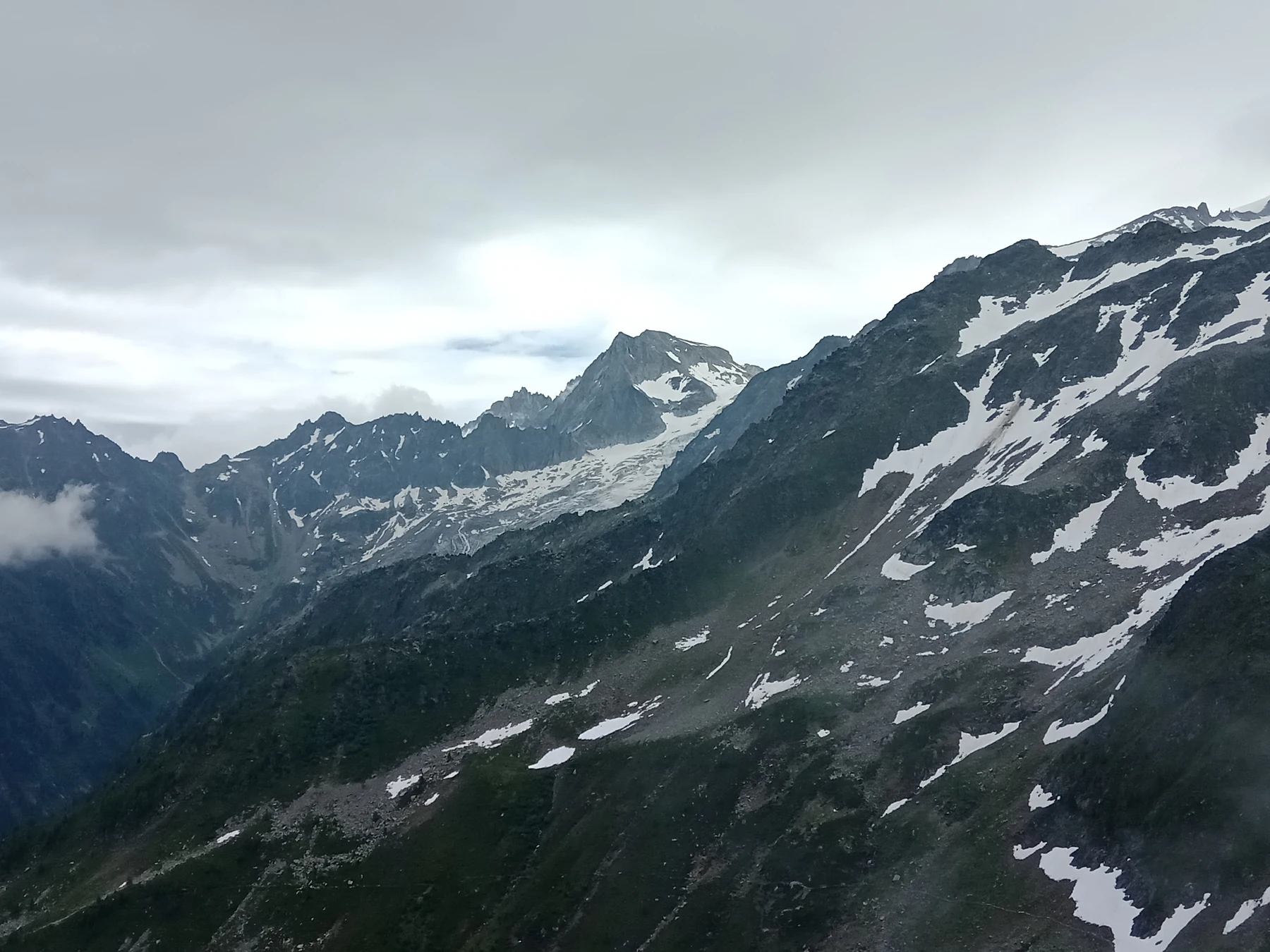
On the rim of the Trient Plateau
Swisstopo gives 3,272 m for the Pointe d'Orny. The Swiss Alpine Club archives give 3,271 m. The Petite Pointe d'Orny, at 3,186 m, stands further to the north-west. The Col d'Orny, at 3,070 m on the federal map, is a pass to the south of the Pointe.
The Orny Glacier extends to the south, while the north-east face overlooks the Arpette valley. In 1909, Eduard Spelterini photographed this face and the Arpette Glacier at its foot from a balloon. The Swiss National Library holds this photograph.
First documented ascent
On 30 March 1872, Émile Javelle and Paul Rouget reached the summit. This was Javelle's third attempt to gain the Trient Plateau by the glacier, following those of 28 December 1871 and the following February. At the foot of the glacier, the two men took the path used by the workers who quarried ice from the Trient. In his Souvenirs d'un alpiniste, Javelle describes the climb up a snow slope and the three hours spent on the summit.
On a proposal by Javelle, the Swiss Alpine Club built the first Orny hut in 1876. A second hut was built in 1893. The third was built in 1975 and officially inaugurated in 1977. The Trient Hut is another refuge, situated higher up, below the summit.
The snow-gauge scale of 1902
On 22 September 1902, Paul-Louis Mercanton and his colleagues painted a snow-gauge scale on the rock at the foot of the southern buttress, marked at 3,119 m on the Barbey map of the time. François-Alphonse Forel wished to obtain comparable measurements from one season to the next. The red marks are spaced 50 cm apart. The Swiss Alpine Club invited guides and visitors to note the number of the first mark visible above the snow or ice, with the date, in the hut book.
In 1904, following a retreat of the snow, the hut warden Maurice Joris extended the scale downwards. The mark on the rock makes it possible to compare the snow depth at the same point from year to year. In 1911, members of the Swiss Alpine Club installed stakes on the Orny Glacier to monitor snow accumulation and mass loss through ablation.