
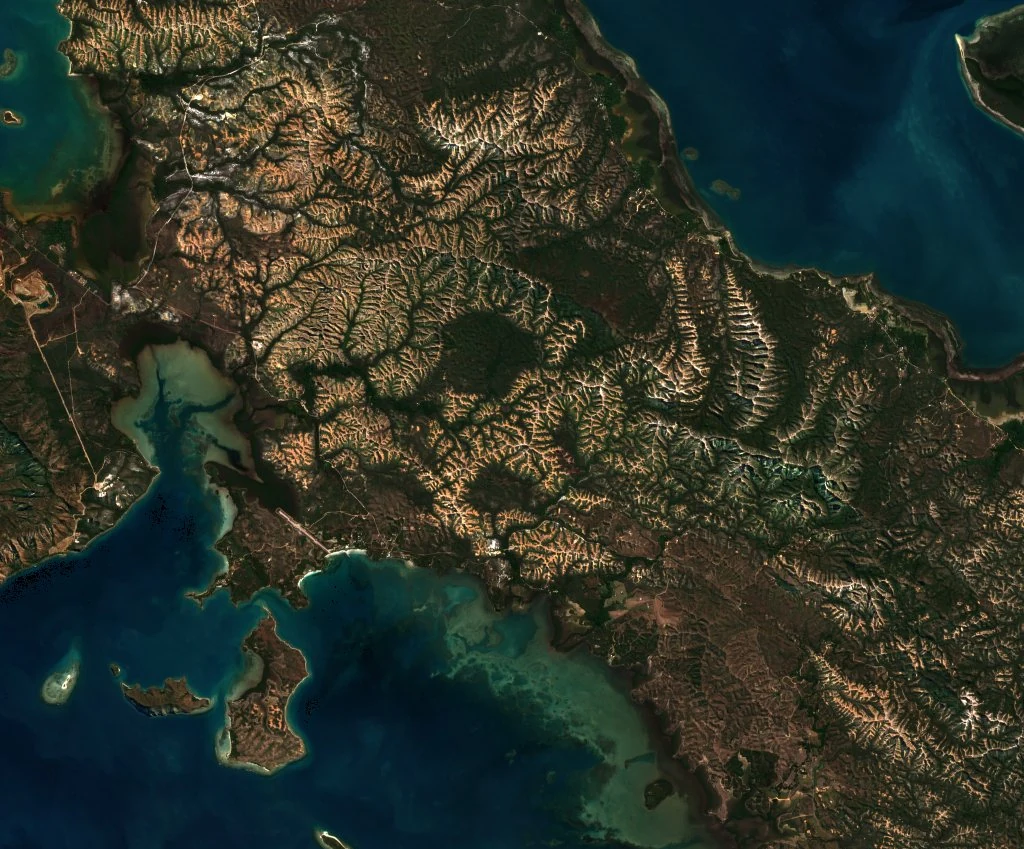
A Road Through the Golone Valley
In May 1972 the Official Gazette listed a 9.5 km rural road from the Malhec lot to the road near Pangaï, through the Golone valley and the Monts Nindo. In 1978 that road was among the routes transferred from Koumac to the newly administered commune of Poum.
The Herbarium and the Holotype
On 22 June 1972, botanist H. S. MacKee collected specimen 25588 at Mont Ninndo at a reported altitude of 300 m. His notes describe a shrub roughly 1.5 m tall, multi-stemmed, bearing bright yellow flowers visited by bees. That collection became the holotype — the single original reference specimen against which the scientific name is permanently anchored — held today as P00062794 at the Muséum national d'Histoire naturelle in Paris. In 1985, J. W. Dawson published the species name Tristaniopsis ninndoensis in the journal Adansonia, naming it for the collection site.
Roots, Fungi, and Soil Geology
Roots also provided clues about the mountain’s ecology. In 2017 Waseem and colleagues compared fungi living with Tristaniopsis roots in a series of New Caledonian sites. At Mont Ninndo they worked with T. ninndoensis on soils derived from volcanic and sedimentary material. Comparing the root tips across sites showed how the researchers could test whether the makeup of these fungal communities varied with the soil.
Another study compared the genetics of T. calobuxus, a different species. The 2014 report identifies Mont Nindo and the Col d’Arama as two separate sampling sites on volcanic and sedimentary soils.