
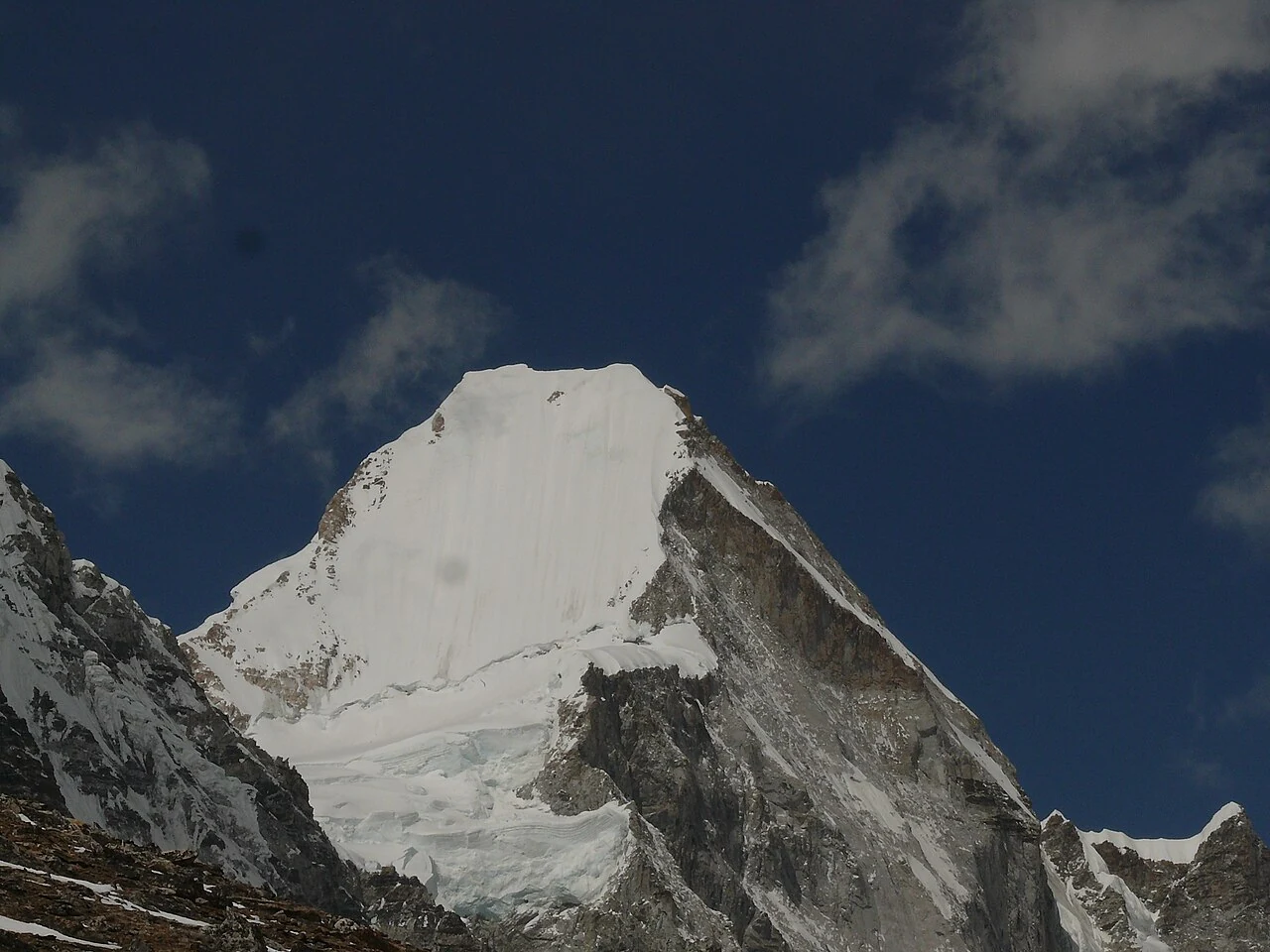
Position and Topography
Lingtren's main summit occupies the border ridge above the Khumbu Glacier and is distinct from a named western outlier recorded as Lingtrennup. Its position between Pumori to the west-southwest and Khumbutse to the east places it within the cluster of high border peaks framing the approach corridor toward Lho La and the upper Khumbu. The spread among published figures — Carter's 6714 metres, the Nepal Department of Tourism and Himalayan Database value of 6713 metres, and the alternate historical mapping figure of 6749 metres — reflects the range of independent survey efforts applied to this section of the border range.
First Ascent
Eric Shipton and Leslie Vickery Bryant, known as Dan Bryant, reached the summit of Lingtren in August 1935 during the British reconnaissance expedition to Everest. The Himalayan Database expedition record notes the ascent in that month. The expedition's goals, as described by Shipton in his reconnaissance report published in the Alpine Journal and in a retrospective account by Charles Warren published in the Alpine Journal in 1995 drawing on his contemporary diary extracts, included investigating monsoon snow conditions, conducting terrain surveys under Michael Spender, and testing potential climbers for the 1936 Everest attempt. Lingtren's ascent took place within that broader reconnaissance program.
Documentary Record
Shipton's reconnaissance report and Warren's 1995 Alpine Journal account, the latter incorporating diary extracts written at the time, together provide contemporaneous and retrospective detail on conditions and objectives across the Khumbu approaches in 1935. Carter's later coordinate work and Nepal's Department of Tourism summit registry supply the principal elevation and position data for Lingtren in standard Himalayan reference literature. These sources, alongside the Himalayan Database expedition archive, constitute the documented record for the peak's location and climbing history.