
Names and Early Survey Records
In 1899 M. A. Stein described a peak named Kajnāg and its attendant ridge northwest of Baramulla, extending toward the upper Kishanganga. The Imperial Gazetteer of India records Kajnag at 12,125 ft (approximately 3,696 m) and notes the presence of markhor. The Survey of India compilation by Burrard and Heron includes a triangulation station named Kāzi Nāg at 12,111 ft (approximately 3,691 m), a distinct historical value that does not establish a different surveying technique or an exact summit position. E. Molyneux contributed an early-spring view of the range from Sopur to Francis Younghusband's 1909 Kashmir volume, reflecting the ridge's prominence as a valley-floor landscape feature.
The Getty Thesaurus of Geographic Names, drawing on the NGA geographical gazetteer, lists the form Kāzi Nāg Dhār. The map in this guide uses the nearby Kazi Nag Top reference point shown at a national park boundary in the 2022 Gazette of India, situated about 5 km southwest of the NGA range point, and not a surveyed summit position.
Protected Status and Conservation History
The Kazinag National Park was formally notified on 18 December 2007 and covers 89 square kilometres. India's 2022 official gazette details the park's establishment and describes its setting alongside the Limber and Lachipora wildlife sanctuaries as a linked conservation landscape. Pir Panjal markhor and Kashmir musk deer are documented across this combined area in the gazette's habitat description.
Community members in the Kazinag landscape monitor markhor populations and report threats, activity documented by the Wildlife Trust of India. In September 2023 the Wildlife Trust of India organised a training workshop for local nature guides in the park.
Vegetation Zones and Botanical Diversity
A University of Kashmir field survey recorded blue pine, deodar cedar, and fir at lower and mid elevations, birch in subalpine forest, and juniper scrub alongside open meadows at the highest elevations. Ahmad and colleagues reported in 2024 a total of 186 plant taxa within Kazinag National Park, comprising 182 species, two subspecies, and two varieties. Of these, 147 taxa are herbs, representing approximately 79 percent of the total recorded flora.
Bird Life and Ridge Landscape
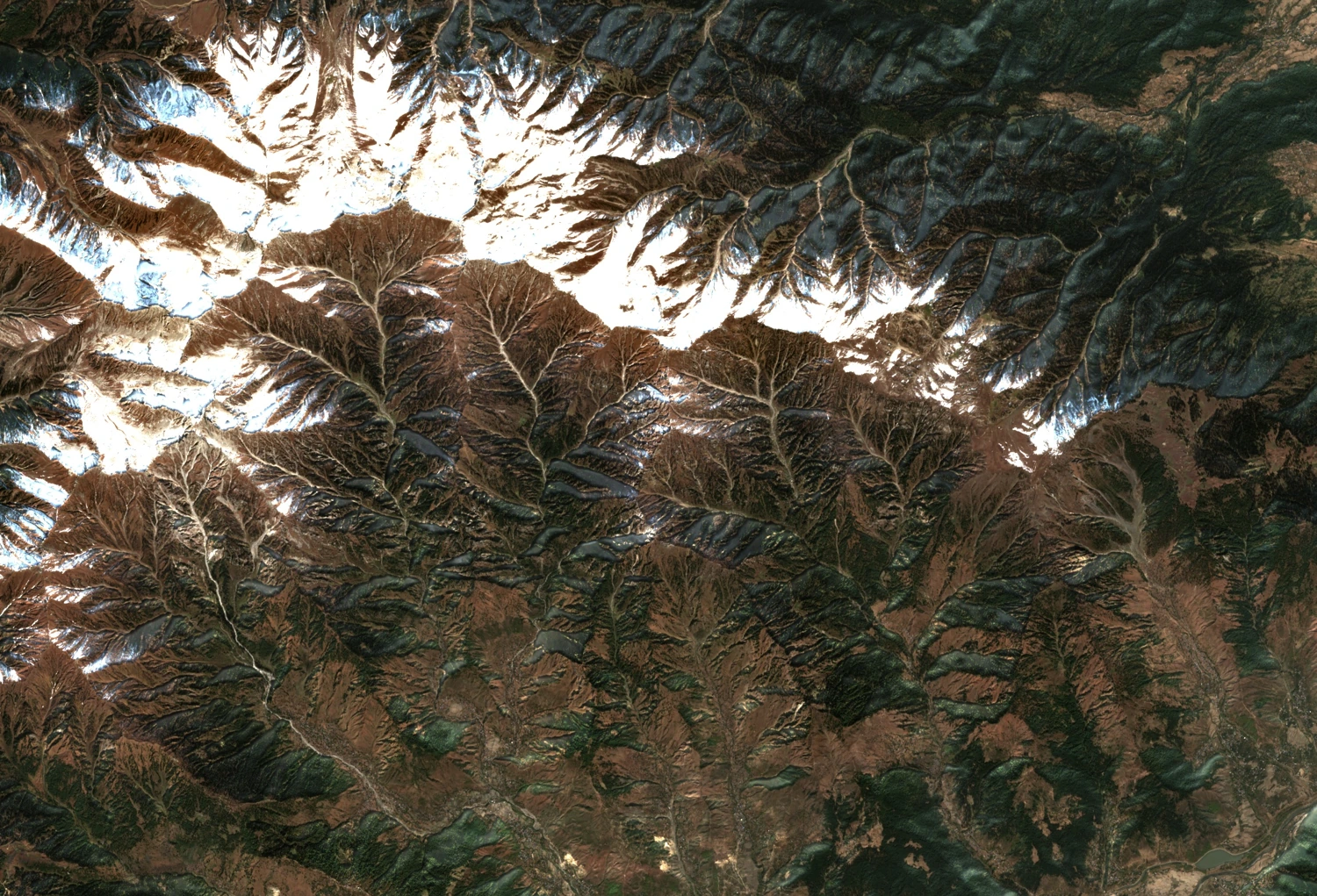
A 2025 inventory covering the national park and adjoining areas, with fieldwork conducted from March 2023 to February 2024, recorded 127 bird species, including the western tragopan and Himalayan monal. A Sentinel-2 satellite image acquired on 2 November 2025 shows snow along the ridge crest and forested ravines on its flanks.