
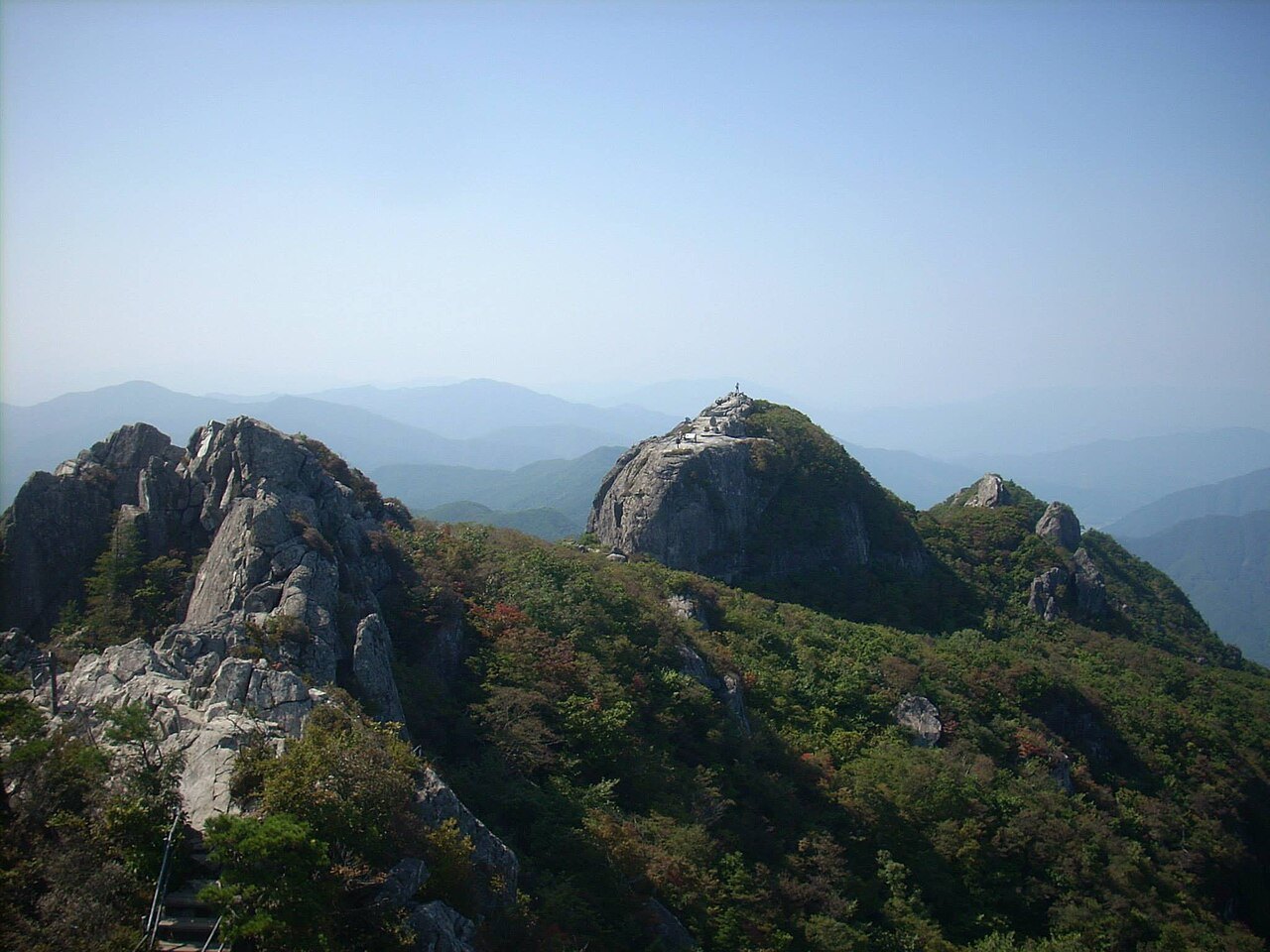
The highest point, Chilbulbong, and the representative summit, Sangwangbong
The highest peak of Gayasan is Chilbulbong at 1,433 m. The nearby Sangwangbong stands at 1,430 m; the Korea National Park Service designates Sangwangbong as the main summit, citing its centrality within the ridge system and its Buddhist associations. The difference in elevation became widely known after Seongju County resurveyed both peaks and requested confirmation from the National Geographic Information Institute.
The two peaks lie on the same ridge and appear as a single mass when viewed from a distance. The route from Baekundong on the Seongju side climbs through Yonggigol and over Seosongjae to reach the summit area. Along the Manmulsang ridge near Baekundong, rocks resembling animals or Buddhist figures appear in succession, allowing visitors to take in the mountain's rock ridges even before reaching the top.
Janggyeongpanjeon: a building that uses the wind
The Janggyeongpanjeon at Haeinsa, on the lower slopes of the Hapcheon side, houses the Tripitaka Koreana woodblocks carved by Goryeo in the 13th century. Preserving the woodblocks required not only keeping out rainwater but also preventing the air from becoming stagnant. Janggyeongpanjeon was built with windows and ventilation openings of varying sizes and placements so that air flows naturally and the internal temperature and humidity are regulated.
UNESCO inscribed Janggyeongpanjeon on the World Heritage List in 1995. The Tripitaka Koreana woodblocks themselves were separately inscribed on the Memory of the World Register. Examining the orientation of the building and its openings reveals that the history of the woodblocks rests not only on the content of the carved characters but also on the mountain's climate and the ingenuity of the architecture that surrounds them.
Listening to the valley on the old Hongnyudong path
The Gayasan Sori-gil trail follows Hongnyudong Valley, running from the direction of the Daejanggyeong Theme Park to Yeongsan Bridge at Haeinsa. It is a low-lying path formed by improving the old valley track, so the forest and water are encountered at a different proximity than when looking down from the summit ridge. At Nongsan Pavilion along the way, there is a tradition that the late Silla scholar Choe Chiwon lived in seclusion on Gayasan.
Baekundong in Seongju is a good starting point for viewing the rock ridges and the two summits, while Hongnyudong in Hapcheon is a route for taking in the valley and Haeinsa in a single flow. Depending on which side you approach the mountain from, different aspects of Gayasan's topography and history come into view first.