
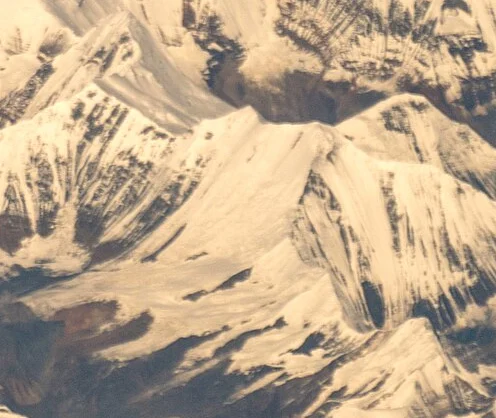
The Southwest Face and West Ridge
The route taken on the first ascent followed the southwest face before joining the west ridge to the summit — a line that demanded careful staging in difficult conditions. Klaus Schreckenbach's account in the Alpine Journal records that the expedition was repeatedly held up by bad weather at high altitude, forcing the team to shelter in snow caves at their upper camps rather than press forward. Those snow caves were not simply a contingency; they became a defining feature of how the mountain was climbed, allowing the expedition to wait out conditions that might otherwise have ended the attempt.
The terrain enforced a natural division of effort. After the delays, Schreckenbach himself, along with Gerhard Haberl and Hans Saler, reached the summit on 20 October 1973. Three days later, on 23 October, a second team followed the same high-altitude line and also gained the top; among that group was Norbu Sherpa. The two separate summit days, spread across nearly a week of high-camp life in unstable conditions, illustrate how the southwest face and ridge demanded patience and logistical flexibility in equal measure.
Place in the Dhaulagiri Massif
The Dhaulagiri massif contains multiple seven-thousanders, and the naming sequence can invite confusion. Dhaulagiri III is a geographically and administratively separate peak from its neighbors; the Himalayan Database treats it as an independent summit under its own identifier. Its first ascent in 1973 came after Dhaulagiri II had already been climbed, completing another chapter in the systematic exploration of the range's subsidiary peaks that followed the celebrated ascent of the main summit in 1960.
The first ascent relied on snow-cave bivouacking above the most demanding terrain, with weather delays shaping the team's progress on the southwest face and west ridge.
The 1973 Expedition in Context
The autumn 1973 ascent was a West German effort documented firsthand by Schreckenbach in the Alpine Journal's 1975 volume, making it one of the more directly sourced first-ascent accounts from that era of Himalayan exploration. His narrative does not describe the mountain as technically straightforward; the weather delays that pushed the summit to 20 October, well into the autumn window, and necessitated another attempt on the 23rd speak to conditions that tested the expedition's reserves. The use of snow caves at high camps reflects the kind of improvised but deliberate mountaineering that characterized many of the harder seven-thousander first ascents of the early 1970s.
Norbu Sherpa was part of the second summit team, which reached the top on 23 October. The peak is formally registered at 7,715 m in Nepal's Department of Tourism figures, placing it among the country's catalogued high peaks.