
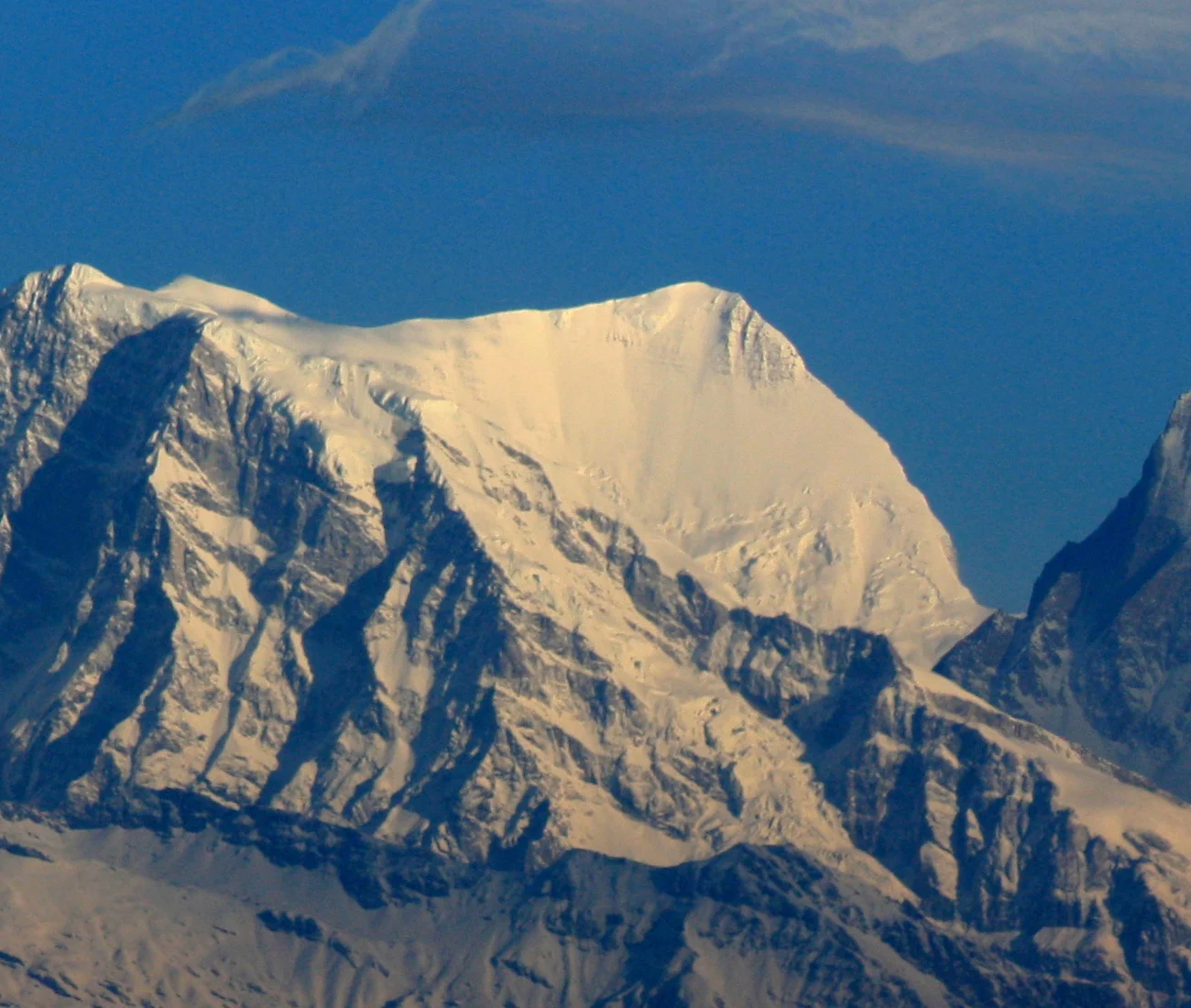
A Summit Set Apart in the Massif
Although Dhaulagiri II shares the broader massif with its more celebrated neighbours, its summit record is kept independently by both the Nepal Department of Tourism and the Himalayan Database, each listing the peak at 7,751 metres. Early expeditions working toward adjacent summits in the massif occasionally used overlapping base terrain, but the approaches to each summit diverge, and the climbing histories of Dhaulagiri I, II, and III are treated as distinct in the official record. That independence matters: the second summit of the range was not a byproduct of attempts on the first, but a separate objective that required its own logistical and topographic solution.
The northern approach through Mukut provided the entry line that the 1971 expedition used to establish its chain of camps before turning onto the east ridge for the summit push. A later ascent in 1978, recorded by the Himalayan Database, approached from the south before joining the east ridge — a variation that together with the original line clarifies the east ridge as the defining feature of the route, with the approach direction describing only the lower part of a longer climb.
The First Ascent of 18 May 1971
On 18 May 1971, Adolf Huber and Jangbu Sherpa became the first climbers to stand on the summit of Dhaulagiri II. Later the same day, Ronald Fear and Adi Weissensteiner completed the second summit pair, making 18 May the sole date attached to the first ascent in the expedition record. Fear's firsthand English account, published in the American Alpine Journal, is the primary narrative source for the climb and records the sequential summit attempts that characterised the final push above the high camps.
The expedition's logistics in the upper mountain centred on a fifth camp whose establishment and shelter conditions shaped the timing of both pairs. Fear's account notes a stove fire in the tent during the period when the teams were staging high on the mountain. Both summit pairs succeeded within the same calendar day.
Comparing the Documented Approaches
The Himalayan Database and the Nepal Department of Tourism independently list Dhaulagiri II at 7,751 metres, and both maintain a summit record separate from the other Dhaulagiri peaks under peak identifier DHA2. The 1978 ascent recorded in the Himalayan Database followed a south approach onto the east ridge, while Fear's account of the 1971 first ascent describes a north approach through Mukut. Fear's American Alpine Journal article and the corresponding account in the Himalayan Journal volume 31 provide primary documentation of the first ascent, covering the approach through Mukut, the camp sequence, and the identities of all four climbers on summit day.
Accuracy in naming the first-ascent party warrants attention. Fear's account refers to the first summit pair as Adi Huber and Jumbu, while the Himalayan Database gives their names as Adolf Huber and Jangbu Sherpa. The names Ronald Fear and Adi Weissensteiner are consistent across sources. Readers consulting secondary literature on the 1971 expedition should bear these spelling variants in mind.