
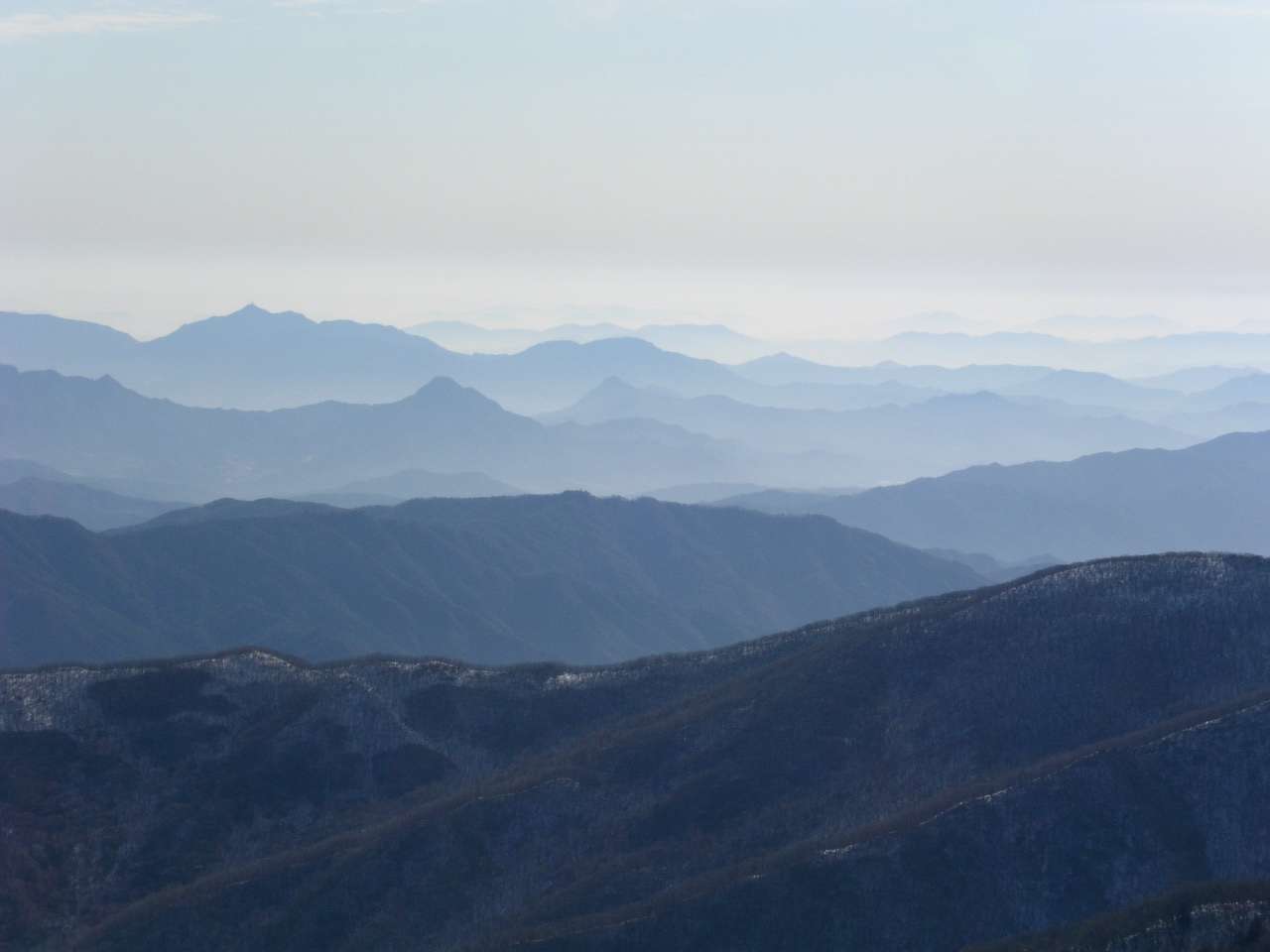
A ridge dividing two watersheds
The main ridge of Deogyu-san, stretching from Hyangjeokbong to Nam-deogyusan, carries significance beyond a simple topographic boundary. Water rising from the northwestern slopes drains into the Geum River system, while water from the southeastern slopes flows into the Nakdong River system. This watershed position, dividing Honam from Yeongnam, makes Deogyu-san a mountain claimed by both regions.
Deogyu-san was designated a national park in 1975, protecting a broad area spanning four municipalities: Muju, Jangsu, Geochang, and Hamyang. In selecting Deogyu-san for its list of 100 Famous Mountains, the Korea Forest Service cited the ridge connecting Hyangjeokbong and Nam-deogyusan and the scenery of Muju Gucheon-dong valley as principal grounds.
The thirty-three views of Muju Gucheon-dong
The key to understanding the cultural geography of Deogyu-san is the Muju Gucheon-dong valley. The valley has traditionally been divided into thirty-three scenic points, known as the thirty-three views. Among them, the thirty-second view is Baengnyeonsa temple, and the thirty-third — the final destination of the journey up the valley — is Hyangjeokbong. This framework, binding everything from the valley's entrance to the summit into a single scenic narrative, has long shaped the culture of visiting Deogyu-san.
Regarding Baengnyeonsa, the Korea Forest Service introduces the founding tradition placing its establishment in the fifth year of Silla King Heungdeok's reign. This is a founding legend handed down within the temple itself, and should be distinguished from historically verified documentary records. Even so, the tradition is noteworthy as context illustrating the long association between Deogyu-san and Buddhist culture.
The name Hyangjeokbong
In the Korea Forest Service list of 100 Famous Mountains, the official entry for Deogyu-san is written as "Deogyu-san (Hyangjeokbong)." Hyangjeokbong is both the name of the principal summit and an alternative name used to refer to Deogyu-san as a whole. As the peak that crowns the thirty-three views of Muju Gucheon-dong, the name Hyangjeokbong carries a distinctive standing as the destination of the valley journey.