
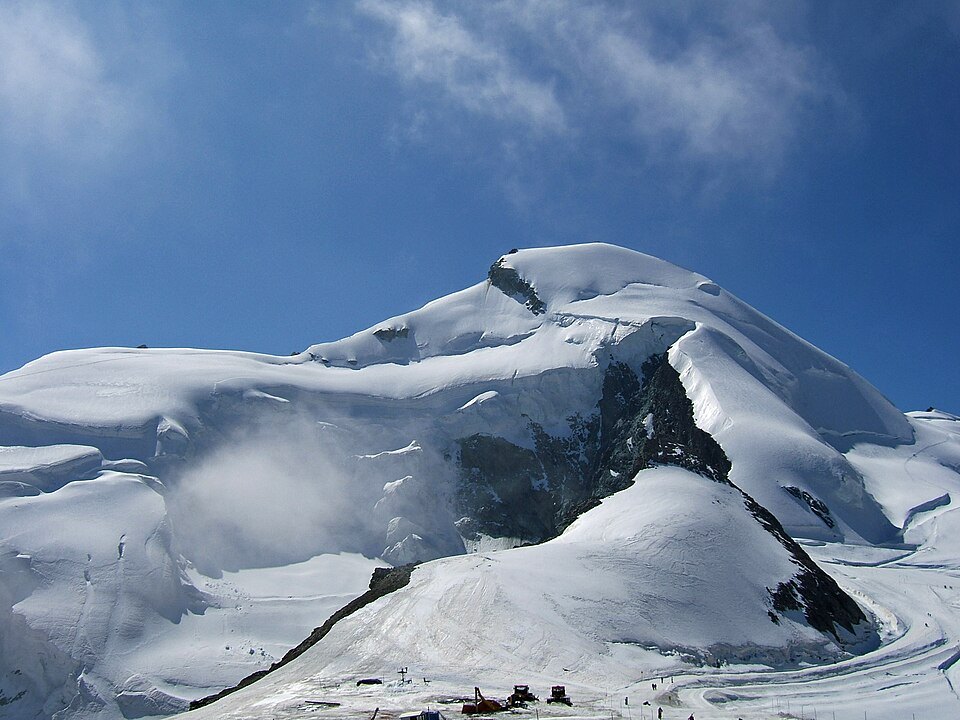
Location and topography
The Allalinhorn stands in the Mischabel ridge, the long mountain chain separating the Saas Valley from the Matter Valley. Within the Allalin Group it is the name-giving summit, though not the highest — Alphubel, Strahlhorn, and Rimpfischhorn all exceed it. To the east below the summit lies the Allalin area, which encompasses the mountain together with several alpine pastures and has given its name to the entire massif. The Metro Alpin ascends to within approximately 570 vertical metres of the summit; from its top station the summit is reachable in roughly two hours according to available information, making the Allalinhorn one of the most accessible four-thousanders in the Alps.
First ascent and early development
The path to the first ascent unfolded in two stages. As early as 1828, Heinrich Michaelis crossed the Allalin Pass in the company of a guide, thereby opening up the route to the southwest ridge — yet the summit itself remained unclimbed for another 28 years. The first ascent was finally achieved on 28 August 1856, when Franz Andenmatten and a guide from the Imseng family, both from Saas-Grund, led the Englishman Edward Levi Ames to the summit via the southwest ridge. The northwest ridge was opened by climbers at a later date as an independent route.
The name Allalin: hypotheses and interpretations
The final stress of the name Allalin suggests, according to linguistic assessment, a pre-Germanic origin. The name had already invited wide-ranging speculation as early as 1840 from the scholar Christian Moritz Engelhardt, who cited it as evidence for his so-called "Saracen hypothesis": he claimed that the Saas Valley had been settled in the tenth century by people of Arab origin. This hypothesis is today considered obsolete.
A different interpretation was put forward in 1976 by Jules Guex, drawing on a letter from the linguist Johann Ulrich Hubschmied. According to this view, Allalin derives from the Celtic word *akarnos for "maple tree". Via a diminutive *agarinus, the form is said to have evolved into agalin, a word demonstrably meaning "small maple" in the Valle Verzasca. In the not yet Germanised Saas Valley this is said to have become ayalin, from which Hubschmied reconstructed a hybrid form all'ayalin. Both explanations — the Saracen and the Celtic — should be regarded as interpretive attempts, not as established knowledge.