
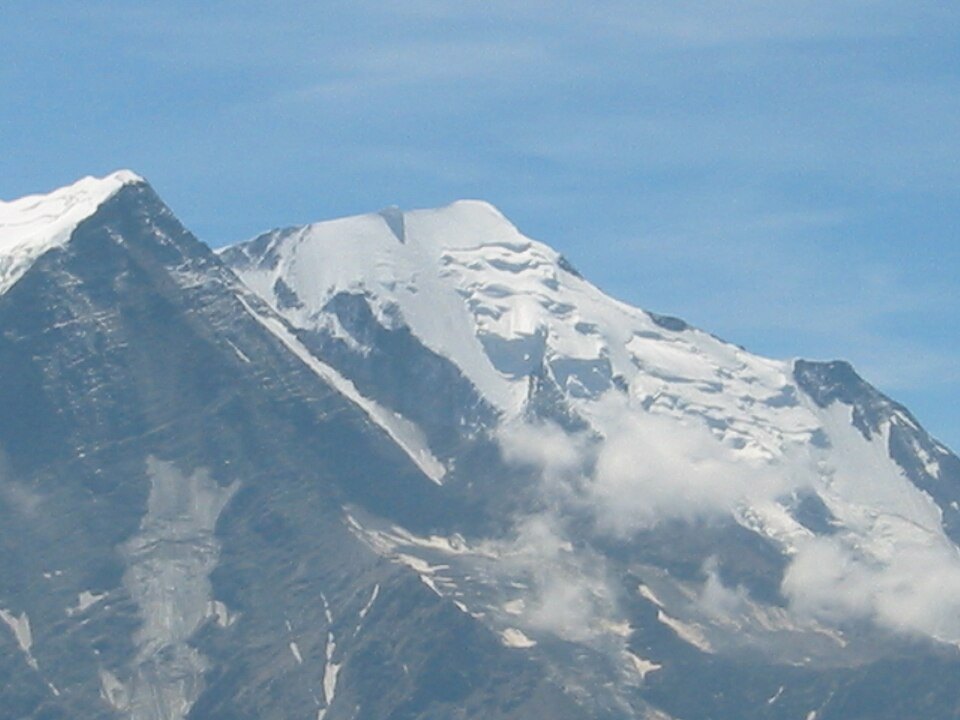
A needle surrounded by glaciers
The Aiguille de Bionnassay has the distinctive feature of being encircled by glaciers on all its faces. The north face, composed mainly of ice with a few exposed rocks, terminates on the Bionnassay Glacier. On the south side, in Italian territory, the Italian Bionnassay Glacier joins the Miage Glacier from the south before ending its course in the Val Vény. To the southeast, the Dôme Glacier also extends this glacial system. This configuration makes the Aiguille de Bionnassay a summit where every approach is conditioned by glacial terrain.
Two founding ascents
The first ascent of the Aiguille de Bionnassay was made on 28 July 1865 by the British climbers Buxton, Grove, and McDonald, accompanied by guides Jean-Pierre Cachat and Michel-Ambroise Payot. The route taken passed by the northwest face. Graded AD with maximum slopes of 55°, this face is described as a very classic route from the Tête-Rousse refuge.
The present normal route, which follows the south ridge, was inaugurated on either 13 or 14 July 1888 — sources differ by one day on the exact date. These two founding routes, separated by more than twenty years, have shaped the practice of mountaineering on this summit.
A Celtic name with mythological resonances
Mountain names belong to the oldest layers of toponymy, often of Celtic or Indo-European origin. According to the sources cited, in Continental Celtic, Bionnassay would literally mean "where the goddess with the axe stands." The name would be a compound including the Gaulish word bio-, meaning "axe." Traditional peoples frequently gave mountains the name of a deity, and this place name would fit within that tradition — though this etymological interpretation belongs to the domain of historical linguistics rather than being an established certainty.