
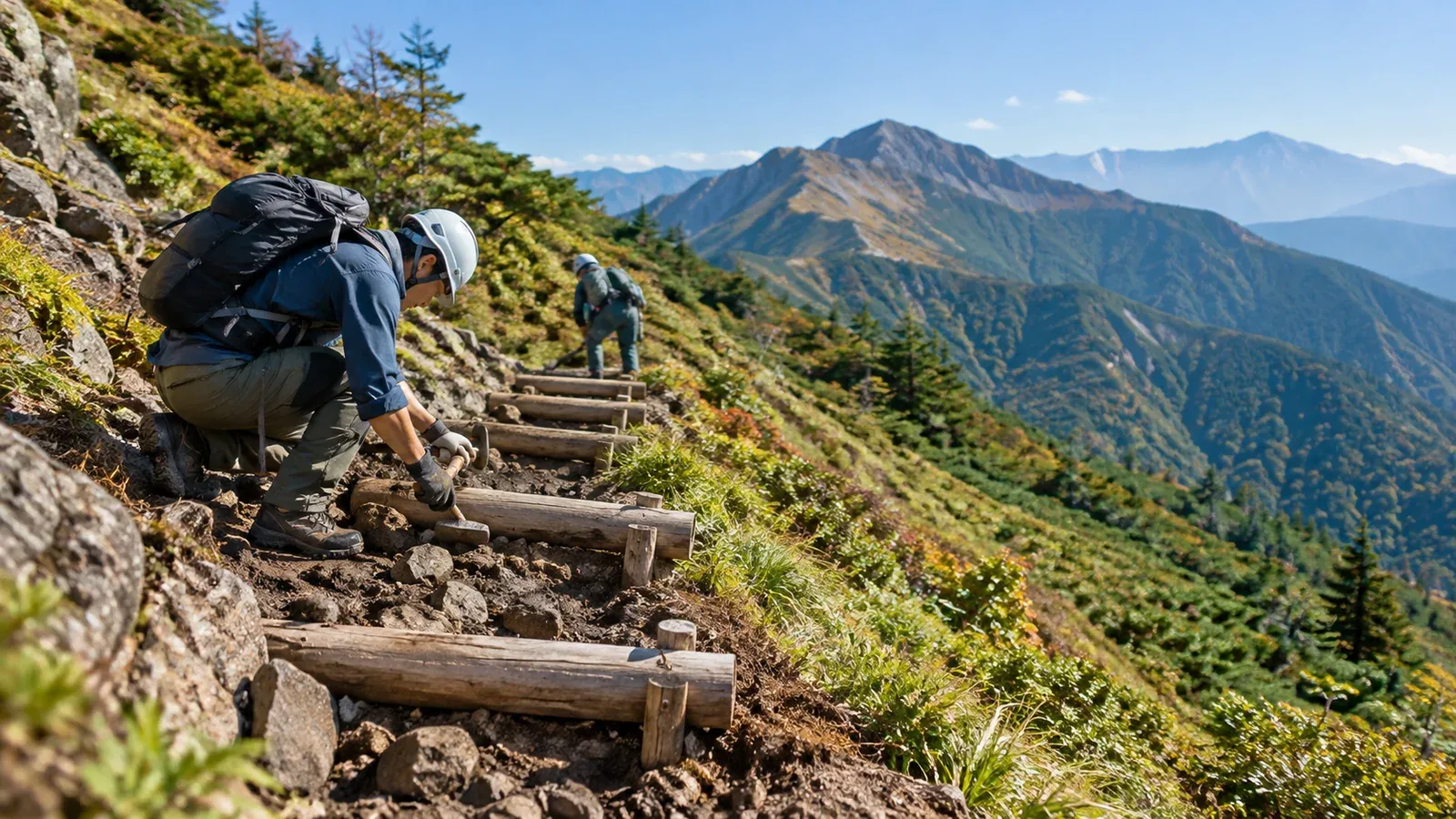
Log steps on a steep slope, a bridge over a stream, a boardwalk across a muddy patch. On a hike, you can see where people have worked to keep the route usable. Finding damage during inspections and carrying tools to the site both take time and people.
Public agencies, huts, local groups and volunteers help keep trails open. In some mountain areas, hikers can contribute to upkeep, too. Here are examples of who does the work and what the money pays for.
Who looks after a trail varies by section
Japan’s national and quasi-national parks include publicly and privately owned land. Land ownership and responsibility for trail maintenance can vary from one section to the next.
A single trail can be maintained jointly by public agencies, huts and local groups. If you want to check closures or repair progress, identify the section on a map and look up notices from the park office or local authority.
Who does the work
Public agencies
The Ministry of the Environment, Forestry Agency, prefectures and municipalities may build or maintain boardwalks, bridges and signs and repair damaged sections, depending on the project and who oversees the site. Distance and terrain affect how difficult and costly it is to move materials to the site.
Mountaineering clubs and local volunteers
Mountaineering clubs, local groups and volunteers may work with trail managers to cut back vegetation and inspect signs. Tasks vary by location. Checking a route for damage is part of keeping it usable.
Mountain huts
Along with providing accommodation and toilets, huts may help maintain trails and improve safety. Environment Ministry guidance includes examples of hut operators and other groups carrying out seasonal inspections and repairs.
What are trail contributions?
Trail contributions let hikers help pay for the upkeep of routes and the surrounding environment. Names and uses vary by area. On Yakushima, mountain conservation contributions support tasks such as maintaining toilets and inspecting and repairing trails.
Work that contributions help fund
Repairing trails after heavy rain, carrying out routine inspections and protecting vegetation all cost money. Nagano Prefecture cites landslides and higher material costs among the reasons upkeep has become harder. For the Northern Japanese Alps Trail Programme, local councils involving huts, public agencies and conservation groups decide how to spend contributions.
Voluntary contributions and access fees
The Northern Japanese Alps Trail Programme asks for a voluntary contribution. You decide how much and how often to give. Mount Fuji’s Yoshida Trail has an access fee under a Yamanashi Prefecture ordinance. Before setting out, check the latest official guidance on which sections and dates are covered and how exemptions work.
Check how contributions are spent
Read the contribution information for its purpose, the sections it covers and the organisation collecting it.
What it pays for. Look in official guidance and activity reports to see which work it funds, such as trail repairs, vegetation protection or toilet maintenance.
What areas it covers. Check official pages or signs to see which mountain areas or facilities the money supports, including the route you plan to use.
Who runs it and how to pay. Check who is responsible, such as a municipality or council, and look for official payment methods such as collection boxes or online payments.
If repair reports are available, look at the maps and photos. You can see what work took place on the section you used.
Take part in trail maintenance
In areas that are recruiting, the Ministry of the Environment’s park volunteers can help with simple repairs and cleanups. Local groups may also recruit trail volunteers. Before applying, check the work involved, experience requirements, equipment and insurance.
Helping with maintenance makes it easier to see where rainwater flows and why a boardwalk was placed where it was. If you find a fallen tree or a washout on a walk, record the location and tell the trail manager. Do hands-on work through activities organised by the manager.
Before your next hike
Look up official trail conditions for your route and any contribution or access fee. If you want to help maintain the trail, check recruitment notices from the park office or local organisations for the tasks and conditions of participation.
Where to look for information
- Trail closures and repairs — park offices, local authorities, visitor centres and huts
- Contributions and access fees — official information from the organisers or local authorities and signs on site
- Trail volunteering — recruitment notices from regional environment offices, park offices and local groups
References and sources
- Japan Ministry of the Environment — Mountain conservation in national parks
- Japan Ministry of the Environment — Technical guidelines for trails in nature parks
- Nagano Prefecture — Hiking trail contributions
- Northern Japanese Alps Trail Programme — How the programme and contributions work
- Yakushima World Heritage Conservation Center — Mountain conservation contributions
- Yamanashi Prefecture — Access rules and fee for Mount Fuji’s Yoshida Trail
- Japan Ministry of the Environment — Park volunteer programme