
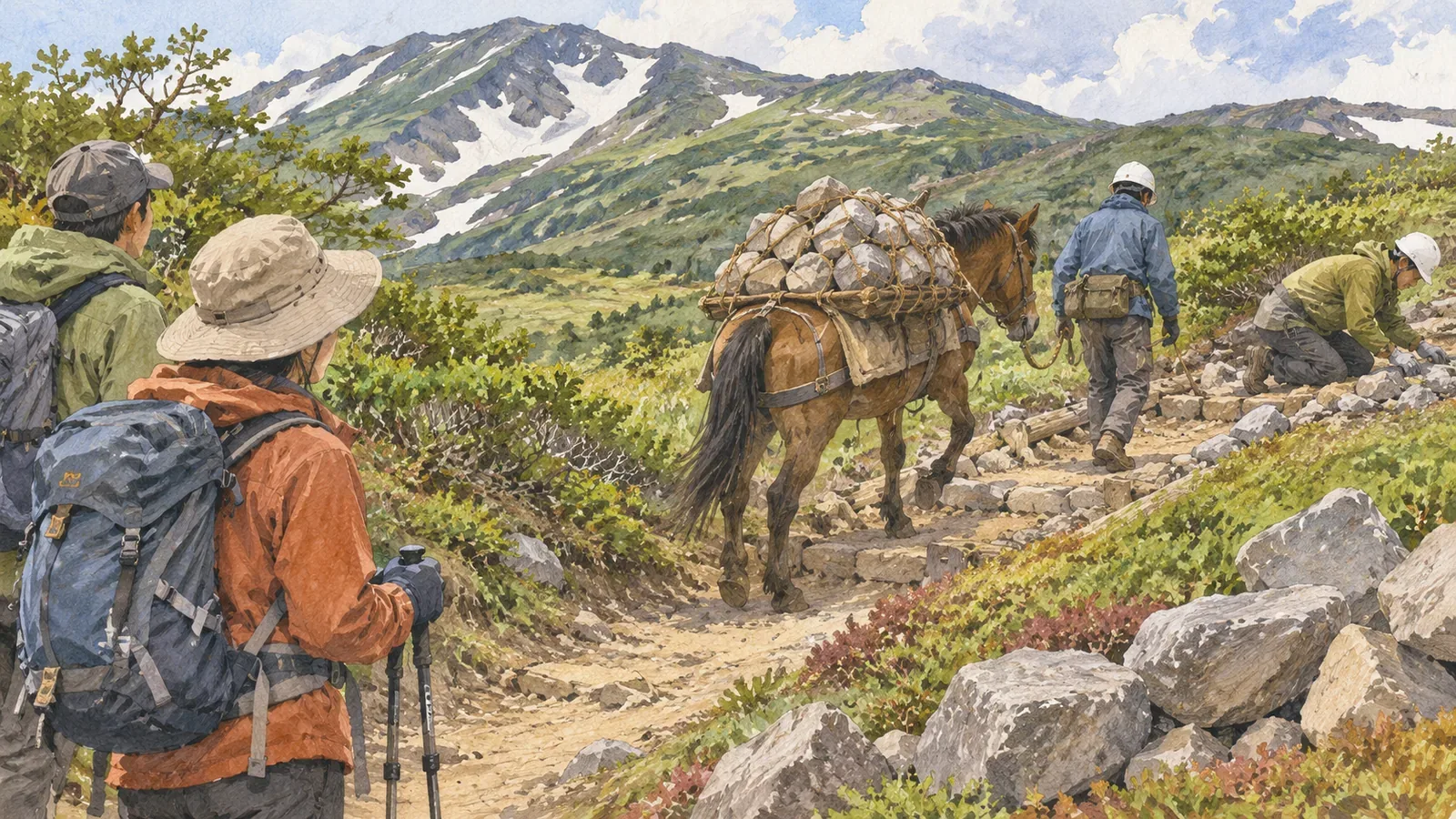
Crews sometimes carry trail materials on foot and sometimes use sleds on lingering snow or helicopters. If you see people carrying loads or materials stored by the trail, check with the crew before deciding where to pass. Leave the materials in place, stay on the trail and wait somewhere safe. The guidance and work notices below explain what to watch for.
Material weights and transport methods depend on the site
Chapter 3 of the March 2005 Daisetsuzan National Park guidance, published by Japan's Ministry of the Environment, lists sleds on lingering snow, cables and helicopters as ways to move stone. It also considers asking hikers to help bring and gather material. It gives the example of a 30 cm cube of granite with a specific gravity of 2.6 weighing about 70 kg. That describes one example, and the weight of other stones can differ.
Appearance alone tells you little about whether material is light or safe to move. Leave stones and timber in place and keep unloading and work areas clear. Even if you want to help someone with a load, ask first. This is the editorial team's suggestion for sharing the trail while leaving the materials alone.
Season and terrain shape the choice of transport
The guidelines mention sleds where snow remains, illustrating how season affects the choice. Helicopters and cables are also options, depending on the scale and work conditions. The method is chosen for the particular site.
The same guidance describes identifying the damaged area, finding its cause, choosing a response and carrying out the work. It calls for recording the work, materials and before-and-after photos. Transport is part of that planning and recordkeeping. If there is a transport notice, check which section and dates it covers.
Staffing matters too. The July 2018 Daisetsuzan draft maintenance manual says that about 300 km of trails are difficult for managers and authorities to maintain alone. It envisages participation by local mountaineering clubs and other groups, with the possibility of public recruitment. For repairs by others, it describes preparing a plan, consulting the ranger office in advance, coordinating with the responsible organisation, following applicable procedures, doing the work and reporting the result. It illustrates organised work in Daisetsuzan at the time. Leave decisions to move materials to the crew.
The Ministry of the Environment's technical guidance index lists the Daisetsuzan trail guidance as a reference. We have not verified the full text of the general trail guidance here, so we treat Daisetsuzan as a local example.
Check access instructions while materials are moving
The 2018 Daisetsuzan draft asks crews to consider visitors and the routes they use during repairs. This does not preclude closures or temporary waits today. In June 2026, a Ministry notice for the Oshidomari Trail on Mount Rishiri asked hikers to follow the crew's instructions and wait somewhere safe while materials were carried by helicopter. Follow the guidance on the day. Previous arrangements may differ.
The Daisetsuzan guidance page explains what happens when walkers avoid muddy or eroded paths by crossing grass or dwarf bamboo. Several paths can form alongside one another, a process known as trail braiding. In Daisetsuzan's alpine vegetation zone, leaf litter and other materials built up for thousands of years over fragile volcanic deposits. Once wide areas are bare, vegetation can take a long time to recover. The page calls for preventative measures such as rope barriers where braiding advances.
Walking around supplies or work can widen the trail in much the same way as avoiding mud. This is the editorial team's inference. When the space to pass looks narrow, choose to stay on the trail. The guidance describes Daisetsuzan. Restrictions differ by place, so follow signs and the manager's instructions.
What to look for on the trail and how to practise at home
The editorial team suggests that when you encounter materials or a crew, stop on stable footing without blocking the path and look around. Take photos, notes or use your phone only after stopping. If there is nowhere safe, write what you remember after the hike. Look at where the materials are, how much room is left to pass and whether there are ropes or signs. Follow the crew's instructions and stay off grass or dwarf bamboo beside the trail.
If you use trekking poles in Daisetsuzan, fit tips with caps in accordance with local conservation rules. The park's page says sharp tips can dig into the soil, contributing to loss of soil, and damage plants. The draft manual also lists caps among the equipment and practices for workers.
You can practise at home. Look at a record of a trail you have walked and choose three places: a narrow stretch, a muddy stretch and a place with grass or dwarf bamboo beside it. Write down where you would stop and wait if materials were there, and where you would turn back if you could not pass. The exercise prepares you to think on the day. Follow the actual conditions and the manager's directions on site.
Check the crew's movements and wait on the trail
Gunma's 2026 volunteer call for Mount Tairappyo listed carrying materials on pack frames. Its deadline and dates have passed, and it is an example of transport as part of trail work in Japan. When you meet a crew, check where they are going and where they want you to wait. If you cannot pass, wait or turn back. Leave the materials where they are and follow directions rather than estimating the weight of a stone by sight.
References and sources
- Japan Ministry of the Environment: Daisetsuzan National Park trail maintenance guidelines, chapter 3 (March 2005)
- Japan Ministry of the Environment, Kamikawa, Higashikawa and Kamishihoro ranger offices: draft Daisetsuzan trail maintenance procedures manual (July 2018)
- Daisetsuzan National Park Liaison Council: Technical Guidelines for Mountain Trail Maintenance in Daisetsuzan National Park
- Japan Ministry of the Environment: technical guidelines and examples of park facilities
- Gunma Prefecture: volunteer recruitment for Mount Tairappyo trail maintenance (June 10, 2026)
- Japan Ministry of the Environment: notice about improvements to the Oshidomari Trail on Mount Rishiri (June 10, 2026)