
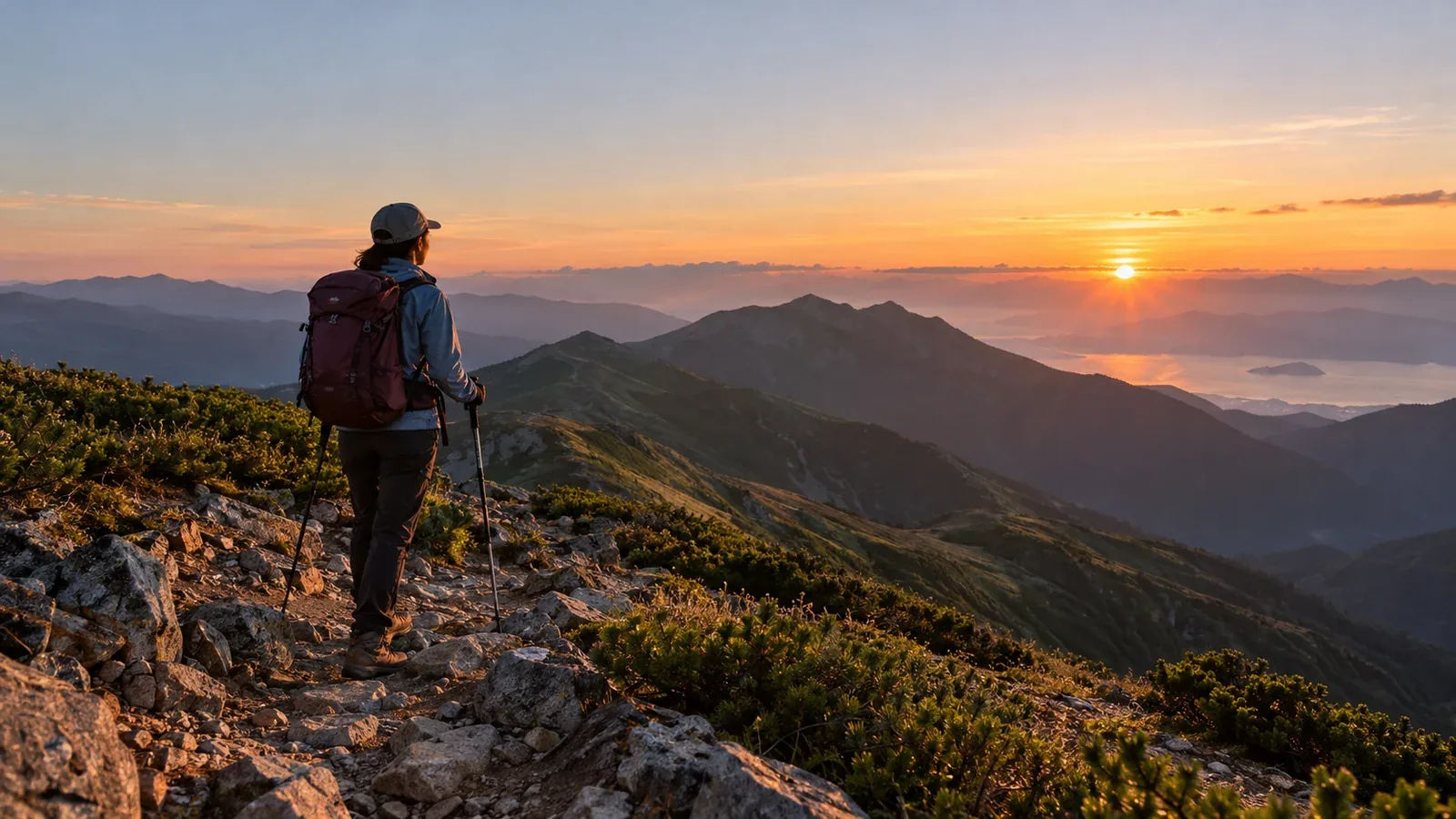
Check sunrise, sunset and the forecast before choosing a start time. On steep ground and ridges, walking after dark demands more experience and equipment. Set a finish time before sunset and work backward to the time you need to start.
Sunrise and sunset vary by season, latitude and longitude. Japan’s National Astronomical Observatory lists sunrise at 4:25 and sunset at 19:00 in Tokyo on June 21, 2026. On December 22 they are 6:47 and 16:32. The daylight difference is about 4 hours 50 minutes. Recalculate your route when the season changes.
How far ahead of sunset should you aim to finish?
A finish at sunset leaves little room for surprises. One planning example is to aim to reach the trailhead, car park or bus stop one to two hours before sunset. Some routes or terrain call for an earlier finish.
There are three reasons. A forest or deep valley can grow dim before the published sunset. Fatigue can slow you on the second half of the descent, especially where footing is uneven. Reroutes and longer breaks also need a margin.
As a conservative starting point for a day hike, plan from one hour after sunrise to two hours before sunset. With sunrise at 5:00 and sunset at 18:00, that gives ten hours from 6:00 to 16:00. Start by choosing a route that fits.
Daylight and walking hours by season
Spring, March–May
The days are still short in early March and lengthen quickly. Around the early May holidays, some areas have sunrise near 5:00 and sunset from 18:30 to nearly 19:00. Snow can still make routes difficult. Ask local authorities or huts about remaining snow before leaving.
Summer, June–August
Summer has the longest days. Afternoon thunderstorms can develop in the mountains. Start and finish early, and use the forecast and time to reach suitable shelter to plan to leave exposed ridges and summits before the risk rises. A 4:00–5:00 start may be possible in some areas. Carry a headlamp if you will be walking before light.
Autumn, September–November
Daylight is still fairly long in September and shortens quickly after that. In some areas November sunsets fall between around 16:30 and just before 18:00. Cooling after dark can add to the risk. Recalculate the usable time for your date and place, and allow for queues or slow stretches during autumn foliage season.
Winter, December–February
With the shortest days, even a low-elevation hike needs careful timing. With sunrise at 6:30 and sunset at 16:30, the interval from one hour after sunrise to two hours before sunset is seven hours. Adjust for terrain and weather. Snow and ice can slow you well beyond the guidebook time. Choose a route that fits your winter experience.
How to look up sunrise and sunset
Look up the date and a location close to the trailhead. The National Astronomical Observatory of Japan has a calculator by date and location. A weather app may show times too. Treat them as reference times that do not account for nearby terrain blocking the sun.
In valleys and forests, mountains and trees can block sunlight before the published sunset, making footing harder to see. Check the map and choose an earlier finish if the descent crosses an east-facing slope or dense forest.
Putting the times into your route plan
Use these steps to build a schedule around the light.
- Look up sunrise and sunset for the date. Use the National Astronomical Observatory of Japan’s calculator.
- Set a latest finish time. One to two hours before sunset is a starting example.
- Check the route’s reference time and adjust for your pace, breaks and footing.
- Subtract the planned duration from the finish time to find the latest possible start.
- Start 30 minutes to an hour earlier to allow for delays.
Suppose a six-hour guidebook route will take eight hours with your pace and breaks. With sunset at 17:00, an example finish deadline is 15:00–16:00, which makes 7:00–8:00 the latest start. For another margin, leave 30–60 minutes before that. If the calculation requires a start before sunrise, shorten the route or reconsider doing it in a day.
Carry a headlamp
A delay can happen even on a well-planned hike. Carry a headlamp in any season. Walking after dark makes it easier to lose the route or fall. Plan to finish before sunset, check the lamp charge and carry spare batteries or a backup power source.
Before you go
Look up the day’s sunrise and sunset, set your latest finish and compare it with the route time. Nordwand’s hiking logs and certified guides can help you learn what the route takes in practice.
Further reading
- Japan Meteorological Agency, weather forecasts
- National Astronomical Observatory of Japan, sunrise and sunset
- National Police Agency of Japan and prefectural police, mountain incident statistics
References and sources
- National Astronomical Observatory of Japan, calendar calculator
- National Astronomical Observatory of Japan, Tokyo sunrise and sunset for June 2026
- National Astronomical Observatory of Japan, Tokyo sunrise and sunset for December 2026
- Nagano Prefecture, Safe Hiking Guidelines
- U.S. National Weather Service, Lightning Safety Outdoors