
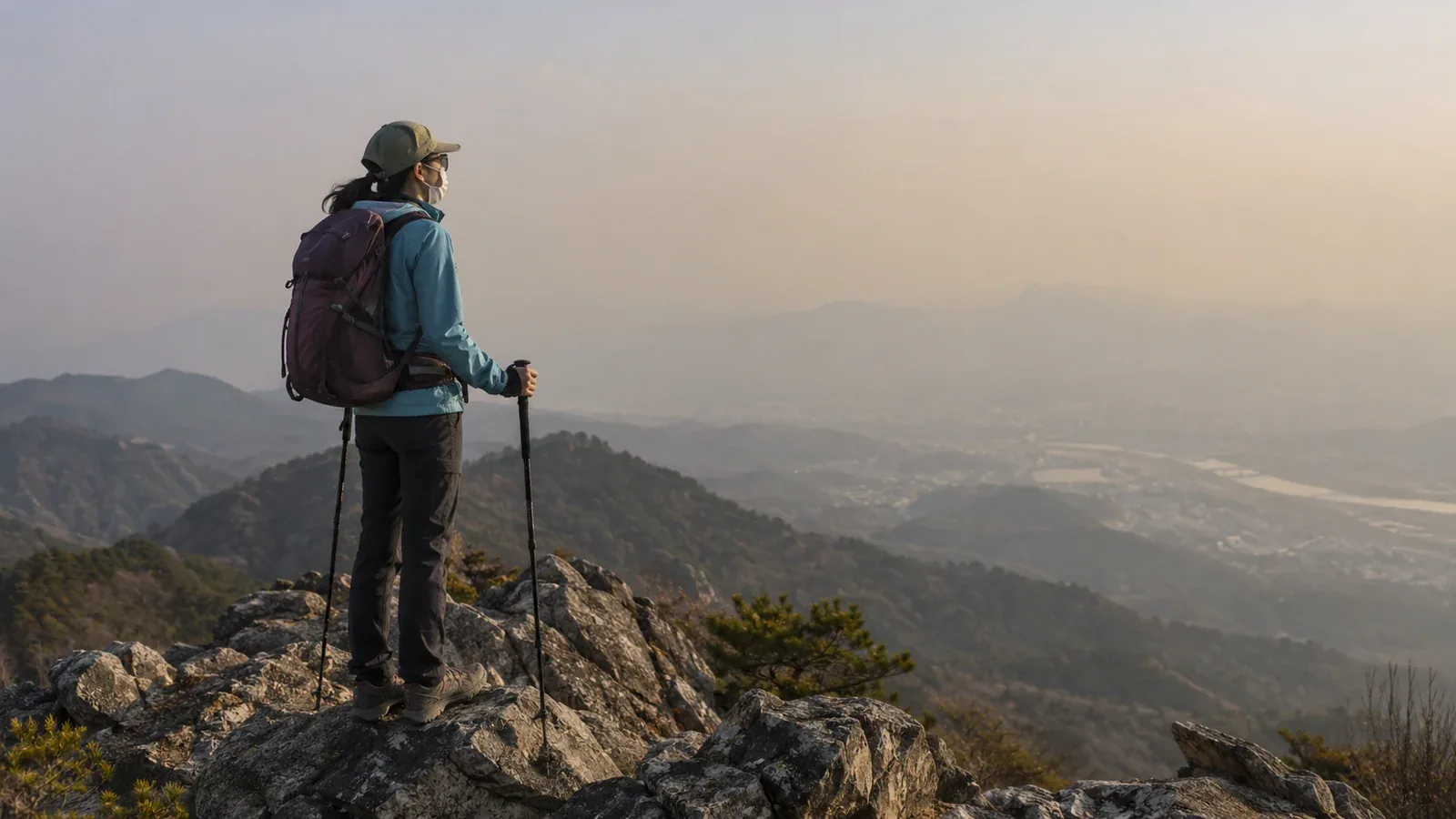
A spring forecast may warn of Asian dust or high PM2.5. With no rain or snow in the forecast, it can still be hard to decide whether to head out.
Asian dust comes from dry areas such as northern China and Mongolia. PM2.5 is a size class for airborne particles about 2.5 micrometres or less in aerodynamic diameter. Sources include industry, vehicles and wildfires, and Asian dust can also contain fine particles. Both can reduce visibility, and fine particles can reach deep into the lungs.
Here is how dust and PM2.5 affect a hike, what to check and how to adjust your plans.
Visibility: How dust haze differs from fog
Asian dust and high concentrations of PM2.5 can make distant views hazy, as fog does. Fog consists of tiny water droplets. Wind and humidity also affect particles and visibility. Appearance alone cannot distinguish fog, dust and PM2.5 or tell you the concentration.
Poor visibility makes route finding harder. On a ridge, you may lose sight of the next summit or a rocky landmark. A GPS map and topographic map can help, but you still need to recognize nearby terrain as you go.
Distant roads and towns can help you identify a descent in clear weather. When haze hides them, check the map, compass and nearby landforms to confirm your direction.
Effects on breathing and eyes
You breathe more air when you exercise hard, so you can inhale more particles. PM2.5 can reach small airways and alveoli, and Asian dust can irritate the nose, throat and airways. Reduce strenuous outdoor activity when concentrations are high.
Take particular care if you have asthma, COPD, allergic rhinitis or conjunctivitis. Discuss hikes during high-pollution periods with a clinician if you have a relevant condition. If your eyes turn red, your throat feels dry or your head feels heavy, stop and reassess.
Sunglasses can block some particles from reaching your eyes. Particles trapped under contacts can be uncomfortable, so consider glasses on days with dust or high PM2.5.
What to check before leaving
Use the Japan Meteorological Agency’s Asian dust forecast, the environment ministry’s PM2.5 observations and local advisories for different purposes.
Three sources to check
- Asian dust forecast: The Japan Meteorological Agency shows where dust is expected and gives estimates by region.
- PM2.5 observations and advisories: The environment ministry’s Soramame-kun network displays preliminary readings from monitoring stations. Check official prefectural or local updates for the outlook and any high-concentration advisory.
- Regional weather forecast: Compare the dust forecast with your route timing, precipitation and conditions that affect visibility. Spacing between surface pressure lines alone cannot establish dust concentration.
Japan’s Ministry of the Environment uses a provisional advisory benchmark of 70 µg/m³ as a daily average. When concentrations are high, limit prolonged strenuous outdoor exercise. Check local advisories. People with respiratory or heart conditions may need to take care at lower levels.
Bright skies can make it tempting to go. Strenuous exercise increases how much air you breathe. Consider the concentration, effort, health and visibility together.
How to adjust on the mountain
Choosing a respirator
If you need particle protection, use a well-fitting respirator such as an N95 or a DS2, Japan’s national test class for particulate respirators, according to the instructions. Reduce the effort if breathing becomes difficult and stop outdoor activity if symptoms develop.
Put it on and check the seal before entering the affected area. Shortening prolonged outdoor effort still matters when wearing a respirator.
Adjusting pace and duration
Reduce time outdoors when concentrations are high. Finish a day hike early and avoid long stops on an exposed ridge to reduce total exposure.
Carry water for the temperature and effort. To cut particle exposure, shorten the time outdoors or reduce the intensity.
Contacts and sunglasses
Consider switching to glasses when particles irritate your contacts. Wraparound sunglasses can reduce exposure around the eyes. Choose lenses light enough to see the terrain clearly.
When to postpone or shorten the hike
High dust or PM2.5 concentrations can be reason enough to postpone, particularly in these cases.
- The local authority has issued a high-concentration advisory.
- You have an existing respiratory or eye condition, or you already feel unwell.
- The route crosses ridges or rocky terrain where good visibility is important.
- You can move the hike to a later date.
If visibility is poor or you feel unwell, choose a shorter route or wait for the air to improve.
Before you go
The day before, check JMA’s dust outlook, Soramame-kun readings and local advisories. If concentrations are high, consider moving the hike. Discuss your plan with a clinician if you have a relevant condition. In Nordwand’s Base Camp, local hikers can share current conditions. Check the official Japanese agencies for current thresholds and guidance.
Further reading
- Japan Meteorological Agency, Asian dust information
- Japan Ministry of the Environment, Soramame-kun air quality monitoring network
- Japan Ministry of the Environment, PM2.5 information
- Japan Ministry of Health, Labour and Welfare, DS2 respirator standards