
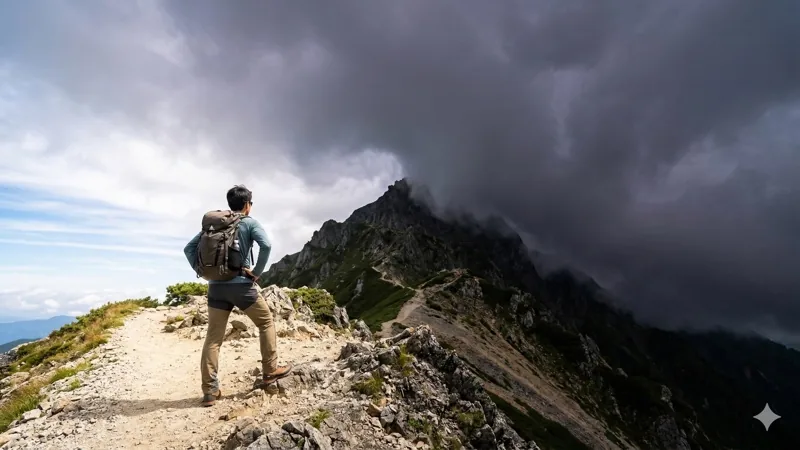
“We’re nearly at the summit.” “We’ve come too far to turn back.” The more strongly you feel that pull, the more reason to stop and take stock. Here is how the time and money you have already spent can affect your decision.
What is easy to miss when the summit is close
The forecast worsens, you fall behind schedule or someone feels unwell. Stop when you notice a change and reconsider both the section ahead and the descent. The summit may be close even when the way back will take a long time.
When the summit seems just 30 minutes away, check the time, sunset, how long you need to get down and how the weather is changing. Nagano Prefectural Police recommend working backward from your descent time to set a cutoff before the hike.
Sunk costs: How past spending affects decisions
A sunk cost is money, time or effort you have already spent and cannot recover. In experiments, psychologists Hal Arkes and Catherine Blumer found that people were more likely to continue an activity when they had already invested more in it.
On a hike, that includes time spent getting this far, energy already used and expenses you cannot get back. How much energy you still have and how much time remains are relevant to the decision to continue or return.
If you are unsure, compare the route and descent time for continuing, turning back or shortening the hike. Check the condition of the way back, too, and choose the safest course available now.
When it is easy to put off turning back
1. One “just a little farther” after another
Every extra ten minutes can use up daylight or make the way back harder. Before spending another ten minutes on the trail, check the time and the return route from where you are.
2. Holding back around other people
When someone experienced says you can go on, it can be hard to disagree. The leader may also assume everyone wants to continue. Take a short break and ask each person how they are feeling and what is worrying them.
3. “I don’t know when I’ll be back”
On a trip far from home or over a long weekend, not knowing when you can return can make a change of plan feel harder. When you notice that thought, say out loud what the conditions are today, including the weather and when you need to be down.
4. Getting attached to the preparations
Even after buying gear, taking leave and booking a place to stay, reconsider the route if rain or wind picks up. Work out the safest course first, then deal with reservations and costs.
Five ways to make turning back easier
1. Agree on turnaround criteria before you leave
Combine a time and place before setting out, such as turning back if you have not reached a junction by noon. Be ready to turn back sooner if the weather, trail or anyone’s condition deteriorates.
2. Leave room for another visit
Come down while the route is still manageable. Once you are back, consider another season or route. Putting the summit in a future plan can make the decision in front of you easier.
3. Let anyone suggest turning back
Agree that anyone can ask to stop or turn back. When they do, pause and ask what has changed, then decide based on everyone’s condition.
4. Review a day when you turned back
After the hike, recall where you turned and what prompted the decision. Write down anything you can reuse, such as getting back earlier than expected or descending before the weather turned.
5. Set goals for the day beyond the summit
Alongside reaching the summit, make room for walking with friends, enjoying the view or getting everyone down on time. If you shorten the route, you can still look back on what you achieved.
Use the decision on your next hike
When you notice bad weather or a delay, stop early and check the descent route and timing. If you looked up alternative ways down before leaving, you can compare them on the spot.
Tell your companions exactly what you observed, such as how many minutes you are behind or that the wind has picked up on the ridge. Agree on what to check next and which route you will take down.
Sunk cost is one way to think about decisions. On a mountain, consider your position, the time, weather and route, as well as everyone’s condition and equipment.
Summary
It is easy to put off turning back when you are thinking about time or money already spent, one more short push, what others want or when you might get another chance. Set turnaround criteria in advance and make it easy for people to speak up about concerns.
For your next hike, agree on a time to reach a junction and one condition that would make you turn back. After the descent, talk about which information actually helped you decide.