
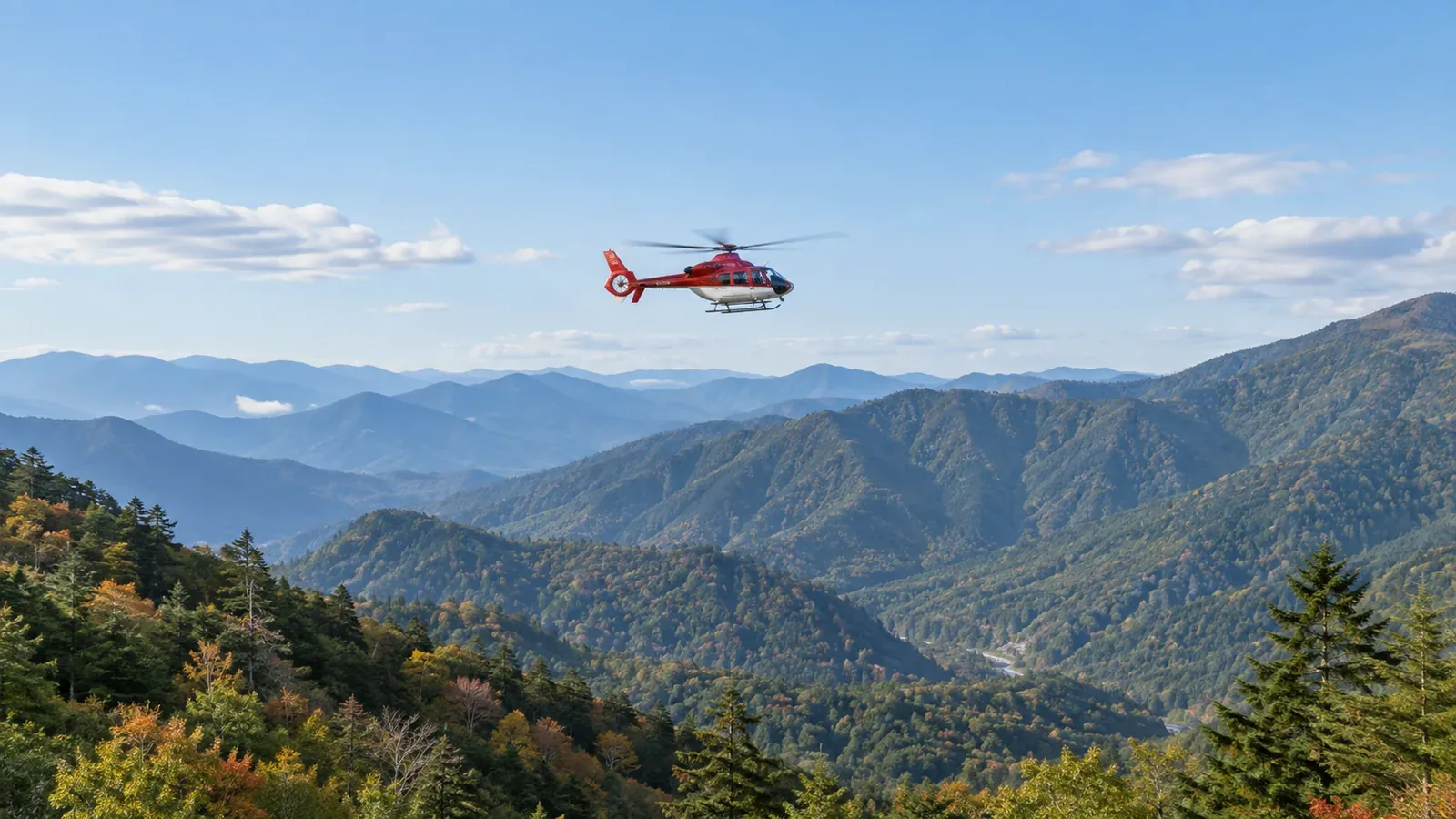
As of November 14, 2026, Saitama Prefecture has a fee for rescues by its disaster-response helicopter in designated mountain areas. According to figures the prefecture gave the Saitama Shimbun, 44 rescues qualified for the fee between its introduction in 2018 and September 15, 2026. Shizuoka and Yamanashi, which share Mount Fuji, are coordinating measures for the period outside its official season. The rules they are considering differ in scope and procedure from Saitama's geographic designations.
Saitama has charged for certain helicopter rescues since 2018
Saitama amended the ordinance governing emergency operations by its disaster-response aviation unit and began charging for certain mountain rescues on January 1, 2018. It was the first prefecture in Japan to introduce a fee of this kind. The initial rate was ¥5,000 per five minutes of flight. On April 1, 2024, it rose to ¥8,000 per five minutes, equivalent to ¥96,000 for one hour of chargeable flight.
The Saitama Shimbun reported 44 eligible rescues totalling ¥3,414,000 from the launch to September 15, 2026. This is the total for eligible cases. It does not mean every fee was collected. Separately, the National Police Agency recorded 77 mountain incidents involving 86 people in Saitama in 2025. The two sets of figures cover different periods and cases, so they do not establish what proportion of incidents incurred fees.
The scheme applies when Saitama's prefectural disaster-response helicopter rescues someone inside a designated part of the prefecture.
How Saitama defines its six areas
The fee applies within 1 km horizontally of the central peak of Nishidake on Mount Futago in Ogano, within 3 km of the summits of Mount Ryōkami and Mount Kumotori, within 5 km of the summits of Mount Kobushi and Mount Kasatori, and within 100 m of Otokoiwa on the southern foot of Mount Hiwada. It applies only to the portions within Saitama Prefecture.
The prefecture bases the fee on fuel costs. It counts flight time from takeoff at the disaster-response aviation centre to the completion of transport to a medical facility. Exclusions include people entering for forestry and similar work, to save lives, to operate a hut or as part of school activities. A reduction or waiver may be available to people affected by a qualifying natural disaster after entering the area, people receiving public assistance and others who meet the requirements.
People rescued by Saitama's prefectural helicopter in a designated area generally pay a fee based on fuel costs. The ordinance and related rules specify the areas, rates, exclusions and grounds for a reduction or waiver.
Mount Fuji's off-season measures and proposed fees
Shizuoka began looking at how to handle the cost of rescues outside the official season and explained that position at the governor's press conference on May 22, 2026. On October 2, 2026, the Shizuoka governor was reported to have announced plans for fees for prefectural helicopter rescues at the prefectural assembly. The Yamanashi governor's October 16 press conference confirmed that the two prefectures agreed on that direction.
In the 2026 official climbing season, the three Shizuoka routes required preparatory learning and a ¥4,000 fee per person, among other measures. These seasonal requirements ended on September 10, and the trails closed for winter. The rescue fee under discussion would apply at a different time and serve a different purpose.
The ¥4,000 entry fee supports conservation and safety measures. It does not prepay rescue costs or guarantee that a rescue is available.
Articles 6 and 8 of Japan's Fire Service Organization Act establish municipal responsibility for fire and emergency services and require municipalities to cover their costs. Shizuoka has said that legal questions need to be resolved, including whether the rules could differ for prefectural, city and police helicopters. Whether a charge applies depends on which agency performs the rescue and under what rules.
On September 14, 2026, Yamanashi announced that it planned to charge for its prefectural helicopter rescues outside the official season as a general rule, with reductions or waivers based on filing a climbing notice and meeting safety conditions. It aims to begin applying the measures in September 2027. At its November 12 press conference, Yamanashi said it was coordinating with Shizuoka and planned to submit draft ordinances to the prefectural assembly in February 2027. The treatment of search costs was still under discussion. The new rules had yet to take effect on November 14, 2026.
Shizuoka is also considering mandatory climbing notices outside the official season and an administrative fine for failing to file. These measures are separate from the helicopter rescue fee. The editorial team is following how the Fuji proposals combine seasonal notices and safety measures, compared with Saitama's focus on designated areas.
People get into trouble in the mountains for many reasons
Mountain writer Kenichi Moriyama discussed the National Police Agency's 2024 figures. Of 3,357 people involved in mountain incidents, 2,676 had gone hiking or mountaineering, a category that includes ski mountaineering, stream climbing and rock climbing. The other 681 people, about one in five, were doing things such as foraging, sightseeing, working or stream fishing. In the agency's 2025 data, mountaineering and hiking accounted for 79.1%, and collecting wild plants and mushrooms for 6.5%.
Moriyama says he is open to charging fees and raises questions about the rationale and where to apply a boundary. Why single out hikers when public rescues for road accidents and maritime incidents are generally funded publicly? How would authorities define which areas count as mountains? One option he suggests is to limit fees to national and quasi-national parks and cover them through mountain insurance.
A concern is that people might hesitate to ask for help because of cost. When a rescue is needed, call before trying to confirm the price. From the editorial team's perspective, hesitation is the most serious potential cost of a fee. A delay can make a rescue harder because of darkness or weather. You can ask about a reduction or waiver after the rescue.
In an August 2026 report on a survey of 160 hikers in Nagano, the Shinano Mainichi Shimbun said some respondents considered helicopter fees effective. The most popular answer was advance checks of trip plans and gear, chosen by 75 people (47%). The results reflect the respondents' views.
Prepare for a rescue call before you hike
As of November 14, 2026, Saitama charges for certain prefectural helicopter rescues in six designated areas. Shizuoka and Yamanashi are coordinating a framework for Mount Fuji, and Yamanashi is aiming for September 2027. Check the latest official notices for your destination before you leave.
Private helicopters or private rescue teams can incur charges separately from public services. The costs depend on who arranged the operation, the area and your insurance policy.
- Calling for help: If you cannot descend safely on your own or someone's life or health is in danger, do not delay a rescue call to check the cost.
- Insurance: Check the policy for search and rescue coverage and its limit.
- Trip plan and communication: Share your plan with family and file it as directed for the area. Include escape routes, carry spare power and prepare for areas without signal. The National Police Agency recorded calls for help by phone or radio from the incident site in 76.3% of 3,122 cases in 2025. It did not record the use of these means in 23.7%. The figures do not show how often a call failed.
You can check when to call for help, what your insurance covers, and how to file your plan and communicate before the fee proposals are settled.
After requesting rescue, give your location and nearby landmarks as accurately as you can. Nordwand's location sharing is one way to share your position with family or companions. In an emergency, give priority to contacting the rescue services.
References and sources
- Saitama Prefecture — Fees for rescue operations by its disaster-response helicopter
- Yama to Keikoku Online — Saitama introduces fees for rescues in six mountain areas from January 2018
- Saitama Shimbun — Yamanashi looks to Saitama's model for helicopter rescue fees
- National Police Agency of Japan — Overview of mountain incidents in 2025
- Shizuoka Prefecture — Climbing rules at its three Mount Fuji trailheads
- Tsunehiko Maeda, Yahoo! News Expert — Legal questions surrounding fees for Mount Fuji rescues
- Kenichi Moriyama — Should mountain rescue be subject to a fee?
- Yomiuri Shimbun, via livedoor News — Shizuoka considers who should bear the cost of winter rescues on Mount Fuji
- Shizuoka Broadcasting System — Shizuoka announces plans for helicopter rescue fees outside Mount Fuji's official season
- Kyodo News, via Yahoo! News — Yamanashi advances discussion of helicopter rescue fees
- Chunichi Shimbun — Shizuoka and Yamanashi discuss Mount Fuji helicopter rescue fees
- Shizuoka Asahi Television — Municipal leaders request consideration of helicopter rescue fees
- Kazuya Kobayashi, PRESIDENT Online — Legal issues surrounding helicopter rescue fees
- Shinano Mainichi Shimbun — Nagano hiker survey on equipment checks and helicopter fees
- Yamanashi Prefecture — Outline of measures for unsafe climbs outside Mount Fuji's official season
- Yamanashi Prefecture — Governor's press conference, September 14, 2026
- Yamanashi Prefecture — Governor's press conference, November 12, 2026
- Yamanashi Prefecture — Governor's press conference, October 16, 2026
- Shizuoka Prefecture — Governor's statement to the prefectural assembly, September 2026
- e-Gov — Fire Service Organization Act, Articles 6 and 8
- National Police Agency of Japan — Overview of mountain incidents in 2024
- Shizuoka Prefecture — Governor's press conference, May 22, 2026
- Saitama Prefecture — Map of designated areas for helicopter rescue fees