
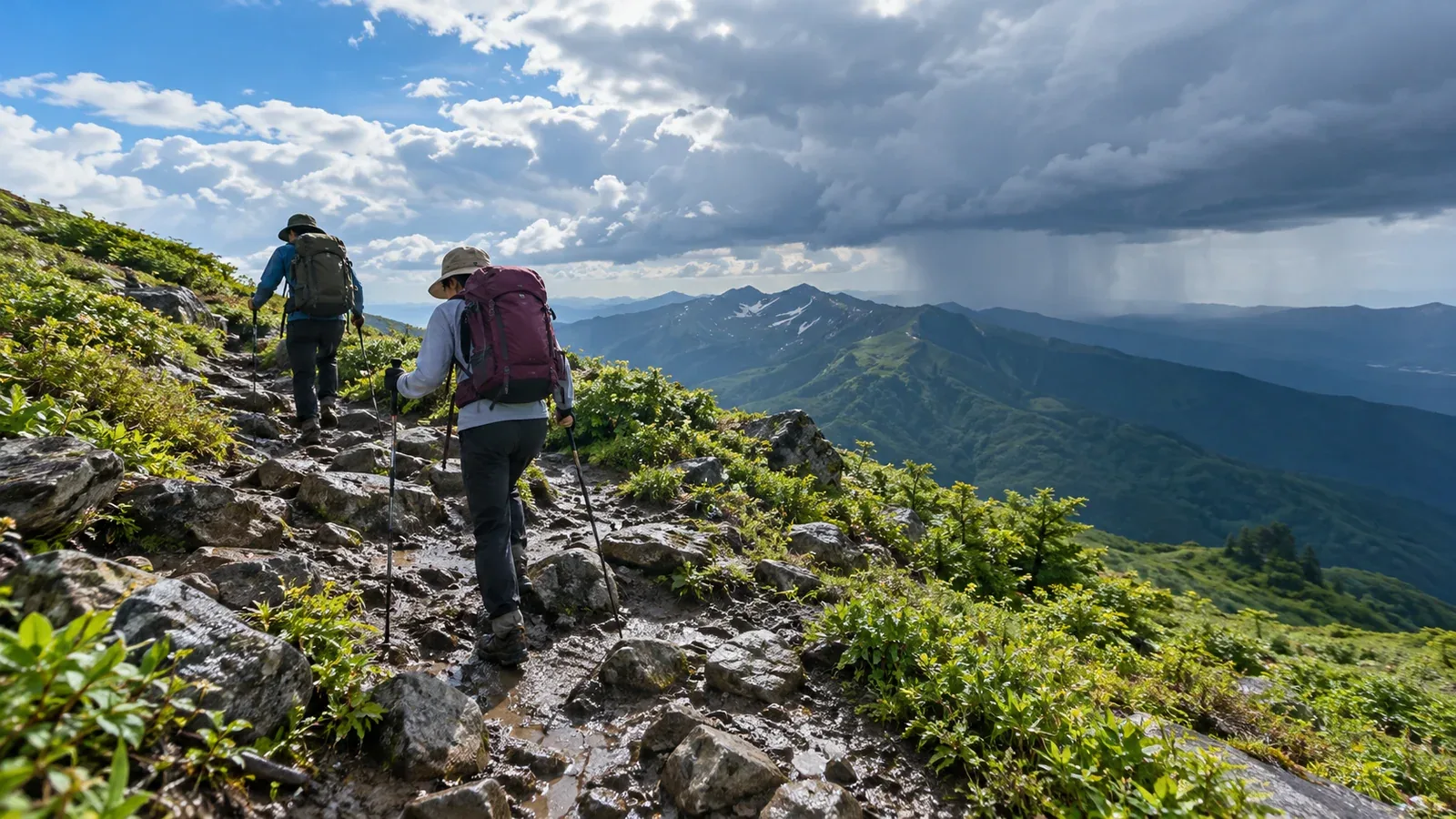
If you plan to hike after Japan’s rainy season, you may wonder whether it’s safe to go the very next day. Even after the season officially ends, heavy rain can leave damage on trails and thunderstorms can still develop in the mountains.
News that the rainy season has ended may get you thinking about a trip. Sunshine and safe hiking conditions are two separate things. This article explains how to use the change of season when deciding whether to head into the mountains.
What the announcement does and doesn’t tell you
The Japan Meteorological Agency (JMA) makes a preliminary assessment for the regions it covers, based on recent weather and the outlook for the next week or so. The transition takes around five days on average, and the agency may revise the date after reviewing the season.
What the announcement tells you
- The region appears to have shifted from a predominantly cloudy and rainy spell to summer weather.
- This is a preliminary judgment based on recent weather and the outlook.
What the announcement doesn’t tell you
- Whether skies will stay clear along mountain ridges
- Whether thunderstorms will develop tomorrow or the day after
- What the trails are like, including high streams, washouts and lingering snow
In summer, storm clouds can develop over mountains in the afternoon even when the valleys are sunny. Check the forecast for the mountain area before drawing conclusions about the ridge from the skies at the trailhead.
What you may encounter just after the rainy season
Trail damage
Prolonged rain can leave soft, slippery ground, dangerous stream crossings and small washouts. A few clear days may do little to improve these conditions. Check the latest route information from the local authority, mountain huts or notices at the trailhead.
Afternoon thunderstorms
When sunshine heats the ground, warm, moist air can rise and build into storm clouds under the right conditions. Ridges and summits offer few places to shelter from lightning, so check the thunderstorm outlook before setting out.
If afternoon storms are forecast, work backward from when you need to leave the ridge and reach a safe place, such as a substantial building. Change the route or postpone if you can’t reach shelter before the storms are expected.
Crowded trails and huts
On weekends with a sunny forecast, popular trails and huts can fill up. Leave time for bottlenecks at narrow sections. If you’re new to hiking, check availability and consider shifting your dates or going on a weekday.
How to decide whether conditions are suitable
Use the same checks before a hike, whether or not the rainy season has officially ended.
1. Check a mountain weather forecast
Check temperature, rain, thunderstorms and wind for the elevations and times you’ll be hiking. Use JMA thunderstorm advisories and lightning nowcasts alongside the forecast to see the wider outlook and recent lightning activity.
2. Follow the forecast from a few days out through the day of the hike
A sunny forecast a week out can turn into a thunderstorm forecast the day before. Keep checking until departure and be ready to change plans if conditions shift.
3. Check trail conditions with local sources
Check recent trail reports from prefectural mountain safety associations, mountain huts’ official websites and social accounts, and the local authority that manages the trailhead. Pay particular attention to washouts and closures.
4. Match the hike to your experience
The end of the rainy season can make you eager to get outside. If the mountain or elevation is new to you, wait for stable conditions. Your first summer hike can wait past the first weekend.
Choosing a day for your first summer hike
Pick a day with a stable forecast and confirmed trail conditions. How long a trail takes to dry depends on rainfall, terrain and sun exposure. Give local reports more weight than the date or the number of days since the season ended.
Timing varies by region. The rainy season usually ends earlier in Okinawa and Amami than in the regions of Honshu. Hokkaido is outside JMA’s rainy-season announcements. Check regional rainy-season information where available and the forecast for your destination.
At elevations of 2,500 m and above, early mornings can drop below 10°C even in August. Pack for cold and wet conditions. Bring waterproof layers and an insulating midlayer if your route takes you along a ridge.
Be ready to change plans around the end of the rainy season
Taking time off or paying for transport can make it hard to cancel even when the weather deteriorates. This is the sunk-cost effect. The time and money already spent do nothing to reduce the risk on the trail.
Consider turning back or postponing if you could encounter a storm on the ridge, the trail has closed, or the latest forecast differs substantially from the one you planned around. Be especially conservative about these signals if you’re new to hiking.
If you can’t move the date, consider a shorter route at a lower elevation after checking the weather and trail conditions there. Postpone if conditions are unsuitable.
What to do next
As the day approaches, check a mountain forecast and JMA advisories alongside official updates from local authorities and huts. For your first hike after the rainy season, start with a familiar mountain and a short route. Plan something higher once you’ve checked the weather, the trail and how you’re feeling. In Nordwand’s Base Camp, you can exchange trail updates with others heading to the same area.
References
- JMA: Rainy-season dates by region
- JMA: Staying safe from lightning
- National Police Agency: Annual overview of mountain incidents
- Prefectural mountain safety associations