
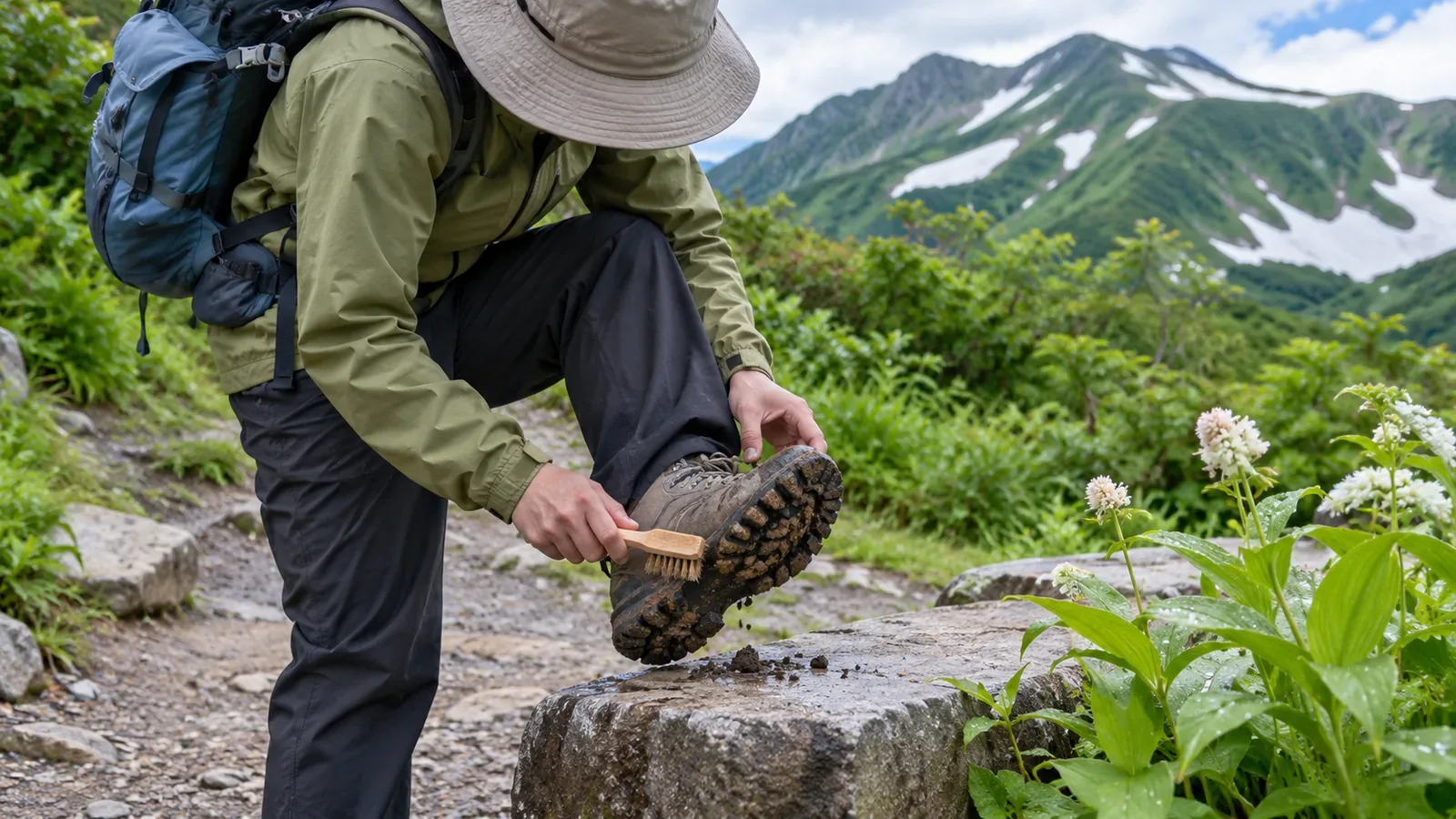
Mud on boot soles can carry plant seeds from one mountain to another. Decide when and where you’ll clean your boots so the mud is gone before your next hike. Research and guidance from Japan’s Ministry of the Environment explain what to make of the figures and what you can do before leaving.
Seeds That Could Germinate Were Found on Footwear at Tateyama
Researchers collected soil from visitors’ footwear at Tateyama Station in early summer and late autumn 2017. The Forestry and Forest Products Research Institute and its partners announced the results on September 7, 2021. Of 344 valid soil samples, 27 contained seeds that could germinate. The study did not investigate whether the plants became established in the mountains.
Japan’s Ministry of the Environment says that plantains and other plants along the Oze boardwalk may have grown from seeds carried on hikers’ shoes. It asks visitors to wash or otherwise remove mud from their footwear before entering Special Protection Zones and to clean it regularly.
Remove mud before entering a protected area. Once inside, stay on trails and boardwalks.
What 3.8% and 52.8% Measure
In the same study, 81.4% of respondents said they knew people could carry seeds. Some 3.8% said they had cleaned their footwear for conservation between its previous use and the Tateyama visit. A footnote gives 43.9% for cleaning for any reason, including to make shoes last longer. The 3.8% is the share who reported cleaning specifically for conservation. The overall share who cleaned their footwear was 43.9%.
After adjusting for other factors, the researchers estimated that the number of seedlings from samples of people who cleaned their footwear was 52.8% of the number from people who hadn’t. They compared the number of seedlings germinating from the collected soil.
When checking your own cleaning routine, see whether you’ve removed the soil from the grooves in your soles before going to another mountain.
Decide Where and When to Clean Before Leaving
The Tateyama survey asked whether people had cleaned their shoes between their previous use and the visit. Use the time between one hike and the next to look after your own boots.
First, choose a day and place after the hike to remove the mud before going out again. At home, for example, you can check where you may use water and where it drains. Use water at a trailhead, hut or stream only where the manager allows it. Keep muddy wash water out of streams, avoid using chemicals on your own initiative and check how to dispose of the water.
Second, check official guidance to see whether you’re visiting a Special Protection Zone or similar area and whether cleaning facilities are available and how to use them. Japan’s Ministry of the Environment recommends checking weather, access, trail conditions and volcano information in advance. Add the state of your boots to that check and finish cleaning before you leave.
Third, check the grooves in your soles in good light before setting out and remove any soil still there. Fourth, keep a record if it helps. At home, note the last mountain you visited in each pair, the date, where you cleaned the pair and where you’ll go next.
If you can’t remove the mud before going in and there’s no designated facility, consider changing the date or destination. Choose a plan that lets you finish cleaning before entering the protected area.
What the Mount Hiuchi and Mount Myōkō Boot-Cleaning Study Found
In a separate study announced on October 16, 2023, Tokyo University of Agriculture and Technology and the National Institute for Environmental Studies set up a brush and mat at the trailhead for Mount Hiuchi and Mount Myōkō. The researchers randomly switched among four conditions: footprint markers leading to the station, information about seeds being carried in, instructions for preventing it, and a control with no information. The footprint markers and the instructions increased cleaning. The roughly 21-fold and 5-fold figures are odds ratios, which compare the odds of cleaning between conditions.
This study measured whether people cleaned their footwear at the trailhead. The researchers identified questions for future work, including how many seeds the tools remove, what upkeep costs and how to get information to people before they visit.
In the study, clear directions to the station or practical instructions made people more likely to clean. Before you go, decide when and where you’ll check your soles. Look at the manager’s guidance for any trailhead cleaning station and its instructions, and use the brushes, mats and markings they’ve put in place.
Plan to Have Clean Boots Before Your Next Hike
Mud on boot soles can carry seeds that are able to germinate. Clean the soles before entering a Special Protection Zone. At Tateyama, 3.8% was the share who reported cleaning for conservation, and 52.8% was the adjusted comparison of germination counts. Check the destination’s guidance, inspect your soles before leaving and remove any mud that remains.
References and sources
- Forestry and Forest Products Research Institute and Partners: Study of Non-Native Seeds Carried on Footwear (September 7, 2021)
- Japan’s Ministry of the Environment: Guidance for Visitors to Special Protection Zones
- Tokyo University of Agriculture and Technology and National Institute for Environmental Studies: Using Footprint Markers to Encourage Boot Cleaning (October 16, 2023)
- Japan’s Ministry of the Environment: Etiquette in National Parks
- Nishizawa and Colleagues: Study of Soil on Visitors’ Footwear at Tateyama Station (2021)