
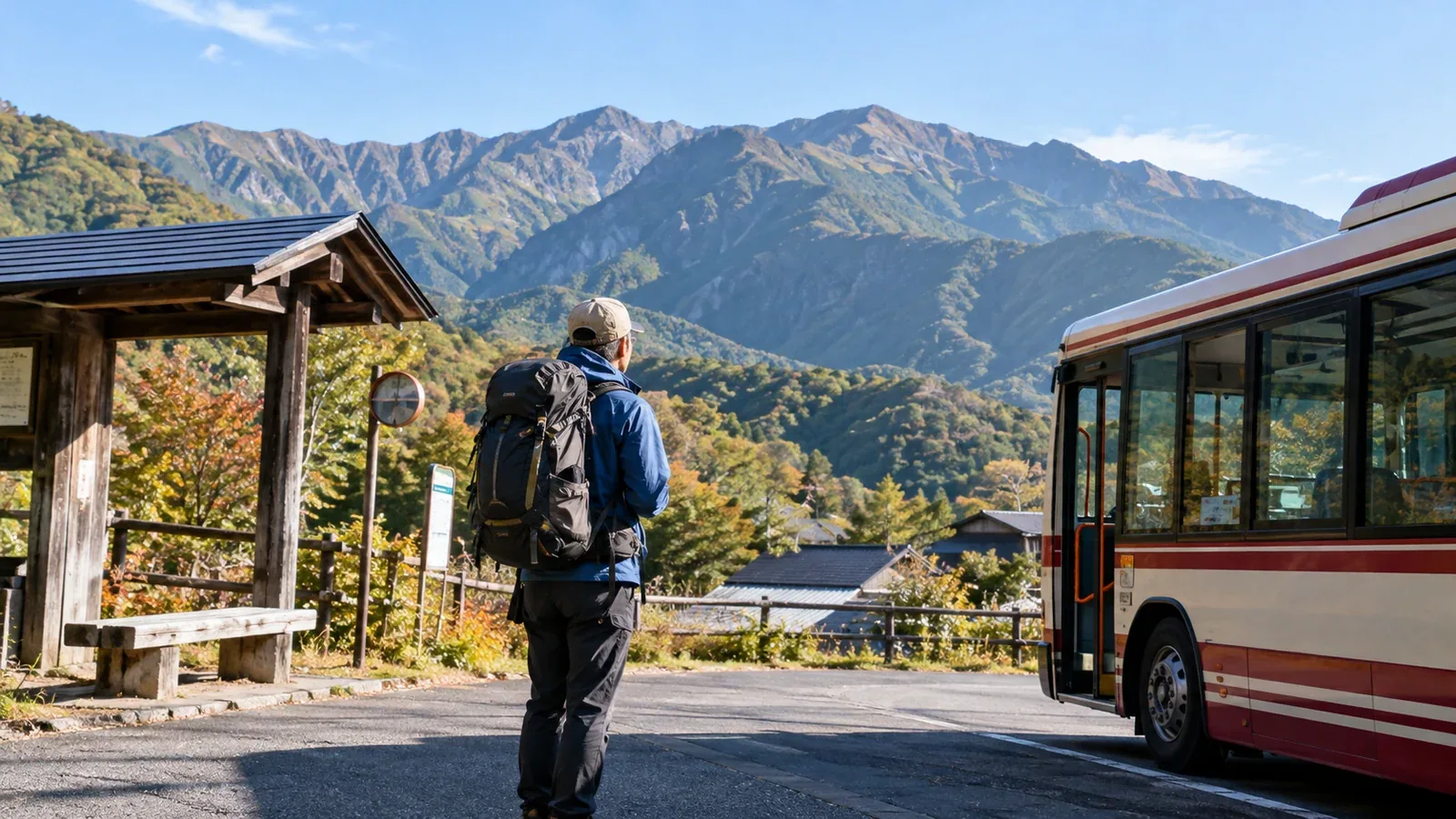
When a traverse starts and ends at different trailheads, plan the journey in and the journey home separately. In some mountain areas you can connect by bus and train. In others, there are few services from the trail's end.
If you leave the return journey until later, you may reach the end after the last bus or find that no taxi is available. Work out your transport while you plan the hike itself.
This guide walks through the transport choices and checks for a hike with different starting and finishing points.
Start with how the one-way route works
If you park at the start and descend to another trailhead, you'll need a way back to your car. Think of the journey to the starting point and the journey from the finish to your car or home as one plan.
There are three main ways to arrange the journey.
- Use public transport for the whole trip: Reach the start by train and bus and return from the end by public transport as well. This is the simplest arrangement if you can do without a car.
- Leave a car at the finish and transfer to the start: Park at the end of the route, then take a bus or taxi to the starting point and begin walking. You can pick up the car when you finish.
- Use two cars with your group: Leave one at the finish and one at the start. After the hike, drive the car at the finish to collect the one at the start.
What works depends on public transport in the area and the size of the group. Start by checking whether buses or trains serve the area.
How to check public transport
Some mountain buses run only in season or have few trips and service days. Your finishing trailhead may have no bus at all, or the last service may leave before evening.
Find routes through local authorities or tourism associations. Then confirm service on your date, the stop or platform, the last departure, and any reservation requirements with the operator. Hiking buses and shuttles in areas with vehicle restrictions may change season dates or schedules. Use information for the day you'll travel and check for cancellations on the day.
If you're taking the train, check the operator's timetable and service updates as well as your route planner. Confirm days of operation and the last train. Allow for walking to the station and consider whether a late bus could leave you without a connection.
If public transport doesn't fit the itinerary, consider a taxi. Ask the taxi company in advance which areas it serves, where it can pick you up, whether you need to book, and how to contact it if you're late. Arrange pickup if needed, as there may be no signal at the end of the trail.
Two ways to use a car
Leave the car at the finish and transfer to the start
Having a car at the finish can reduce waiting and transfers after your descent. Here's how it works.
- Park at the trailhead where you'll finish.
- Take a bus, taxi, or ride with a companion to the starting trailhead.
- Pick up the car at the end and check that you're fit to drive before leaving.
Arrange your bus, taxi, or ride to the start first. Check the operator or local authority's official parking information for capacity, whether multi-day parking is allowed, gate hours, and fees.
Use two cars
If the group has two cars, leave one at the start and one at the finish. When you finish the hike, drive the second car back to collect the first.
Two cars let you travel without relying on a timetable. Compare parking, fuel, tolls, and pickup time. Roads between the trailheads may take a long way around, so check access as well. Drivers who are fatigued or sleepy should rest, switch with someone else, or stay overnight before driving.
Build in a time margin around the last service
A plan that gets you to the last departure just in time can fall apart after a small delay due to weather, health, or a wrong turn. Include the walk from the trailhead to the stop and any connection time in your calculations.
Work back from the last departure. Set your finish time with enough time to get to the stop and a margin for delays. If you can, aim for the service before the last one. If you can't make it comfortably, consider shortening the hike, changing your start time or where you stay the night before, or arranging another way back in advance.
Published hiking times vary from person to person, and your pack is likely to be heavier on a multi-day hike than on a day hike. Allow extra time in an unfamiliar area.
Before leaving, find lodging you can book, alternative services, or a place where someone can pick you up if you're delayed. If you may stay in a hut, ask about opening days, booking requirements, and how to get in touch when plans change. For a planned overnight in a tent, check where camping is allowed and what reservations are needed. Decide when you'll reassess on the trail so you aren't pushed into rushing for transport.
Areas with private-car restrictions
Some mountain areas restrict private cars. To reach Kamikōchi, for example, transfer to a bus or taxi at the Sawando parking lots from the Matsumoto side or at Hirayu Akandana from the Takayama side. Check the official park or operator information for pickup points and service on your date.
Restrictions and transfer points can differ between your start and finish. Private cars cannot enter the Tateyama Kurobe Alpine Route between Tateyama and Ōgisawa stations, for example, and the route operator lists a vehicle transfer service. Check the restricted stretch, dates, and transfer points at both ends of your own route.
What to do next
Locate the start and finish on your map and check outbound and return services with the local authorities or operators. Compare the last departure with your finish time and allow for the walk to the stop and delays. On Nordwand, you can also ask people who've hiked in the same area about their experience.
References
- Ministry of the Environment and Nagano Prefecture (Kamikōchi restrictions and transfer points)
- Alpico Kōtsū (Sawando–Kamikōchi shuttle buses)
- Tateyama Kurobe Alpine Route (access, parking, and vehicle transfer)
- National Police Agency (planning your drive and dealing with fatigue or sleepiness)
References and sources
- Nagano Prefecture | Kamikōchi traffic restrictions
- Ministry of the Environment | Kamikōchi traffic restrictions, 2026 example
- Alpico Kōtsū | Shuttle buses between Sawando parking and Kamikōchi
- Tateyama Kurobe Alpine Route | Access by private car
- Tateyama Kurobe Alpine Route | Parking
- Tateyama Kurobe Alpine Route | Luggage forwarding and vehicle transfer
- National Police Agency | Road safety rules and guidance