
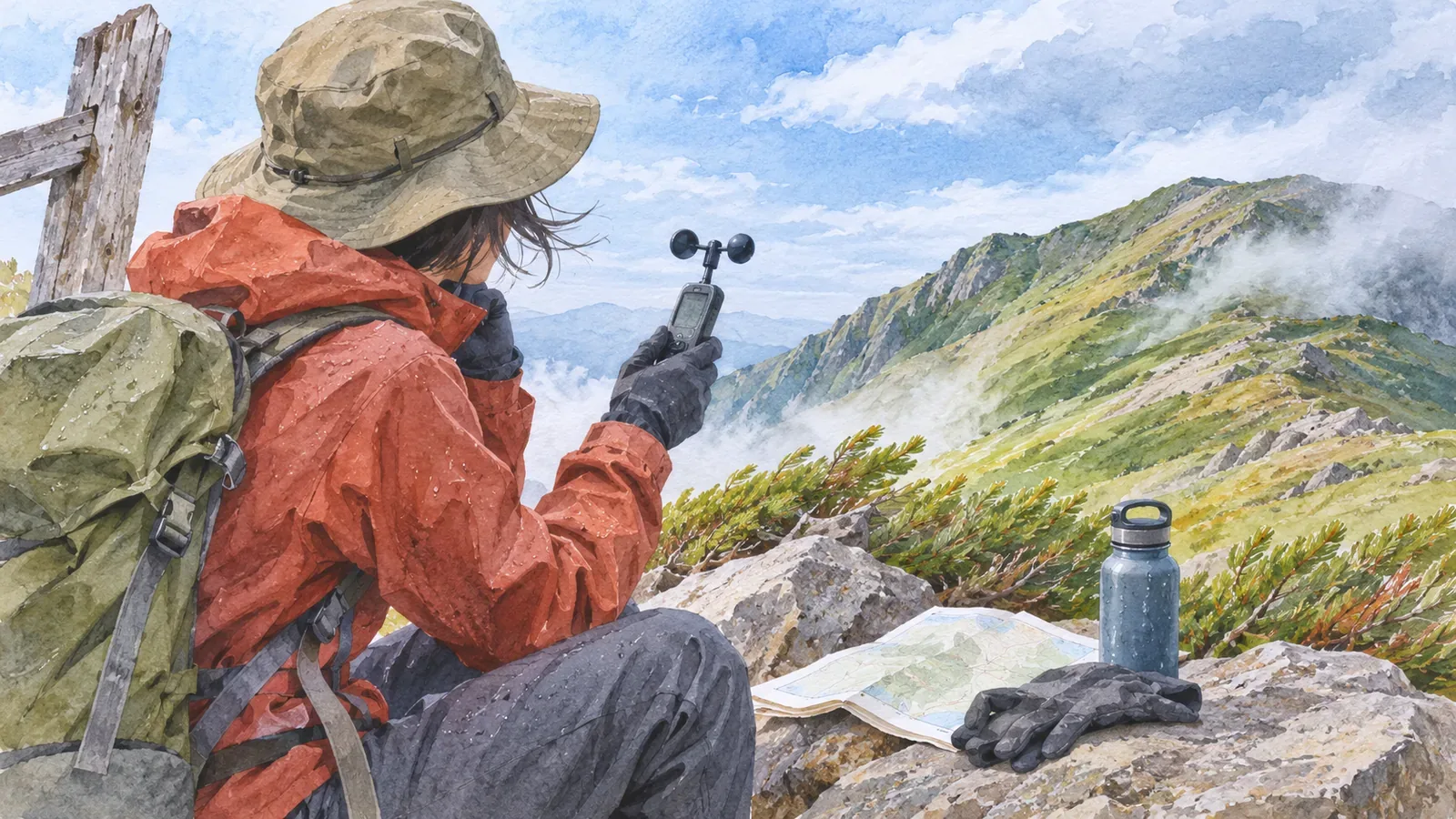
Keep to your original itinerary if the only reason to extend it is a forecast of easing winds. Wind reports apply to particular places and times, and distinguish mean speeds from gusts. Even if the wind eases as forecast, you may still be short of time or physically worn out. Here, extending the itinerary includes leaving or passing a point later, going farther than planned, or staying longer. Use the forecast to reassess the whole hike.
What to check when winds are forecast to ease
The Japan Meteorological Agency defines wind speed as a 10-minute average. AMeDAS wind speeds on the map also cover the 10 minutes ending on the hour. The 15:00 reading, for example, covers 14:50 to 15:00. If the forecast says winds will ease, check the area, forecast time, wind speeds and any advisories. Other services may define fields differently. Read the legend or documentation to see whether a number represents a mean speed or a gust.
The agency currently calculates instantaneous wind speed as the 3-second mean of 12 measurements taken at 0.25-second intervals. The peak gust is the highest such reading in the reporting period. A gust is a sudden, brief increase in wind. A forecast of lower average winds leaves room for short gusts. Knowing how a term is defined and knowing how accurate the forecast will be are two separate things.
Four differences that matter even when the forecast is right
First, average speeds and gusts can differ. The agency’s chart explains that gusts can exceed the average wind speed. Multiplying a forecast average by a fixed factor will not give you the gust speed on that mountain. A drop in the forecast average alone cannot tell you when walking will become easier or whether you will be able to keep your balance.
Second, conditions differ from place to place. The same chart notes that terrain and surroundings affect wind speed and that wind at a spot can differ considerably from a nearby station’s reading. Some strong local winds blowing down from mountains are known in Japan as oroshi, with distinct names in different regions. A forecast of easing winds at the foot of the mountain or a station may say little about a ridge or saddle.
Third, timing matters. As a rule, Japanese prefectural forecasts are issued at 05:00, 11:00 and 17:00 and revised when the weather changes suddenly. Check for updates before leaving and whenever it is safe to do so during the hike. Distinguish the issue time from the time the forecast covers. The longer you wait, the less time you have to descend in daylight and make your transport connections.
Fourth, check how people and gear are holding up. Easing winds do not mean sweat- or rain-soaked clothes have dried or people have recovered from fatigue. How cold it feels cannot be calculated by simply subtracting a wind-speed number. Check temperature, precipitation, clothing, available warm layers and what your companions say. Include the cost of waiting longer when reassessing the itinerary.
Four things to write down before considering an extension
The following is an editorial suggestion. If a better forecast is your only reason to extend the hike, you lose sight of the four differences above. Write these four fields on paper before departure to make decisions easier on the trail. Wind thresholds vary with the range and experience, so this article leaves those open.
In the Forecast field, record when it was issued, the location and time it covers, and the type of wind speed. Check forecasts for the surrounding mountains and the days after your planned descent as well. In On-site conditions, write down wind direction, sudden increases and how easily you can stay steady. In Turnaround criteria, list when to stop or seek shelter and which routes you could take safely. In Deadline, set a cutoff time that leaves a margin for sunset and return transport.
Keep the cutoff and turnaround criteria if the only change is a better forecast. Extending the hike changes how long you are exposed to wind and rain and how much daylight remains. If conditions worsen, turn back ahead of schedule. If the return route becomes dangerous, consider another safe course of action. The original plan cannot justify going back onto a hazardous trail. Use the four fields to organize the information you need for a decision.
Where to stop when comparing the forecast with conditions on site
Wind direction and speed change. Keep notes on how the wind felt separate from instrument readings. A few words on the time, spot, direction the wind came from, how difficult it was to walk and any sudden increase are enough. The agency’s chart describes effects on walking, but you cannot use it to work backward to a wind speed when terrain, pack load and fatigue differ. Keep moving to safety instead of waiting in strong wind to finish the record.
Take notes or check a screen somewhere with firm footing where others can pass. If no such place is available, leave it for later. A connection can provide updates, but you might have no signal or lose power. Keep your turnaround criteria and routes on paper too. Even if the forecast shows easing winds, keep the hike within its original limits if you cannot stay steady or run into another problem on site. If it feels calm, check the time remaining and how everyone is doing before considering any change to the original cutoff.
In short: use the forecast to reassess the plan
A forecast of easing winds is one input when you review a plan. It cannot guarantee an absence of gusts, calm at your current spot, enough time, dry clothes or recovery from fatigue. Setting out the Forecast, On-site conditions, Turnaround criteria and Deadline fields before leaving helps keep a better forecast from dominating your decision. If conditions deteriorate, end the hike early and check what routes or places to shelter you can reach safely.
References and sources
- Japan Meteorological Agency: Wind FAQ
- Japan Meteorological Agency: Wind Terminology
- Japan Meteorological Agency: Wind Strength and Effects
- Japan Meteorological Agency: Weather Forecasts
- Japan Meteorological Agency, Obihiro Weather Station: Before Heading into the Mountains
- Japan Weather Association (tenki.jp): What Hikers Should Know About Temperature — Cold (September 11, 2025)