
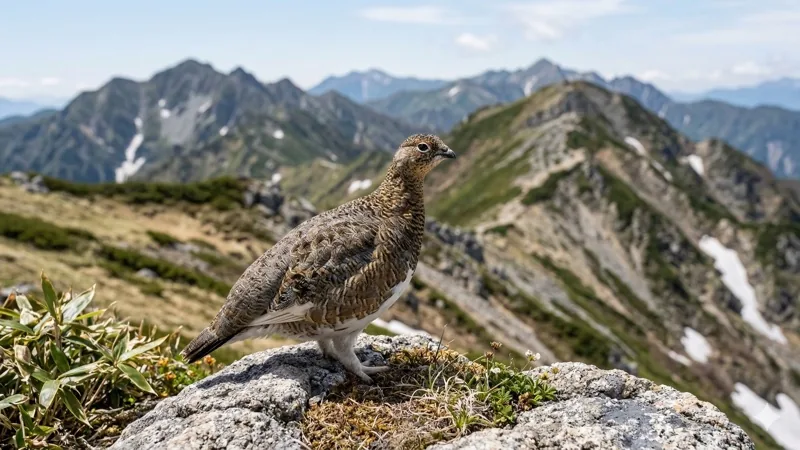
A rock ptarmigan walks along the ridge, a deer calls from the woods, and a bear sighting is posted at the trailhead. On a hike, we pass through places where animals live. Here’s how to avoid surprising bears and give the wildlife you see enough space.
The mountains are home to wildlife
When you see an animal on the trail, remember that you are visiting its home. Feeding it, moving closer, or following it for a picture can interrupt feeding or care for its young.
Animals that receive food from people may start approaching hikers and their packs. Help prevent those encounters by keeping your food to yourself and packing out leftovers.
Avoid surprising a bear
Brown bears live in Hokkaido, and Asian black bears live on Honshu and Shikoku. Start your hiking plan by thinking about how to avoid a surprise encounter.
Let bears hear you where visibility is poor
At brushy bends and along streams, bears and people can be slow to notice each other. Before you spot a bear, use your voice or a bell to make your presence known.
- Use a bear bell or a similar way of making yourself heard as you walk.
- Talking with companions also lets animals hear you coming.
- Look around before entering brushy sections or rounding a bend.
- Where running water or strong winds can drown out sound, also watch the trail ahead and look for tracks or other signs.
Manage food and rubbish
Food and leftovers can draw bears by scent. Check storage rules at campsites and mountain huts.
- Keep food and rubbish in containers or bags that seal.
- Use designated food lockers where provided, and do not leave food in your tent vestibule.
- Pack out rubbish or dispose of it at a designated facility as directed.
- Clean up scraps and spills after cooking.
Check bear reports before leaving and at the trailhead
Check local government or park reports before setting out and read the latest notices at the trailhead and huts. Follow closures. If there has been a recent sighting or you see fresh signs on your intended section, turn back or change routes.
What to do if you see a bear
If you see a bear, do not run. Avoid shouting or sudden movements and put distance between you and the bear.
Respond to the distance and the bear’s behavior
- If the bear is far away and has not noticed you, leave quietly without drawing its attention.
- If the bear has noticed you, move away slowly while watching it, without turning your back.
- If the bear is very close or there are cubs, keep away and avoid sudden movements. If a bear takes food or a pack, do not approach to retrieve it.
If an attack at close range cannot be avoided, lie face down and protect your head, neck, face and abdomen. If you carry bear spray, keep it within easy reach and learn how to use it in advance by following the product instructions and local guidance.
Check park or local government guidance for bear activity and what to do in the area you plan to visit.
Give Japan’s protected rock ptarmigan room
Japan’s rock ptarmigan is designated a national Special Natural Monument. It lives in the Northern and Southern Japanese Alps, on Mount Ontake and Mount Hiuchi, among other places. A conservation program is restoring it to the wild in the Central Alps.
Even if a rock ptarmigan walks onto the trail, stay back. There may be chicks nearby. Wait for the bird to move away so you can watch without interrupting it.
How to watch rock ptarmigan
- Keep your distance. Take photos from well back and leave the flash off.
- Do not feed them. Watch them forage for their own food.
- Do not follow them. Let adults and chicks move freely.
- Stay on the trail. Avoid trampling alpine plants for a photo.
Stop and watch quietly, and you may see a bird walk across the slope or search for food.
If you see deer, macaques, foxes or other animals
Many other animals live in the mountains. The same ground rules apply: keep your distance, do not touch, and do not feed them.
- Sika deer. Deer browsing has reduced alpine vegetation in some places. Give them space and move away quietly.
- Japanese macaques. Put food away and move off without staring or shouting to chase them away.
- Foxes and raccoon dogs. Avoid touching or feeding them. In Hokkaido, be aware of echinococcosis, which can spread through the droppings of foxes and other animals.
- Snakes and stinging insects. Take care in tall grass and near nests. If a hornet comes close, keep low and leave without swatting at it.
Venomous snakes such as the Japanese mamushi and the tiger keelback can be found in tall grass and among rocks. Avoid reaching with bare hands into brush or rock crevices you cannot see into.
Takeaways for the trail
The essentials are to avoid surprising bears, give wildlife space, and keep animals from getting used to human food. Check bear reports before setting out and manage food and rubbish on the trail.
Share recent sightings and wildlife-watching etiquette with your companions so everyone can respond calmly if you encounter an animal.
References and sources
- Ministry of the Environment: Bear safety in national parks
- Shin’etsu Nature Conservation Office: Preventing bear encounters
- Ministry of the Environment: Brown bear safety in Shiretoko
- Shin’etsu Nature Conservation Office: Rock ptarmigan conservation and recovery
- Nagano Prefecture: Watching rock ptarmigan responsibly
- Kanagawa Prefecture: What to do if you see a macaque
- Shiretoko National Park’s Rausu Visitor Center: Land mammals
- Kanto Regional Forest Office: Animals to be aware of in forests