
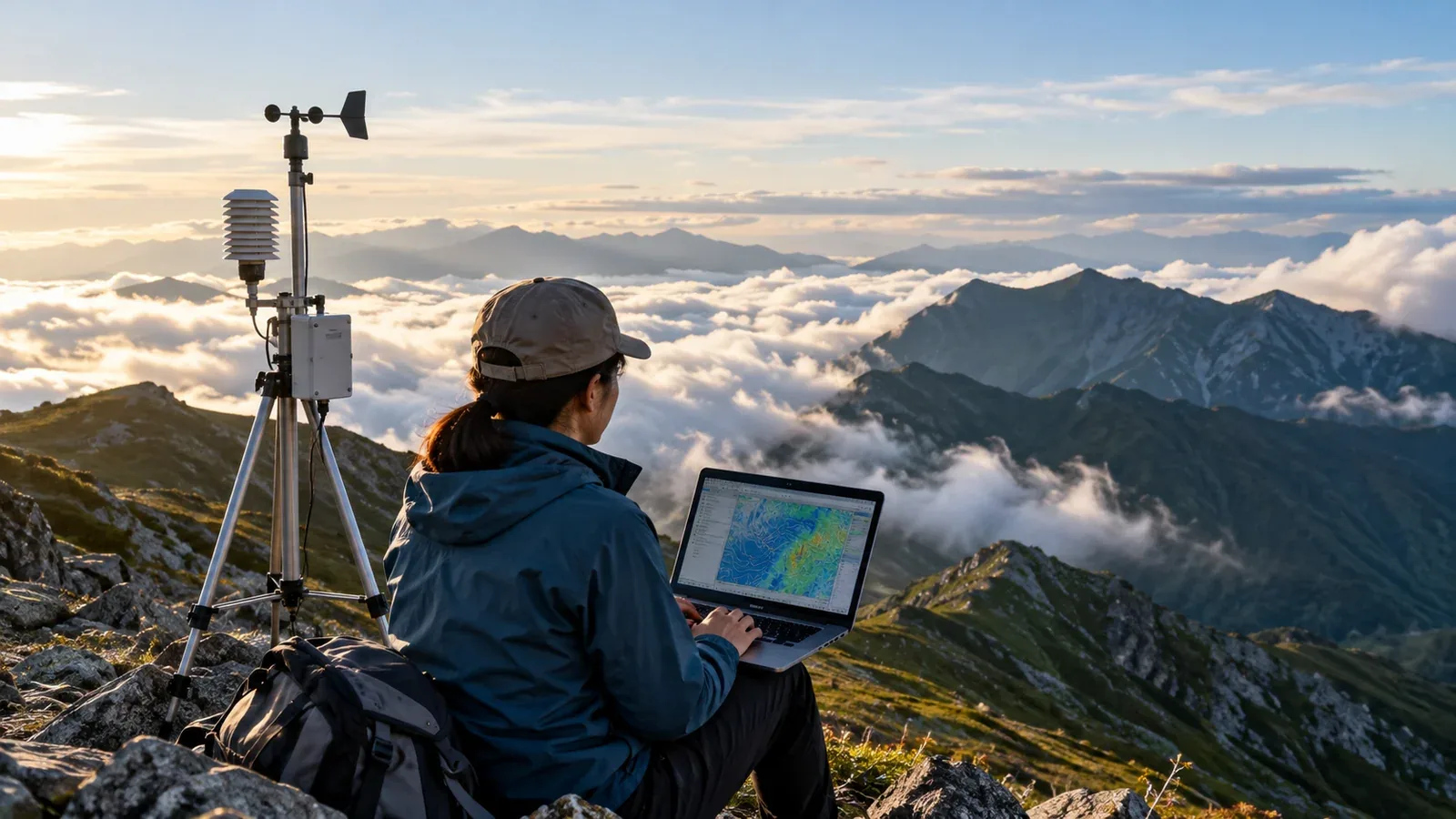
If you want to work with mountain weather, you may wonder what qualification you need. Japan’s national qualification is Registered Weather Forecaster. “Mountain weather forecaster” describes someone who specializes in mountain conditions. In private-sector forecasting, knowing how to interpret mountain weather and gaining practical experience help you apply what you learn for the qualification.
A mountain forecast can directly affect hikers’ safety. Preparing one calls for detailed knowledge and a way to communicate it to people on a route. This article looks at qualifications, specialist knowledge and practical work.
Why the weather forecaster qualification matters
Under Japan’s Meteorological Service Act, a person or organization that regularly provides its own forecasts for users in Japan generally needs a permit from the Director-General of the Japan Meteorological Agency (JMA), whether or not it charges. The permit belongs to the forecast service operator, which can be an individual. Weather predictions must be made by registered forecasters in accordance with the law.
To become a registered forecaster, pass the exam run by the Japan Meteorological Business Support Center, then register with the JMA. The exam has general and specialist written papers and a practical test. There are no age or education requirements. The examination body publishes the current syllabus, dates and pass rates.
Before studying, decide whether you want to produce forecasts or use mountain weather knowledge in another role. That will shape what you need to learn.
What makes mountain weather different
Mountain weather is complex. Working with it means learning how local conditions can differ from broader forecasts.
How terrain changes airflow. A forecast model may not resolve the differences between a valley and a nearby ridge. Interpreting the numbers takes an understanding of mountain and valley winds, föhn winds, rain or snow caused by terrain, and stronger winds on ridges.
Thunderstorms and forecasting limits. Thunderclouds can develop quickly in the summer mountains and disrupt a hiking plan. Use the regional forecast to think about where a route is exposed to wind, rain or lightning. Check thunderstorm advisories and the JMA’s lightning nowcast. Conditions can change rapidly even in areas where it currently shows no lightning activity.
Winter weather and combined cold and wind risk. Wind chill, the relationship between snowfall and snow conditions, and temperature inversions all matter in winter. Misreading them can lead to a forecast that differs considerably from conditions on the ground.
Books help, and time in the mountains lets you compare what you read with what you observe. Repeated practice with both builds the skill.
Career options in mountain weather
You can work on producing forecasts, use existing forecasts in guiding or teach people how to read weather information.
Working for a weather service
At companies that provide mountain forecasts, registered forecasters produce information for hikers. One path is to gain experience in general forecasting before specializing. Look at who provides the forecasts in hiking apps and mapping services, then check those companies’ services and vacancies.
Combining weather expertise with mountain guiding
A mountain guide qualification, such as one from the Japan Mountain Guides Association, and a weather forecaster qualification can support a guiding practice that makes weather assessment central to safety decisions. Some guides build their meteorology skills as they broaden their work and improve their decisions in the mountains.
Freelance work and communication
Mountain experience and weather knowledge can help you teach map and weather chart reading through media, social platforms or hiking courses. According to the JMA, explaining or relaying a forecast already issued by the JMA or a permitted provider does not require a forecast service permit. If you plan to issue and regularly supply your own forecasts, check with the JMA before starting.
How to learn and prepare
The path varies by person. These four steps give you a starting point.
- Pass the exam and register. Start with the general and specialist written subjects, including numerical forecasting, atmospheric dynamics and the fundamentals of climate. Once you pass, apply to the JMA for registration.
- Build specialist mountain weather knowledge. While preparing or after passing, use books, courses and training focused on mountain weather. Look for learning opportunities for hikers from the National Mountaineering Training Center and mountaineering organizations.
- Practise using forecasts on hikes. Read the forecast before leaving and compare it with conditions you observe. Connecting charts with what happens in the mountains builds practical judgement.
- Find ways to gain work experience. Check weather service internships or part-time work, guide training or opportunities to assist with weather observations at huts. Look at recruitment and training pages for what each organization offers.
What to consider for a lasting career
Think about which work will support your income and how much time you can devote to mountain weather. You could work for a weather service and take on mountain projects, or combine guiding, writing and teaching.
A wrong forecast can put people at risk. Say plainly when a situation is hard to assess. Producing accurate forecasts and communicating uncertainty are both part of the job.
Where to start
Check the JMA and the Japan Meteorological Business Support Center for registration requirements, exam dates, subjects and pass criteria. Then look for relevant books and courses from the National Mountaineering Training Center or mountaineering organizations. In the Nordwand community, you can compare experiences and talk about how people read forecasts.
References
- Japan Meteorological Agency: Meteorological Service Act and related information
- Japan Meteorological Business Support Center: Official examination information
- Japan Mountain Guides Association: Guide qualifications
- Japan Sport Council’s National Mountaineering Training Center: Training information
References and sources
- e-Gov Japan: Meteorological Service Act
- Japan Meteorological Agency: Weather forecaster registration
- Japan Meteorological Agency: Forecast service permits
- Japan Meteorological Agency: Frequently asked questions about forecast service permits
- Japan Meteorological Agency: Lightning nowcast
- Japan Meteorological Business Support Center: Weather forecaster examination
- Japan Meteorological Business Support Center: Examination results
- Japan Mountain Guides Association: Qualification categories and scopes of practice
- National Mountaineering Training Center: Training course applications