
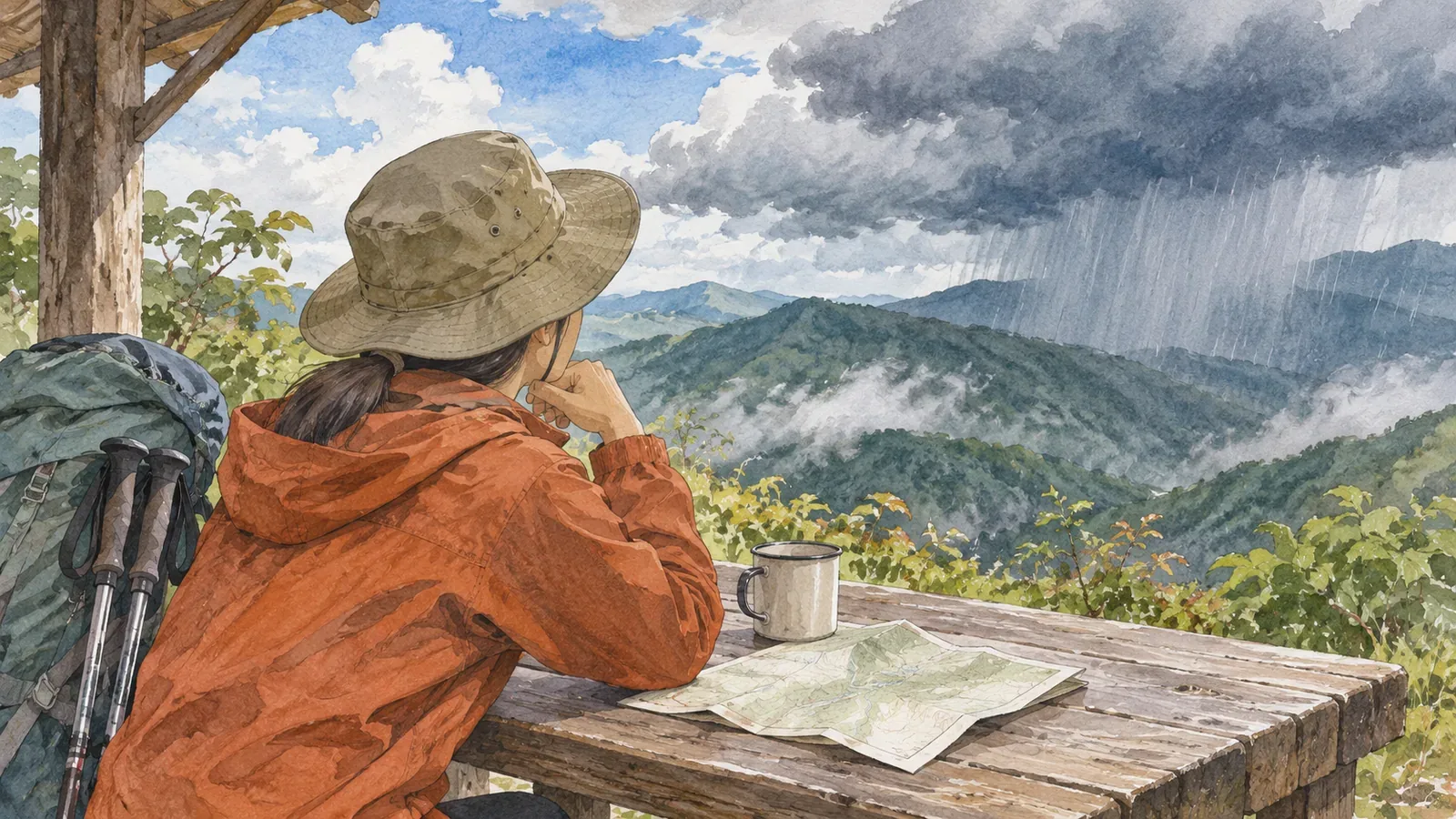
Precipitation probability is the chance of at least 1 mm of precipitation during a stated period. The amount is how much is expected to fall during that period. A high probability can mean light rain, and a low one can still mean a downpour. Check the place and time before comparing the numbers. Here’s how to read the two figures before leaving, using the Japan Meteorological Agency (JMA) definitions.
What precipitation probability tells you
JMA’s probability is the chance of at least 1 mm of precipitation in a forecast area. It is issued in 10-percentage-point steps for six-hour periods. A forecast of 20% means the threshold would be reached about 20 times in 100 comparable forecasts. The probability tells you whether at least 1 mm is likely to fall. It gives no information about intensity or total amount. The same published probability applies at each point in the forecast area. Prefectural forecasts are issued for subdivisions of each prefectural forecast area, so a summit or ridge has no separate value.
Two forecasts of 60% may involve very different amounts of rain. The probability alone doesn’t tell you what gear you’ll need or how the route will be affected. The published number applies throughout the forecast area and can’t pinpoint how the summit differs or where rain will be heaviest. Look up local rainfall amounts as a separate step.
The time windows differ too. Prefectural precipitation probabilities through tomorrow are shown in six-hour blocks, while a weekly outlook gives the probability for the whole day. The weekly figure alone can’t tell you whether it will rain by day or by night. As departure approaches, check the six-hour windows that overlap your hike and then look for more detail.
Where to check the expected amount
The gridded weather forecast is one way to estimate rainfall. It divides Japan into grid cells and uses colors to show weather, temperature and precipitation through the end of tomorrow. Weather and temperature are shown in three-hour steps. Each cell’s average three-hour precipitation is grouped into six bands: none, 1–4 mm, 5–9 mm, 10–14 mm, 15–19 mm, and 20 mm or more. It is issued daily at 05:00, 11:00 and 17:00.
Today’s forecast uses squares 5 km on a side. JMA changed from 20 km squares in March 2020. A cell average can hide differences within the cell. Check where the trailhead and summit sit on the map, along with the surrounding pattern.
The Obihiro Weather Station suggests checking total rainfall over the previous 72 hours to assess trails and streams, especially when planning several days ahead. Its guide is written for Tokachi and the surrounding area, so apply that advice in light of local conditions elsewhere. Several days of light rain can add up and affect the trail.
The wording matters too. JMA’s “occasional rain” means intermittent rain for less than half of the forecast period. “Temporary rain” means a continuous spell lasting less than a quarter of the period. Weather icons give priority to rain or snow when either is expected. Check the written forecast and regional time series before assuming a rain icon means all-day rain.
How to read probability and amount together
A few days out, check the weekly outlook and the A–C confidence grades for whether precipitation will occur from day three onward. Check the days around the hike and after the planned descent. Closer to departure, line up the prefectural six-hour probabilities and gridded three-hour amounts with your itinerary. Record rain that has already fallen in a separate column. The previous 72-hour total describes past observations. Keeping past and expected rain apart shows why trails and streams still need checking even when the outlook is improving.
If the probability is high but the forecast average is low, prepare for precipitation while keeping the amount in perspective. Heavy local rain is still possible despite a low average. High probability and large amounts are reasons to consider shortening or canceling. If both are low, prepare for rain and check again before leaving. If the figures seem inconsistent, check the area, time window and issue time. Weigh them alongside wind, lightning and local trail conditions.
Try making a table before leaving. For each period of the hike, write down the probability, the amount band and what remains uncertain. That makes it easier to spot periods with a high probability and a low amount, or the reverse. Use the table to organize your decision and leave room for forecast error.
Rechecking on the day and understanding the limits
JMA’s short-range forecast and “Rain Cloud Movement” are useful for a last check. The short-range forecast shows hourly precipitation totals. It updates every ten minutes for the first six hours, on 1 km squares, and every hour for hours seven to fifteen, on 5 km squares. Use “Rain Cloud Movement” on the JMA site for precipitation intensity over the next hour.
The forecast for the first six hours accounts for the movement of precipitation, terrain, and rain strengthening or weakening. Numerical model results are incorporated in the latter part of that horizon. Local downpours can still appear with little warning, and radar can show echoes where nothing is reaching the ground. Check the latest forecast before losing signal in the mountains. A saved image can be read offline, but it won’t show later changes.
Forecasts change as observations and calculations are updated. Compare the latest issue for the same valid period. Different providers may offer different figures for the same place. Align issue times and what each forecast covers, then allow for the uncertainty by building in time or keeping cancellation as an option. A past national accuracy score can’t tell you how often the predicted rainfall for a particular mountain will be right.
The Obihiro guide notes that forecasts can change substantially near typhoons and stationary fronts, including Japan’s early-summer and autumn rain fronts. Check the forecast, warnings and advisories at departure, even if yesterday’s forecast looked favorable. If conditions deteriorate in the field, reconsider your route without waiting for an update.
Summary: probability tells you the chance, and amount tells you how much
Probability describes the chance of at least 1 mm of precipitation. Look up expected amounts in gridded or short-range forecasts, and past amounts in observations. Check the location and time for each. Carry rain gear even with a low probability, and weigh other conditions even if the average amount is small. Use the latest information to review your route.
References and sources
- JMA: Weather forecasts
- JMA Obihiro Weather Station: Before you go into the mountains
- JMA: Gridded weather forecasts
- JMA: Questions about weather forecasts and weather charts
- JMA: Precipitation nowcasts and short-range forecasts
- JMA: Improvements to gridded and time-series weather forecasts (March 13, 2020)
- JMA: Weekly weather forecast