
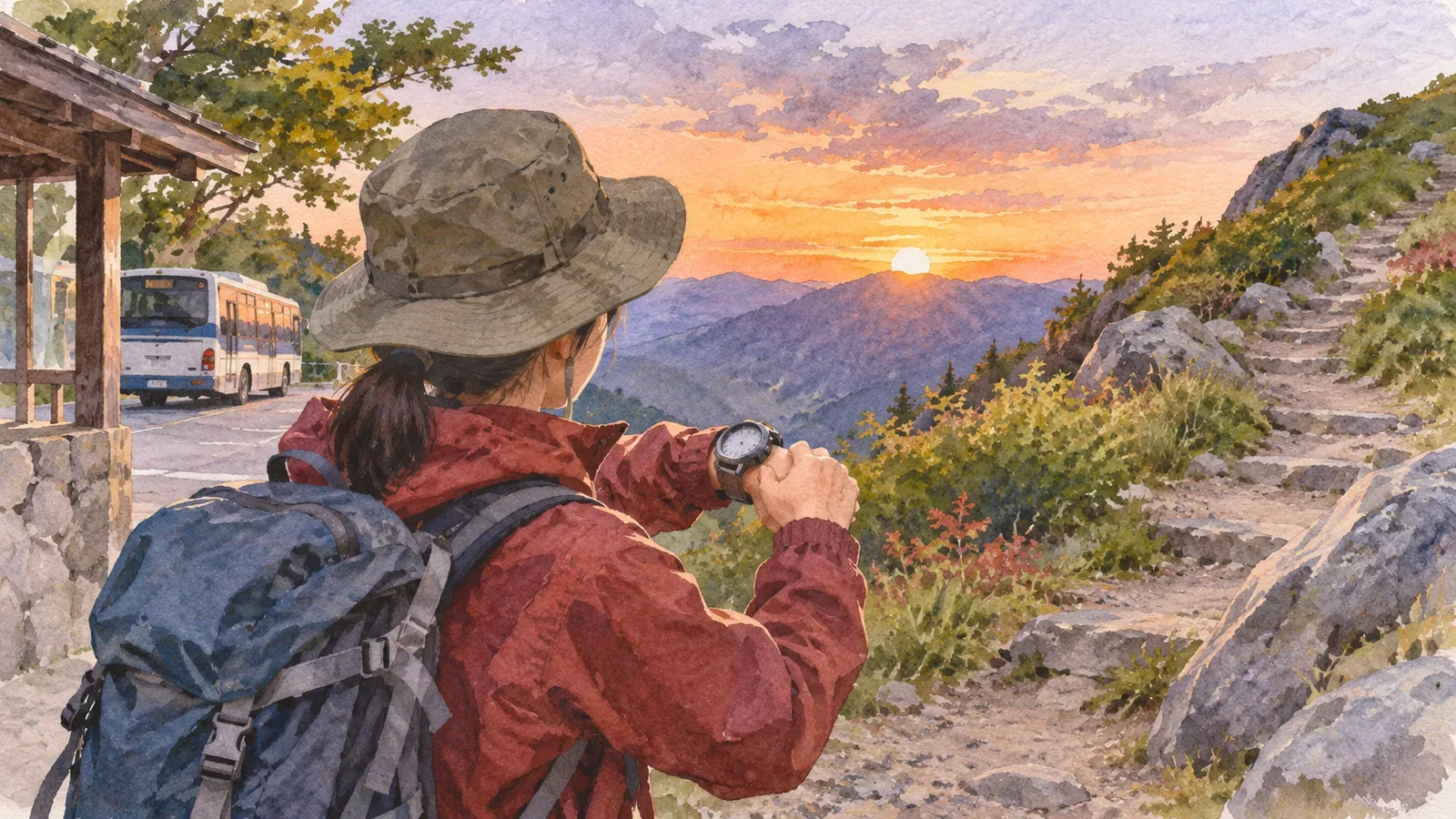
Write down a turnaround time before setting out so that a bus or train deadline does not make you rush the descent. You have a sunset time to plan around, and some routes also depend on public transport. Schedules can vary by season and year. Here is how to check them and build them into your route. Treat the turnaround time as the latest you can continue. Head back earlier if conditions deteriorate.
Two clocks: sunset and the last ride
Public guidance recommends working back from a deadline. In a 2014 Mount Fuji ranger diary, the Kanto Regional Environment Office advised hikers to estimate their walking time and start early enough to return before sunset. It noted that day hikers who were still heading towards the summit around 3 or 4 p.m. would be descending at dusk. The account concerns the Yoshida Route in 2014. Timetables and routes differ, but the method works for other hikes.
Fukui Prefectural Police advise arriving early in the afternoon because darkness makes it easier to lose the trail, trip or fall. Yuzawa Town asks hikers to check current weather and trail conditions and leave enough time to get down before sunset. Check any facility’s check-in deadline and operating hours separately with its operator.
A 2021 summer hiking advisory from the Central Council for Mountain Accident Prevention also urged hikers to check transport operations and access to trailheads. That advice appeared under pandemic precautions at the time. For your trip, check the operator’s current service for the day and season, any reservation requirement, and the stop and destination. Write the service you intend to take into your itinerary.
Sunset and the last ride apply to different places. Work backwards separately from the time you need to be safely off the mountain and the time you need to reach the stop with minutes to spare. Use the earlier turnaround time. On the day, assess how you feel, the weather, the trail and how much walking remains, and head back earlier if needed.
Working back from the last service
Choose one time for each checkpoint where you may turn back. Official guidance gives no fixed numbers. Use your own records and follow Kanagawa Prefectural Police’s advice to plan around your fitness and experience. First, check the operator’s latest timetable for a service you can catch with time to spare and for the last service. Write both down and check them again shortly before leaving. Second, estimate how long it takes to get from the end of the trail to the stop. Third, use a guidebook time or your own records to estimate the descent from the checkpoint to the trail exit. Fourth, set aside time for breaks, getting ready and minor delays. Subtract the last three estimates from the departure time of your intended service. That gives you one turnaround time. If only the last service works, review whether the hike is viable with a backup in case of delay. Do the same calculation from sunset, leaving out the walk to the stop, and use the earlier result.
Give the descent its full share of time. The Environment Ministry’s 2014 Mount Fuji account gives a standard 8–10 hours for a day hike and an average of 3 hours 30 minutes to descend the Yoshida Route. Those figures apply to Mount Fuji in that account. They illustrate how a descent alone can take hours.
For each junction, hut or other checkpoint, write down a rule such as “If we haven’t reached this point by this time, we turn back.” That spreads the decision across the route. Agree in advance that reaching the turnaround time means heading back, even if the summit looks close.
Arrange a way back if you miss the last service
Review any plan that depends on rushing down the trail to catch the last ride. The Fukui police booklet lists unrealistic routes and schedules among the less obvious risks. It also cautions against starting a hike short on sleep and rest after driving through the night. Plan the trip there, the hike and the trip home together, and allow for delays without relying on a faster descent.
Write down how you would get home if you missed the last ride. Possibilities include accommodation, another service, someone who can pick you up and a person you can contact. Include options you’ve confirmed you can use, along with their costs and hours. Mountain huts have operating seasons, booking requirements and check-in rules, so confirm in advance whether you can stay.
Fukui police also recommend preparing a turnaround plan in case you cannot complete the hike as planned. Include how you will get home after turning back so that the risk of missing your ride weighs less on the decision. Agree to use your backup if delayed. The booklet warns that losing the trail, tripping or falling become more likely after dark.
What to write down, share and check on the day
The National Police Agency’s 2024 overview recommends allowing enough time, identifying hazards and escape routes, and preparing, sharing and submitting a hiking plan. Kanagawa police also recommend telling your family or another contact. Add your turnaround times, last departure and confirmed backup to the copy you share. Tell your contact when you are down and agree on how to notify them of changes. For amendments and descent reports, follow the current instructions of whoever received your plan.
Communications have limits. The National Police Agency says GPS-enabled phones can help you request rescue, but reception and battery power are limited on many mountains. Agree in advance on check-in times, how your contact will follow up if you are late, and who they can ask for help if they cannot reach you. If you discover an accident or an immediate danger, act without waiting for the check-in time.
To study the time or the map, stop where your footing is secure and others can pass. Check at junctions and before changing your route. When the turnaround time arrives, end the outward leg and check whether you can safely use the planned descent. If you are lost or too unwell to move, assess the situation and request rescue if needed.
Set your turnaround time before you leave
Work back separately from sunset and your transport deadline, allowing for the descent and delays. Write the earlier turnaround time for each checkpoint. Confirm an alternative way home if you miss the last ride and share it with your hiking plan. The last ride has a fixed time, but you can choose your turnaround time before leaving. Check the time from a safe place and turn back when you reach the deadline you agreed on.
References and sources
- Ministry of the Environment | Mount Fuji ranger diary 14: Planning a day hike
- Yuzawa Town | Hiking information
- Fukui Prefectural Police | Preventing mountain accidents
- Central Council for Mountain Accident Prevention | Summer hiking advisory, July 2021
- Atsugi Police Station, Kanagawa Prefectural Police | Preventing mountain accidents
- National Police Agency | Overview of mountain incidents in 2024