
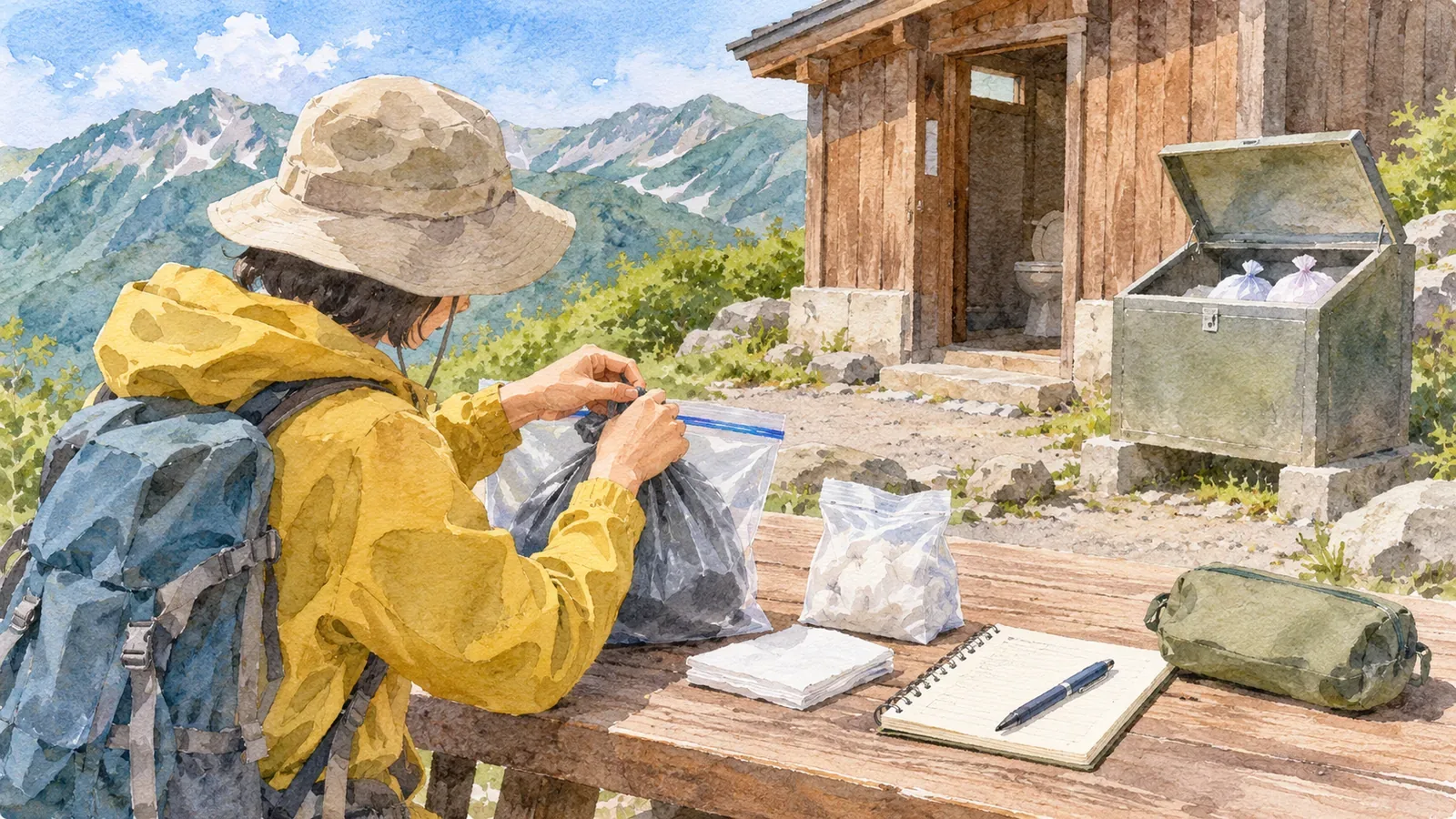
Before you leave, work out how you will seal a used portable toilet and where you will take it for disposal. Yakushima’s guidance provides an example of what to plan if you use a designated collection bin or take the bag home.
Seal the used bag and carry it out in an odour-proof outer bag
The Yakushima World Heritage Center shows four steps. Fit the bag over the seat and spread the absorbent sheet before using it. Afterwards, remove the bag and tie it closed. Place it in the odour-proof outer bag. Once you descend, put it in a dedicated collection bin at a trailhead or another designated location. These steps illustrate the Yakushima guidance. Check the instructions for your own kit and the signs where you use it.
The Ministry of the Environment’s technical guide describes portable toilets as a system in which the user takes the bag to a designated collection point or home. Follow the relevant disposal rules. Do not burn or bury a used bag on the mountain.
The Ministry’s report on hut toilets calls for making portable toilets easy to obtain, use and dispose of. On longer hikes, work out how many days you may need to carry used bags and decide how many spares to pack and where to store them. If you plan to drop off a bag at a hut along the way, ask first whether the hut takes them.
Find the collection bins and check disposal rules where you’ll take the bag
The Yakushima World Heritage Center lists collection bins at the Shiratani Unsuikyō entrance, Arakawa trailhead, Yakusugi Land entrance, Yodogawa trailhead, Ōko Forest Road entrance and the parking lot in front of the Yakusugi Museum. Its guidance also says that bags brought down to inhabited areas on the island can go with burnable waste. Elsewhere, check both the collection points for the hike and the waste rules of the municipality where you’ll dispose of the bag.
On a traverse or loop with a different finishing point, check for a bin where you’ll come down. Seeing a bin at the start doesn’t mean you’ll pass it on the way back. Mark the bin on your route and pick another disposal point if you won’t pass it. Yakushima’s bins are for used portable toilets only. Keep general rubbish out.
In 2014, the Ministry’s Mount Fuji notice said the toilets near the summit on the Yoshida ascent trail would be unavailable from September 11. Portable toilets were distributed and collected at the Fuji Subaru Line fifth station at that time. The official climbing site still asks hikers to carry a portable toilet and pack it out after use. Check the guidance for the year you visit for collection locations and dates.
The Ministry’s report also notes the problem of used bags abandoned near trails. Seal the bag and take it with you when leaving the booth or toilet. Be ready to carry it home if the bin you planned to use is unavailable.
Check how to handle toilet paper and general rubbish
The Yakushima World Heritage Center says its portable-toilet booths do not provide toilet paper or rubbish bins. The booth has a seat for attaching a bag you bring, without the waste collection system of a flush or pump-out toilet. The used toilet bag is only one of the things you may need to carry out.
Fujisan Club’s 2018 guidance asks hikers to bring a rubbish bag and take all their waste home. Check the portable toilet’s instructions and local signs to find out what to do with used paper. The Ministry’s guide also notes that some facilities require paper to be separated.
Prepare the waste bag, the odour-proof outer bag and a bag for general rubbish according to the product instructions and local disposal rules. Check whether toilet paper can go in the waste bag before sealing it. Keep sealed bags closed when sorting your rubbish.
Write down how you’ll carry out the bag after descending
Before leaving, make a note of five things to plan between using a portable toilet and disposing of it.
First, record your finishing trailhead and whether it has a collection bin. Second, check the municipality’s disposal rules in case you need to take the bag home. Third, decide which bag you’ll use and where to store it in your pack. Fourth, count your spare kits and odour-proof bags. Fifth, plan how to carry the used bag on your journey home. Record bin hours and conditions, and follow any local sorting signs, such as those on Yakushima.
At home, look over an unused kit and familiarise yourself with how to fit, seal and store the bag. After use, seal it promptly as directed and carry it out of the booth. Stop on stable ground where others can pass before updating notes or rearranging gear. You can leave the notes until later. Seal the bag straight away.
In short — Plan for your finishing trailhead and disposal point
Seal the bag as the product directs and take it to your planned disposal point. Before you leave, check that the collection point fits your route and find out how to dispose of the bag if you take it home. Collection and sorting vary by location. Plan with the latest local guidance.
References and sources
- Ministry of the Environment, Yakushima World Heritage Center — Portable toilet guidance
- Ministry of the Environment — Guide to human waste treatment in toilets in natural areas
- Ministry of the Environment — Provision and maintenance of mountain hut toilets (Chapter 2)
- Ministry of the Environment — Guidance for using public toilets on Mount Fuji (2014)
- Fujisan Club — How to take your rubbish home from Mount Fuji (2018)
- Official Mount Fuji Climbing Website — What to know before climbing Mount Fuji