
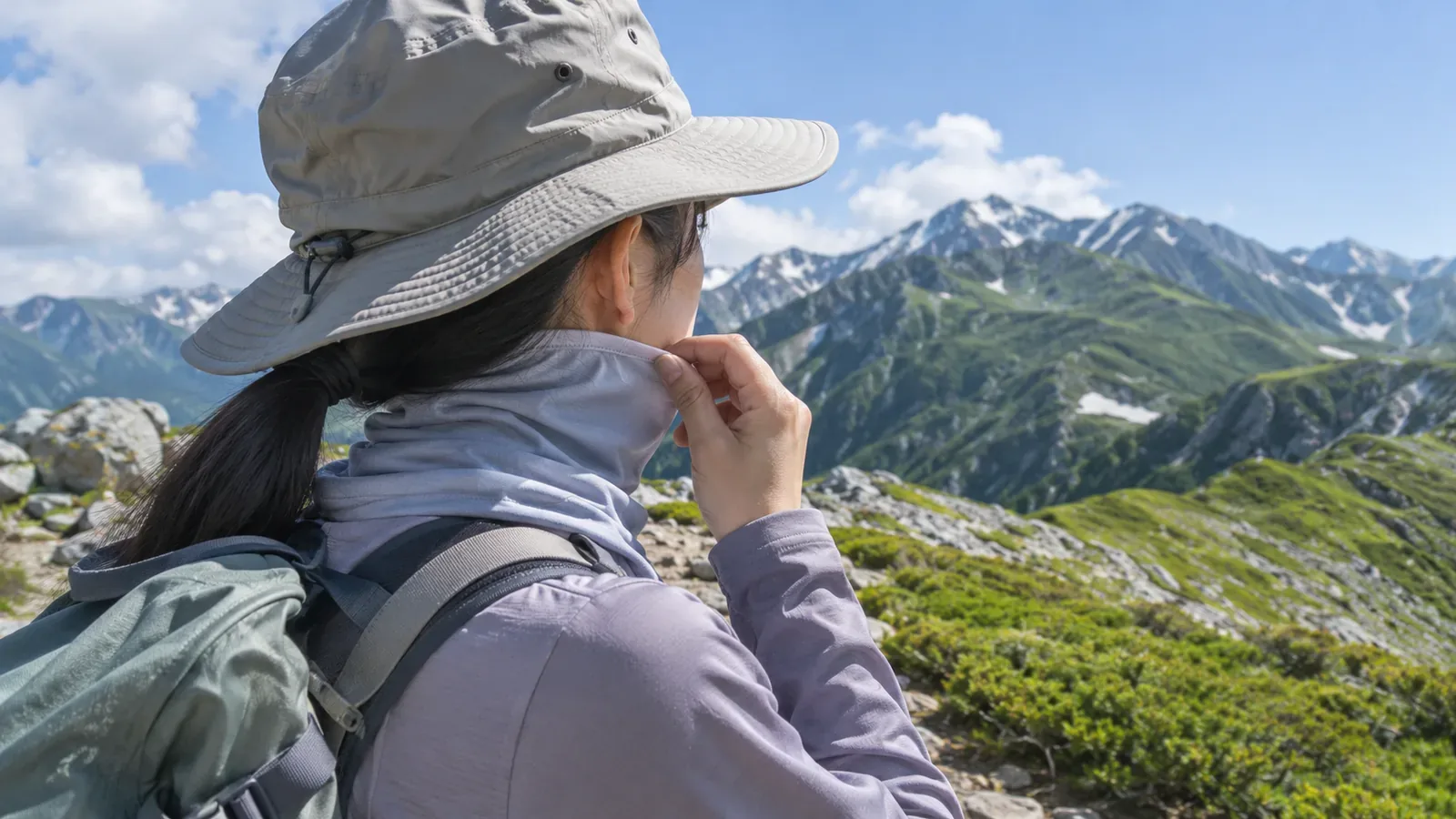
To find out which movements expose your neck and ears, try on what you will wear in the mountains. Put on your hat, collar, hood and pack and change position somewhere safe. The skin you can see in the mirror gives you clues for planning, but a fitting cannot measure how much UV the clothing or shade blocks.
A hat’s shadow and coverage of the neck and ears are different
Japan’s environment ministry handbook recommends combining a wide-brimmed hat with clothing covering the neck and arms and well-fitting sunglasses. It gives an estimate that hats reduce UV exposure to the eyes by about 20%. This is no uniform rating for all hats or all parts of the body. The handbook notes that wide-brimmed hats can have a greater effect.
Keep the estimate for eyes separate from protection for the neck and ears. When trying on gear, distinguish areas of exposed skin, areas under fabric and areas in shade with no fabric. UV protection varies with the fabric and its condition. Even covered skin can receive some UV. Check product specifications and avoid using the number of covered areas as a protection score.
Light reaches you from several directions
UV also reaches you after scattering in the air or reflecting off the ground. The ministry explains that surfaces like fresh snow reflect strongly and that UV generally increases at higher elevations. Adding reflectance and altitude figures together cannot tell you the dose at your neck or ears. Check what your outfit covers while allowing for light from beyond the area directly above the hat.
Clouds also give only partial protection. The ministry’s handbook gives an estimate of 80–90% of UV-B passing through thin clouds. The Japan Meteorological Agency explains that even in overcast weather you may receive strong UV if the sun comes out briefly. The forecast uses a representative altitude for a cell about 20 km square, usually the elevation of the plains when the cell includes both plains and mountains. UV may be stronger than shown in the mountains where the air is unusually clear.
Our editors infer that scattered and reflected UV may reach your face from the sides and below as well as from overhead. Even when it feels as if your hat shades you, its shadow may miss your earlobes, the back of your neck and the area under your chin. The sources do not measure UV reaching those spots. Use the possibility to decide what to check.
A fitting routine to try at home
Try on your gear on a stable surface at home. In the mountains, check the ground and surroundings before stopping to adjust your clothing. If something shifts and blocks your view or leaves you getting cold, deal with it before the planned break. Find a place to adjust your gear before reaching hazardous terrain. Be prepared to stop the hike if you cannot make the necessary adjustments.
Put on the hat, outer layer, hood, neck covering and sunglasses you plan to wear. Load your pack as you normally would and put it on too, so you can see whether the straps or back panel shift your clothing. Secure the mirror and use a bright room. You can check indoors without looking directly at the sun or staying in strong sunlight.
Try the positions you use on a hike. Start by standing upright, then turn your head left and right as if looking at a map or the view. Look up as if toward a ridge or the sky, then down as if checking your footing. Swing your arms and try holding hiking poles. Finally, check what changes when you move a zip or hood.
Check the tops and backs of the ears, the lobes, the back and sides of the neck and any gaps around the collar. For areas you cannot see, ask someone at home to look or take a picture with a device set on a stable surface. Record whether skin is exposed, covered by fabric or shaded without fabric, keeping the last two distinct.
Put exposed spots on one sheet for decisions on the day
Make specific notes for each position, such as “looking right exposes the left side of my neck.” Consider adjusting a collar or covering, applying sunscreen to exposed areas or changing the hiking hours. After adjusting, check that you can see, move your neck and breathe comfortably and that you are not overheating. Keep enough ventilation and freedom of movement while covering more skin.
Check the UV index on the day. The WHO recommends special care when it is 3 or above and advises combining shade, clothing, a hat, sunglasses and sunscreen. The forecast is a general index and cannot be combined with the fitting sheet to calculate a personal safety score. Use sunscreen according to the instructions and keep time in the sun short.
Repeat the fitting each season. From autumn to winter, you may wear higher collars, hoods and neck coverings. Snow also increases reflection from below. If your fitting leaves areas exposed and the UV index is high, keep options such as starting at a different time, shortening the hike or choosing another day. It may be more practical to change the plan than keep adjusting clothing to cover every spot.
In short: check which movements expose your skin
When trying on gear, check which positions expose the neck or ears and whether anything interferes with movement or visibility. Record fabric coverage and shade separately, and combine protection based on product information and the day’s UV index. A count of visible spots cannot tell you how much UV you will receive or whether the protection is adequate.