
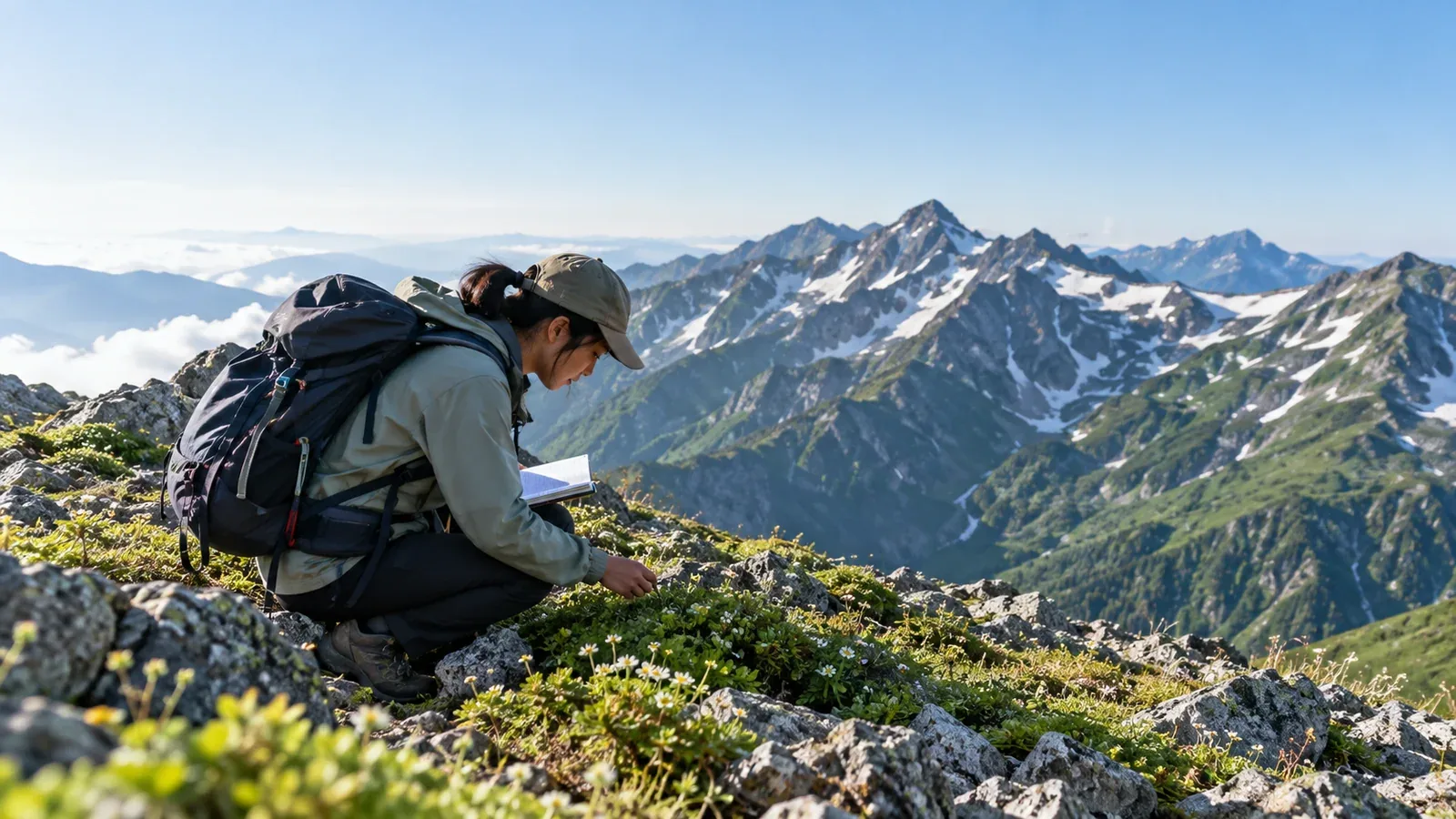
Guiding and mountain rescue are often the first careers people think of when they want to work in the mountains. Research offers another way to spend your working life getting to know them.
Mountain researchers study how terrain forms, which species live in mountain ecosystems and how weather changes at high elevations. Based at universities or research institutes, some collect observations in the field while others analyze satellite data or numerical models. Fieldwork requires both research skills and the ability to move safely in the mountains.
This article looks at the main areas of mountain research, the training they require and the institutions where you can build a career.
Three main areas of mountain research
Geography and Earth science: landforms and geology
Why does a mountain have the shape it does? Researchers may study where glacial landforms occur, how quickly bedrock weathers or how landslides and sediment move. In Japan, they also study volcanic terrain and periglacial landforms shaped by processes such as freezing and thawing.
Field methods include GPS surveys, drone-based terrain modeling and rock sampling. Work on steep slopes or ridges where snow still lingers may require more advanced mountaineering skills.
Ecology: alpine plants and animals
Alpine plants grow in harsh conditions, and changes in temperature or snow cover can affect where plant communities occur. Researchers ask how the range of Siberian dwarf pine and the flowering times of alpine plants respond to climate change, and how far rock ptarmigan or bears range.
Ecologists return to the same sites to build records over time. They monitor fixed plots, update vegetation maps and track animals with camera traps or transmitters. Reaching sites off the trail takes the skills and fitness to travel safely.
Meteorology and cryospheric science: mountain weather, snow and ice
Mountains can have very different weather from the plains. Meteorologists study topics such as local strong winds, lightning formation and how precipitation varies with elevation. Cryospheric researchers investigate snow cover and glacier mass balance.
Researchers use data from the Japan Meteorological Agency’s AMeDAS network and the National Research Institute for Earth Science and Disaster Resilience’s mountain snow and weather network. To study local conditions that these networks may miss, they may install instruments near ridges or summits and retrieve them later.
A typical route into research
One route is to study geography, Earth science, biology or meteorology at university and go on to a master’s or doctorate. Research posts at universities and institutes may ask for a doctorate or an equivalent research record. Check the requirements of the jobs you’re interested in.
As an undergraduate or master’s student, look for a lab that fits your topic and methods. The Universities of Tsukuba, Shinshu, Shizuoka and Yamanashi, for example, collaborate on master’s-level training in mountain science. Read faculty publications, ask how often students go into the field and find out whether the lab has access to a field station.
Institutions that study aspects of mountain environments include the National Institute for Environmental Studies (ecology and climate), the National Research Institute for Earth Science and Disaster Resilience (snow and ice and slope hazards), the Meteorological Research Institute (weather, snow and ice), and the Geospatial Information Authority of Japan (terrain and surveying). Check their websites for openings.
How much mountaineering skill do you need?
The skills depend on the site and the work. Ordinary hiking skills may suffice for monitoring along a maintained trail. Crevassed snow and ice, steep rock faces and alpine terrain with lingering snow require training and a safety plan suited to the site. The work may call for skills such as using crampons and an ice axe or belaying with a rope.
In graduate school, supervisors and experienced researchers can teach you how to work at the site. Find out how your institution manages field safety and what to do in an emergency, and learn about local hazards such as avalanches and rockfall. For the technical skills you need, look for training suited to the terrain, including courses run by the Japan Mountaineering and Sport Climbing Association or regional mountaineering associations.
Some researchers spend most of their time indoors, using remote sensing to interpret satellite data or aerial photographs, or running climate models. Those approaches offer a route into mountain research even if you feel less confident about your fitness or field skills.
Related jobs outside research
Research posts are competitive, and a doctorate can be followed by a wait for a permanent position. It’s worth looking at related fields that draw on the same knowledge.
Technical staff at Japan’s Ministry of the Environment, Forestry Agency, Ministry of Land, Infrastructure, Transport and Tourism, and prefectural environmental departments can work on projects such as alpine vegetation monitoring or landslide investigations. Environmental survey teams at engineering consultancies, mountain weather services and foundations that run nature parks may also seek people with expertise in mountain ecology or meteorology.
Some jobs accept a master’s degree or relevant experience. The requirements vary by posting, so check the employer’s official information.
What mountain research gives hikers
Research gives hikers ways to understand the terrain around them. Meteorology helps improve forecasts, survey data goes into the contour lines on topographic maps, and long-term field surveys help protect rock ptarmigan.
Learning what researchers look for can change how you see a hike. Knowing how freeze–thaw cycles affect rock gives you clues about how a ridge formed. Looking at where plants grow and when they bloom can make you more aware of elevation, snowmelt and the changing seasons.
What to do next
Start with project descriptions or reports from institutions such as the National Institute for Environmental Studies, the National Research Institute for Earth Science and Disaster Resilience or the Meteorological Research Institute. See what they’re studying now. If you’re considering graduate school, read a few recent papers before contacting a prospective supervisor. Nordwand’s magazine also covers guiding and hiking qualifications if you’re exploring other ways to work in the mountains.
References
- Monitoring climate change impacts in alpine zones (National Institute for Environmental Studies)
- Snow and ice disaster investigations (National Research Institute for Earth Science and Disaster Resilience)
- Research into atmospheric and snow and ice processes (Meteorological Research Institute)
- Fundamental geospatial data and digital elevation models (Geospatial Information Authority of Japan)
- Geographical Review of Japan (Association of Japanese Geographers)
- Japanese Journal of Ecology (Ecological Society of Japan)
- Journal of the Japanese Society of Snow and Ice
- Mountain Studies degree program (University of Tsukuba)
- Rock ptarmigan conservation and recovery program (Ministry of the Environment)