
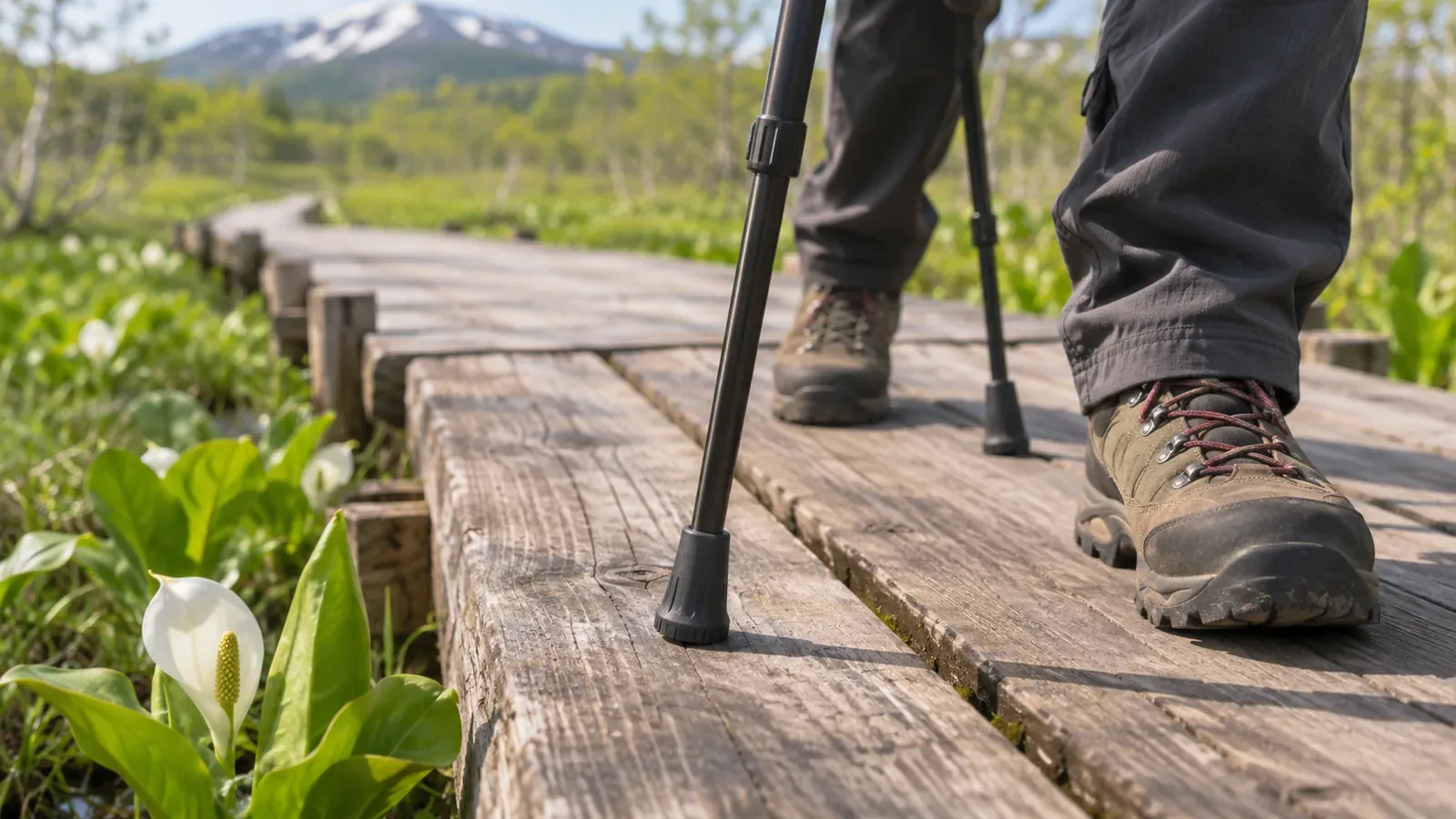
On a boardwalk, pay attention to the gaps between planks as well as the pole tips. The Oze Preservation Foundation asks hikers to fit tip caps and keep pole tips within the trail. The LEKI manual also warns that without the basket, a shaft can jam between planks and break. Check both the park rules and the instructions for your own poles. Save any changes to your grip or setup for somewhere with stable footing.
How pole tips can damage boards and plants
The Oze Preservation Foundation asks hikers to fit caps over their pole tips and keep the tips within the trail. Sharp tips can damage plants and soil and wear out boards sooner. The foundation’s trekking guide also warns that planting poles can damage trailside vegetation and asks hikers to cover the tips when carrying poles without using them. Japan’s Ministry of the Environment asks visitors to stay on the boards to protect the fragile wetland.
Gunma Prefecture’s booklet explains that repeatedly stepping in one place can kill plants and compact and dry the ground. If the peat cracks or washes away in the rain, plants can no longer grow. Boardwalks let you cross the wetland without stepping into it. Keep your pole tips on the planks too.
Replacing a boardwalk takes work. Gunma Prefecture explains that boards in a wetland can rot or break after about seven to ten years. Fukushima Prefecture gives a service life of around ten years, depending on conditions. Where heavy machinery cannot reach, helicopters carry in the materials and the work is done by hand. Sharp pole tips can damage the boards that crews work to maintain.
Gaps between planks and what baskets do
In the LEKI manual published by Caravan, the company warns that using a pole without its basket can let the shaft jam in gaps in rocks or a boardwalk and break. The cap covers the tip. The basket is the disc-shaped part above it. Check the instructions for your particular model for the parts you need and how to fit them.
The Ozenuma Visitor Center’s August 6, 2024, repair report warns of cracked or tilted boards. Look at where the pole tip will land before placing it. If a pole gets wedged, avoid yanking on it. Get stable footing first and check the product instructions or ask the boardwalk manager.
Three things to check before leaving
First, look at the condition of the caps. Tips vary by model and the cap described in the guidance may look different from your rubber tip protector. Check the manual for the part that fits your pole, then look for looseness, chips or exposed metal. Fit or adjust the parts somewhere stable, such as at home.
Second, check the rules for the boardwalk you plan to use. Oze’s guidance applies there, and other trails may have different conditions. Check the posted rules for your destination as well as the manufacturer’s instructions. Think ahead about whether you can walk steadily with the permitted equipment and reconsider the route if necessary.
Here is what to check for each way of handling your poles.
• Using them: Are poles allowed here? Are the required protectors and baskets fitted securely? Can you walk steadily with them?
• Carrying them with the tips covered: Are the tips pointed away from plants beside the boards and the feet of the people behind you?
• Collapsing and stowing them: Is there a spot where you can stop to do it without blocking the way?
Third, look for possible places to stop. Use maps or photos to locate boardwalk sections and look for rest areas or wider spots where you could adjust the tips or change your grip. Decide where to stop when you see the footing and traffic on the day. Put your phone away while walking.
On the boardwalk, keep pole tips on the planks
If you see a chipped board, a large step or a slippery-looking plank, stop on secure footing before it and reconsider how to proceed. Avoid experimenting on the spot with a technique that takes away your support, such as holding the poles off the boards. Caravan’s LEKI instructions say to make adjustments from a stable stance. Assess the boards and your equipment and consider turning back if you cannot get through safely.
If a cap comes off or you drop a pole, stay out of the wetland and follow local instructions or ask the manager. Adjust your poles or change your grip only after stopping somewhere stable and out of the way. If there is no such place, wait.
Fit the right parts and use your poles within their limits
In Oze, fit tip caps and keep pole tips within the path. Your manual may also warn about gaps between planks or specify when baskets must be fitted. Read the instructions for your model and inspect the parts before leaving. On the trail, find secure footing before changing your grip or adjusting a pole, and reconsider the route if you cannot pass safely.
References and sources
- Oze Preservation Foundation: Trail Etiquette in Oze
- Oze Preservation Foundation: Ozenuma Visitor Center, Boardwalk Repairs (August 6, 2024)
- Oze Preservation Foundation: Oze Trekking Guide (booklet)
- Fukushima Prefecture: The History of Conservation in Oze, Part 2, Managing Overuse
- Japan Ministry of the Environment: Visiting Oze National Park Responsibly
- Gunma Prefecture: Boardwalks and Vegetation Restoration in Oze (booklet extract)
- Caravan: LEKI User Manual, Precautions