
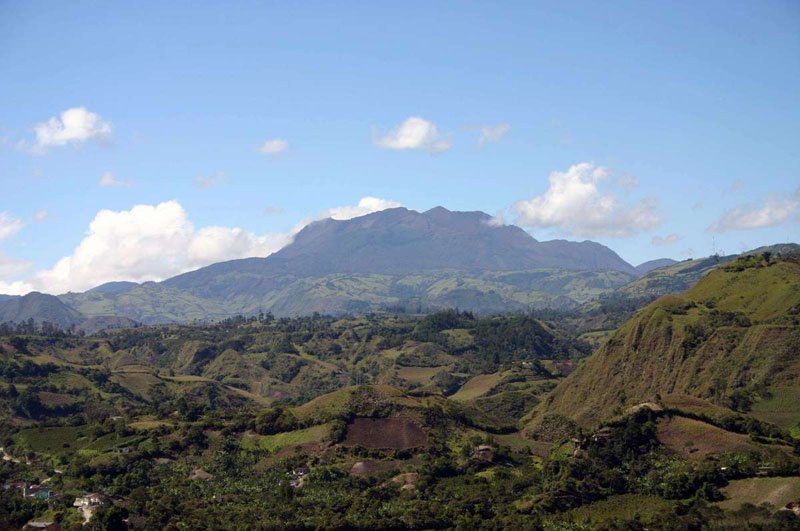
Architecture of the complex
The two calderas of Doña Juana open in different directions, the product of independent collapse episodes throughout the complex's history. Lava domes that occupy the summit sector developed on top of that base. The GVP catalog links the older caldera to pyroclastic currents that occurred during the mid-Holocene, establishing a time frame for the largest-scale events that preceded activity recorded in written sources.
Historical eruptive episodes since 1897
The documented historical episodes began in 1897. The GVP describes dome growth and the generation of pyroclastic flows in that sequence, and records 13 November 1899 as the date on which deaths associated with the activity occurred. The SGC provides a broader historical framework extending to 1936, although the precise dating of some episodes varies between sources.
Seismic and geochemical monitoring
In 2008, three seismic stations identified as Lava, Florida, and Páramo were operating within the monitoring network of the complex. In 2011, geochemical monitoring of thermal springs was added to record fluid signals that may reflect changes in the magmatic-hydrothermal system. The SGC manages this surveillance by combining seismicity data with analysis of the surrounding thermal waters.