
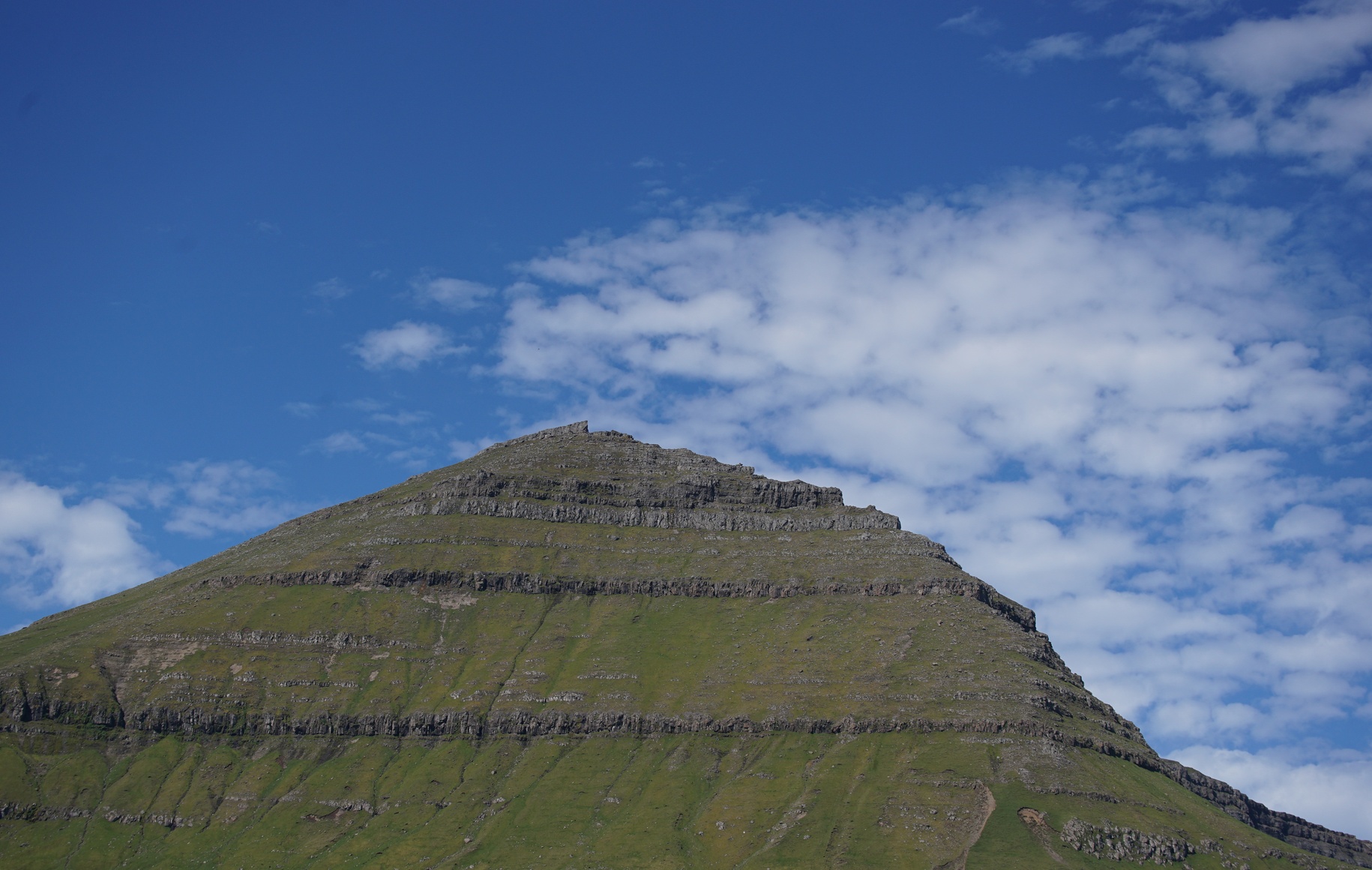
Lava Layers Above Glacial Hollows
The upper roughly 320 metres of Slættaratindur belong to the Enni Formation, a sequence of basalt lava flows identified in field geology surveys of the island. Approximately 30 metres below the summit, the Argir Beds — a sedimentary horizon sandwiched between successive volcanic layers — are exposed at the surface. The harder layers stand out as ledges. Vegetation grows across gentler slopes between them, as seen in the 2018 photograph.
After the volcanic episode, glacial action reshaped the northern Eysturoy landscape. Geomorphological mapping by Ole Humlum and colleagues, published in the Geological Society of Denmark bulletin, documented cirque basins excavated by ice in the northern part of the island, features that reflect the scouring capacity of glaciers moving through terrain already structured by the layered lava sequence.
From 882 to 880 Metres
The Danish General Staff topographic department surveyed Slættaratindur in 1895 and established the figure of 882 metres, which became the long-standing official height. A photograph produced by that department, dated to 1898 or 1899, survives and shows the view northwest from the summit toward Eiði and the Risin og Kellingin sea stacks.
In summer 2012, Faroese environmental officials installed a fixed reference point at the summit and measured it using GPS, forwarding the data to Denmark's national mapping agency. On 7 September 2012, the Faroese Environment Agency announced a corrected elevation of 880 metres. The agency’s summit inventory now lists Slættaratindur first, ahead of nearby Gráfelli at 856 metres.
The Midsummer Ascent
Visit Faroe Islands documents a tradition of climbing Slættaratindur on or around 21 June, the summer solstice. The ascent is timed to the brief northern night, when the sun sets and rises within a short interval and the transition between the two is visible from the summit.