
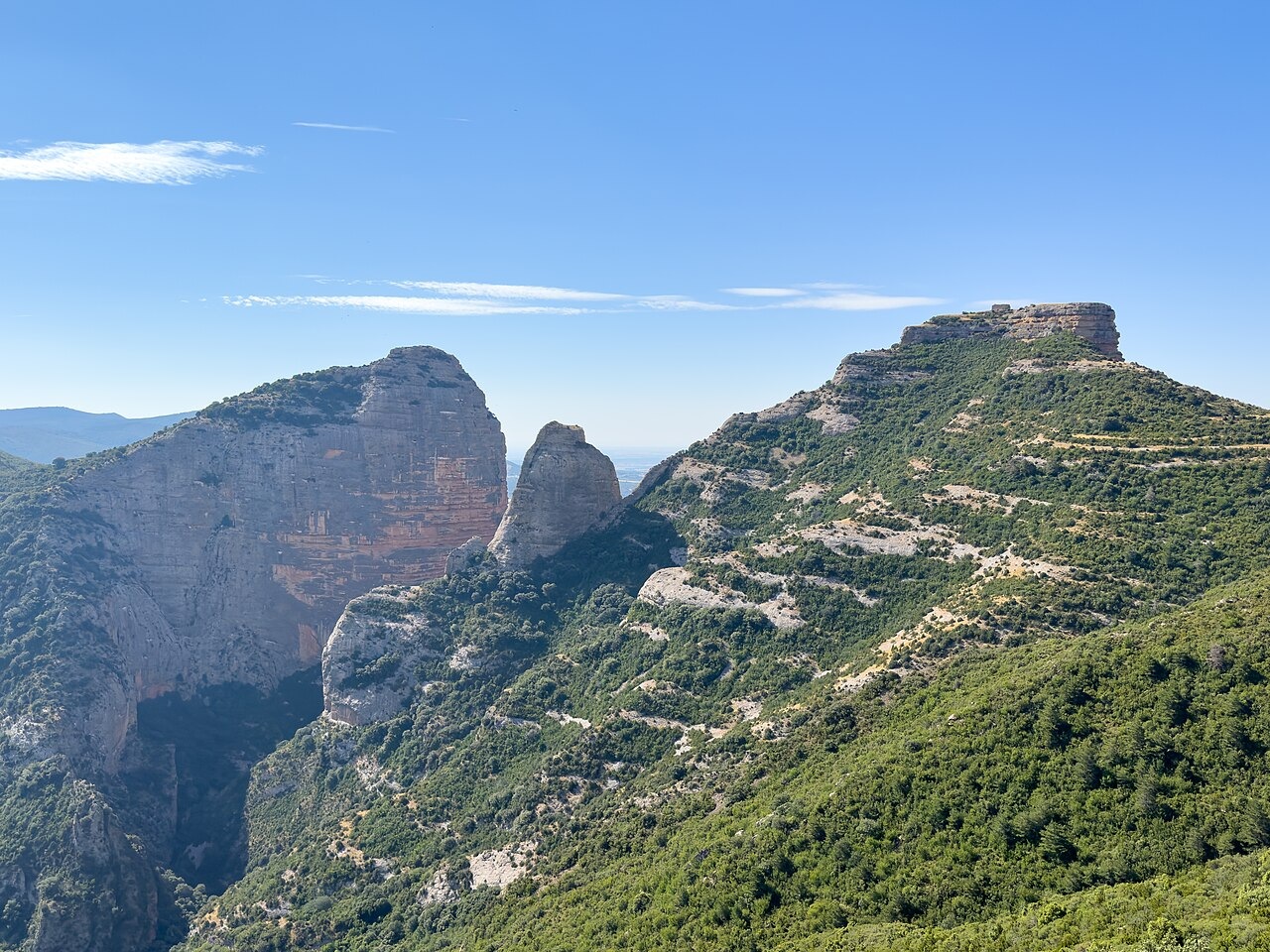
Rock Built from Ancient Gravel
The towers are composed of Miocene conglomerates belonging to the Sariñena Formation, also referred to by some geologists as the Uncastillo Formation. These cemented gravels and boulders were originally deposited by an alluvial fan as the ranges of Sierra de Gabardiella and Pico del Águila rose along regional thrust faults, filling the margin of the Ebro basin with coarse sediment.
A later phase of erosion dismantled much of that fill. River incision along fractures in the rock progressively isolated the towers from the surrounding sediment, leaving the Flumen to pass between them through the gap visible today. Griffon vultures have been recorded using openings in the rock faces, with the vertical walls providing shelter within the natural park's territory.
Fortifications Above the Flumen Defile
According to the Government of Aragón heritage record, citing the medieval geographer al-Razí, fortifications once occupied both the Sen and Men positions above the river passage toward Huesca. On the higher western tower, the heritage catalogue records the remains of a rectangular tower, a smaller tower, and a church, assigning the site a broad period spanning the eleventh to twelfth centuries. The park authority identifies that chapel specifically as San Miguel and dates it to the twelfth century.
The eastern fortification, Castillo de Men, is listed in the heritage inventory as lost. The two positions together commanded the Flumen corridor, a natural approach route whose geography made the gap a point of strategic observation for the valley below.
Roland's Leap and the Name
The place name Salto de Roldán connects to a local tale in which the Frankish hero Roland, pursued by enemies, escaped by leaping with his horse between the two rock towers. The provincial volume Hoya de Huesca, citing pages 245 and 246, notes that two early seventeenth-century authors mentioned the formation under related forms, while the late eighteenth-century writers Padre Huesca and Pedro Blecua provide the first known attestations of the name "Salto de Roldán" as recorded in that work.
Local historians from at least the seventeenth century have suggested that the two-pointed notch on the coat of arms of Huesca echoes the silhouette of the gap, though this remains a historical interpretation rather than a confirmed origin.