
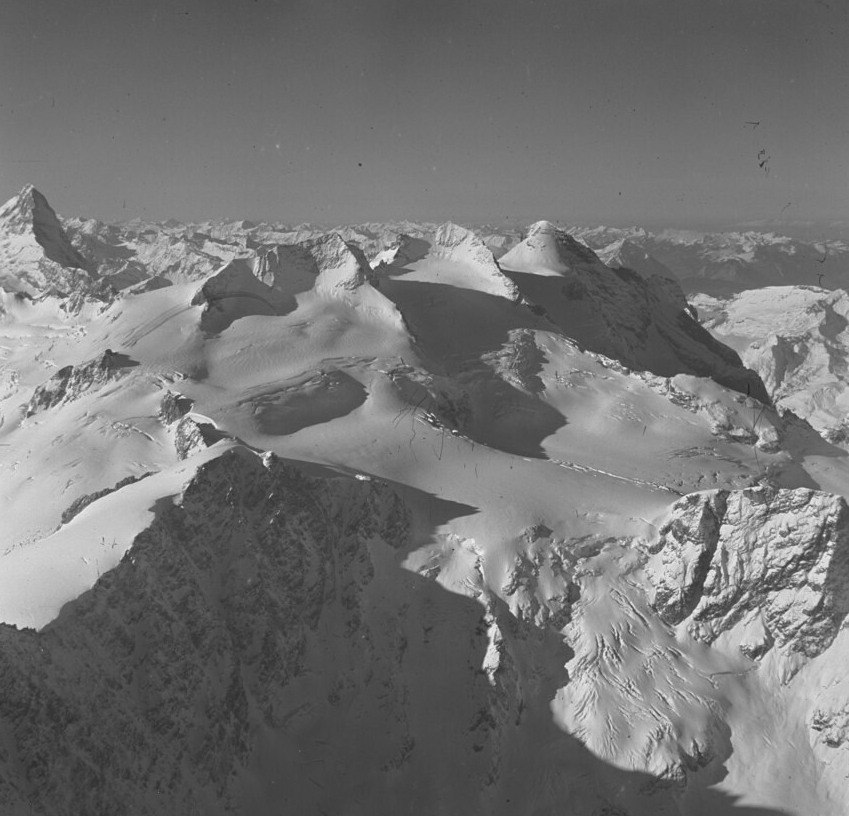
One Summit Among Three
The name Wetterhörner has long served as shorthand for a massif that is, more precisely, three separate peaks — Rosenhorn, Mittelhorn, and Wetterhorn — each with its own elevation and its own ascent record. Rosenhorn stands at approximately 3,688 metres in the more recent Alpine Club overview, making it the lowest of the three named summits. The distinction between the individual peaks and the group name matters for reading the historical record accurately, since accounts that refer only to Wetterhorn may describe ascents of any of the three and the separate first-ascent histories of each summit can otherwise be lost inside the collective label.
The Ascent of 28 August 1844
The guides' archive of the Swiss Alpine Club records the first ascent of Rosenhorn on 28 August 1844. Johann Jaun and Hans Währen were among the expedition, and the archive specifies that Dollfus-Ausset was the first member of that party to step onto the summit. This level of detail — naming not only the guides but which individual reached the top first within a single ascent — reflects the documentary care that distinguished the records kept in connection with the Neuchâtel glaciological network from more informal climbing accounts of the same era.
The Neuchâtel Glacier Researchers and Their Guides
The guides' archive situates the 1844 Rosenhorn ascent within the broader activity of Neuchâtel glacier researchers who were working systematically through the high terrain of the Bernese Oberland during this period. Johann Jaun and Hans Währen appear in this history not simply as mountaineers but as guides attached to a scientific programme, and their movements on the glacier approaches to peaks like Rosenhorn were shaped by the survey and research priorities of the naturalists they accompanied. The archive is careful to distinguish between the surveyors' measurement work and the ascent record itself, and that distinction should be preserved: the fact that the party had a survey context does not mean that any specific measurement was taken at the Rosenhorn summit.